 listicle
Best Commercial Security Alarm Services in Australia 2026
Table of Contents
- What Makes a Commercial Security Alarm Service Stand Out
- Top Commercial Security Alarm Services in Australia
- 1. Tupper Security: Rapid Response and Tailored Protection for South-East Queensland
- 2. ADT Security: Nationwide Coverage with Integrated Solutions
- 3. Chubb Fire & Security: Premium Monitoring with Service Plans
- 4. Securecorp: Enterprise-Grade Integrated Security
- 5. BPoint Security: Tiered Monitoring Options for Flexible Needs
- 6. Mr Secured: Brisbane and South-East Queensland Specialist
- Understanding Commercial Alarm Monitoring Costs in Australia
- Back-to-Base Alarm Monitoring Providers and How They Operate
- AS/NZS 2201 Security Standards and Compliance
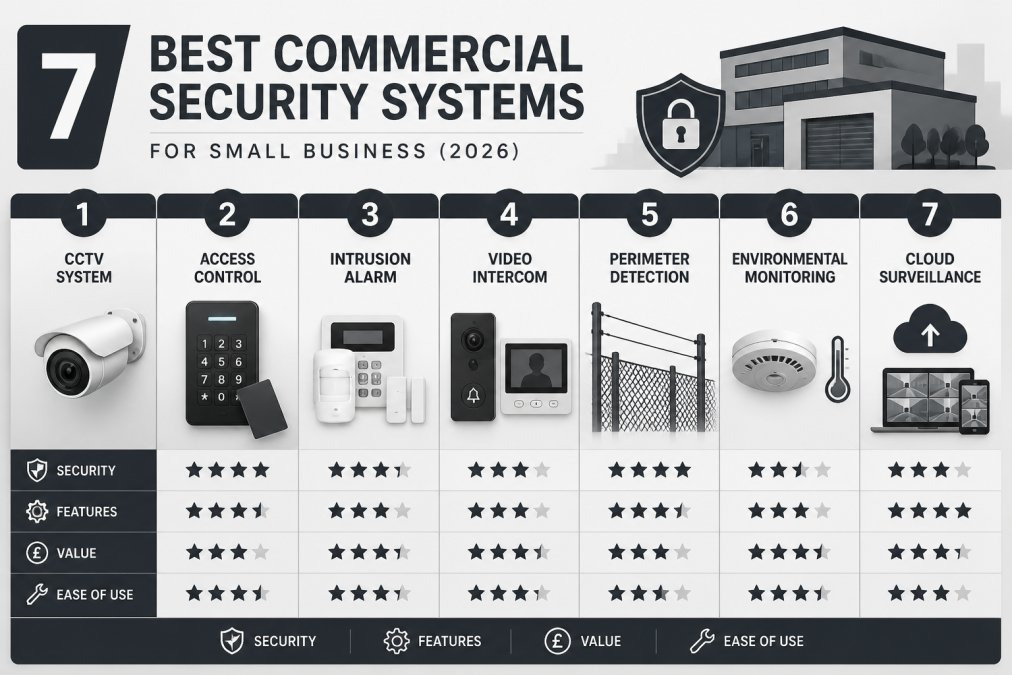
- Key Features That Matter in Commercial Alarm Systems
- How to Choose the Right Provider for Your Business
- Frequently Asked Questions
Last Updated: August 5, 2026
Australian businesses lose millions annually to theft, break-ins, and unauthorised access. The right commercial security alarm service prevents incidents rather than merely responding to them. This guide breaks down the best commercial security alarm services available across Australia in 2026, helping you understand what separates a genuinely responsive provider from one that merely promises fast response times.
What Makes a Commercial Security Alarm Service Stand Out
A standout commercial security alarm service combines rapid physical response, genuine 24/7 monitoring capability, and systems tailored to your actual site operations rather than generic templates. The difference between a provider arriving in 8 minutes versus 25 minutes can mean catching an intruder on-site versus discovering the break-in the next morning.
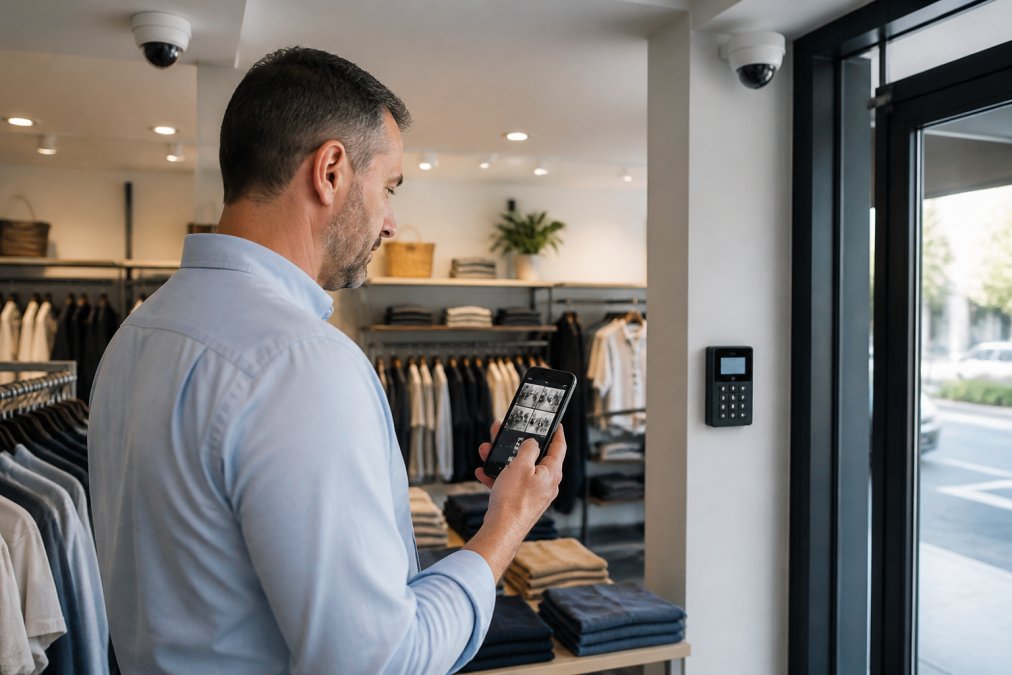
The best providers conduct proper risk assessments before installation, understand your specific vulnerabilities, and design systems that integrate with existing infrastructure. Key differentiators include whether the provider holds proper Australian security licences, whether monitoring occurs from local operations centres (not offshore call centres), and whether they offer auditable access control alongside alarm monitoring.
Top Commercial Security Alarm Services in Australia
1. Tupper Security: Rapid Response and Tailored Protection for South-East Queensland
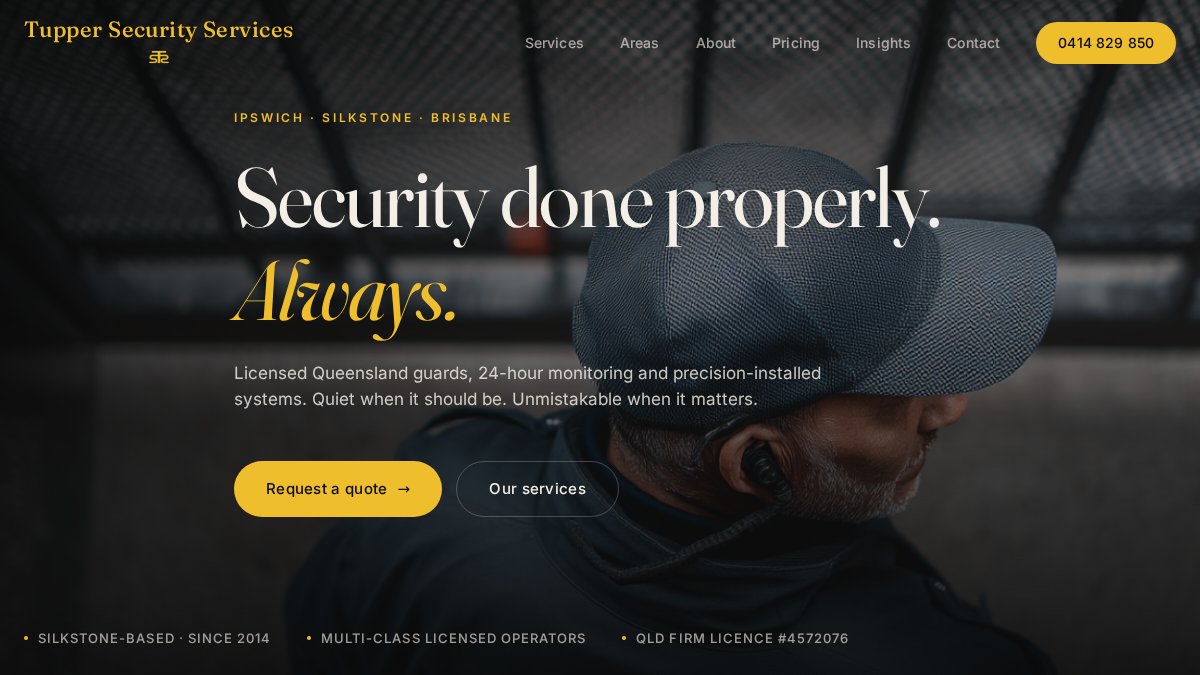
Tupper Security operates from a Silkstone depot positioned to serve Ipswich and South-East Queensland with response times that matter. What sets them apart is being genuinely local with multi-class licensed operators on payroll.
Their approach centres on independent site risk assessments before installation. Rather than selling a standard 8-zone system to every client, they analyse your actual operations: staff entry patterns, high-value asset locations, customer flow during trading hours. This intelligence drives system design that catches real threats.
The company delivers 24/7 alarm monitoring and dispatch, auditable access control systems (critical for retail loss prevention), and documented shrinkage reporting. Their high-resolution, remotely accessible IP surveillance integrates with alarm systems so you can verify incidents in real time. They've served Orion, Mater Hospital, and USQ across retail, healthcare, and education sectors.
Best for: South-East Queensland businesses prioritising rapid physical response and tailored system design.
Pros:
- Multi-class licensed operators with genuine local presence
- Customised security design based on site-specific risk assessment
- Rapid response times from Silkstone depot
- Integrated CCTV, access control, and alarm monitoring
- Established since 2014 with proven track record
Cons:
- Service area limited to South-East Queensland
- Not suitable for national multi-site operations
2. ADT Security: Nationwide Coverage with Integrated Solutions
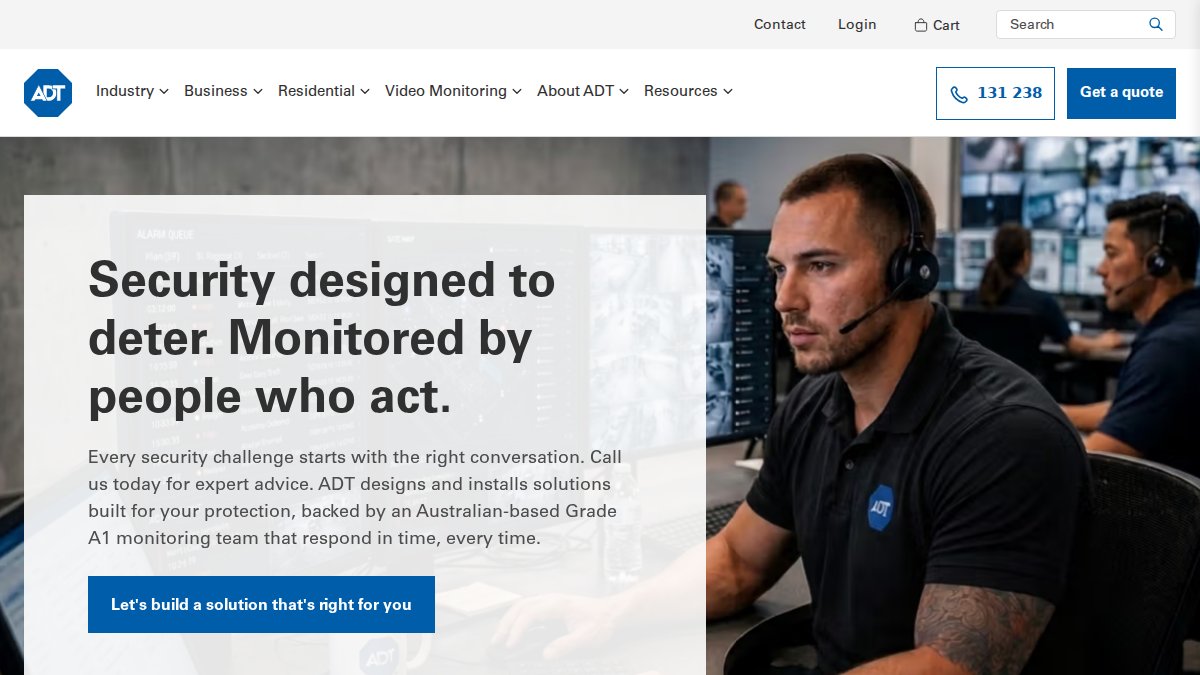
ADT Security operates across Australia with established infrastructure in every state, making them ideal for businesses with multiple locations or national expansion plans. Their 24/7 security monitoring runs from dedicated Australian Customer Care Centres.
They offer customisable business alarm systems with remote activation capability, CCTV systems supporting up to 64 cameras with motion-activated HD recording, and enterprise access control. Mobile patrol service provides up to six alarm responses. The integration between systems is genuine, your monitoring centre can verify CCTV footage during an alarm event rather than dispatching blindly.
Best for: National or multi-state businesses requiring consistent service standards across locations.
Pros:
- Nationwide presence with established reputation
- Genuine integration between alarm, CCTV, and access control
- Professional installation and customised packages
- Established infrastructure in every Australian state
Cons:
- Pricing requires custom quotes
- Response times vary significantly by region
- Monitoring agreements are mandatory
3. Chubb Fire & Security: Premium Monitoring with Service Plans
Chubb Fire & Security combines 24/7 alarm monitoring for burglary, intrusion, and fire detection with comprehensive service plans including routine preventative maintenance. Remote connected services allow technicians to diagnose and reprogram systems without on-site visits, reducing downtime.
Chubb BusinessWatch monitoring costs $36.80 (including GST) per month on a 36-month contract, with system service and connection charges starting at $113.85 (including GST). For businesses already managing fire safety systems, the integrated approach reduces vendor fragmentation.
Best for: Commercial customers seeking comprehensive monitoring bundled with included maintenance, particularly those managing fire safety systems.
Pros:
- Comprehensive service plans include preventative maintenance
- Integrated fire and security monitoring
- Remote diagnostics reduce downtime
- Leading security provider with strong Australian presence
Cons:
- Contract terms required (36 months minimum)
- Higher per-zone costs for systems exceeding 16 zones
- Premium pricing
4. Securecorp: Enterprise-Grade Integrated Security
Securecorp operates nationwide offering integrated security services: manpower (static guards and mobile patrols), electronic security installation and maintenance, and 24/7 alarm monitoring from ASIAL Grade A1 operations centres.
Their video verification services stand out, they offer virtual patrol tours and virtual alarm responses where monitoring staff review CCTV footage during incidents rather than dispatching security blind. For high-risk sites, this verification capability reduces false alarm callouts and ensures responses target genuine threats. Pricing for guarding and patrols ranges from $40-$120 per hour depending on service type and location.
Best for: Large organisations requiring integrated security combining electronic systems, monitoring, and on-site security personnel.
Pros:
- ASIAL Grade A1 monitoring with video verification capability
- Integrated electronic security and manpower services
- Virtual patrol and response options reduce false alarm costs
- Nationwide group with extensive enterprise experience
Cons:
- Pricing not publicly available
- Focus on larger enterprises may not suit small businesses
- Higher cost structure than single-service providers
5. BPoint Security: Tiered Monitoring Options for Flexible Needs
BPoint Security offers straightforward tiered alarm monitoring allowing businesses to select service levels matching their risk profile and budget. Standard Alarm Monitoring costs $48 plus GST per month with 12-hour check-ins. Premium Alarm Monitoring upgrades to dual-SIM technology with 60-minute check-ins for $59.30 plus GST monthly. Advanced Alarm Monitoring adds ethernet cable backup with 120-second check-ins for $75.31 plus GST.
The tiering system appeals to businesses wanting to start with basic monitoring and upgrade as operations expand. Permaconn technology provides reliable communication through Optus and Telstra networks, reducing single-point-of-failure risk.
Best for: Small to medium businesses wanting transparent, tiered pricing with flexible upgrade paths.
Pros:
- Clear pricing tiers ($48-$75.31 per month)
- Dual-SIM technology in higher tiers for reliability
- Regular system check-ins ensure alarm panel functionality
- Flexible upgrade path as business grows
Cons:
- Standard tier has infrequent check-ins (every 12 hours)
- Monitoring-only service requires separate installation provider
- Limited to monitoring rather than full-service security
6. Mr Secured: Brisbane and South-East Queensland Specialist
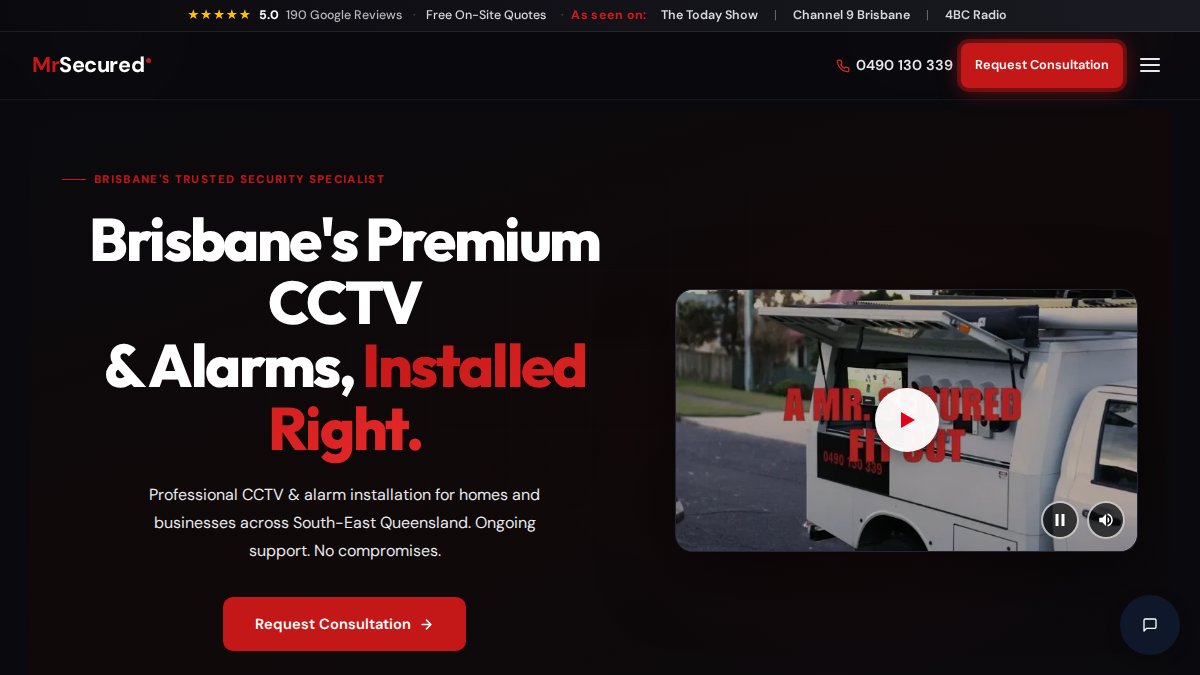
Mr Secured operates in Brisbane, Gold Coast, Sunshine Coast, and Ipswich, focusing on commercial CCTV and alarm system installations with a reputation for honest advice. They specialise in Ajax alarm systems with video sirens and app control, allowing site managers to monitor and control systems remotely.
The company emphasises clean installations and avoiding unnecessary upselling, they'll recommend the system your site actually needs rather than pushing premium options.
Best for: Brisbane and South-East Queensland businesses seeking professional CCTV and alarm installation without aggressive upselling.
Pros:
- Strong positive customer reviews and local reputation
- Focus on honest, tailored advice
- Modern Ajax alarm systems with app control
- Professional installation with attention to detail
Cons:
- Service area limited to Queensland's southeast
- Pricing not publicly available
- Primarily installation-focused rather than full monitoring provider
Understanding Commercial Alarm Monitoring Costs in Australia
Commercial alarm monitoring costs in Australia vary significantly based on system complexity, response tier, and contract terms. Monthly monitoring fees typically range from $36-$75 depending on check-in frequency and communication technology. Installation costs vary dramatically based on system scope, from $1,500-$3,000 for a basic alarm panel with motion sensors and door contacts, to $5,000-$15,000 or higher when adding CCTV, access control, and integration.
Contract terms matter significantly. Providers offering month-to-month flexibility typically charge premium rates compared to those requiring 24 or 36-month commitments. A 3-year contract at $60 per month totals $2,160 in monitoring costs before any response fees or system upgrades.
Back-to-Base Alarm Monitoring Providers and How They Operate
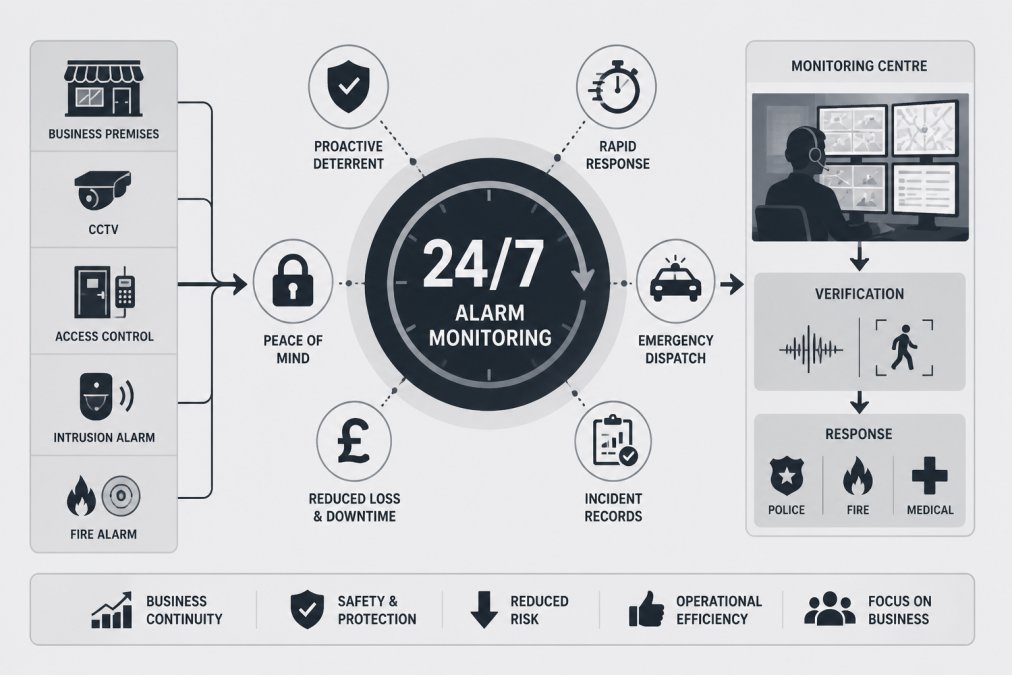
Back-to-base monitoring is the industry standard for commercial security alarms. When your system detects an intrusion, it automatically signals a monitoring centre which verifies the alarm and dispatches an appropriate response.
The monitoring centre receives alarm signals through multiple communication paths: primary connection via broadband or dedicated line, with cellular backup if primary fails. Modern systems use dual-SIM technology where two separate mobile networks provide redundancy. Video verification reduces false alarm response costs significantly by allowing monitoring staff to review CCTV footage before dispatching. Response options range from police notification only to dedicated mobile patrol. ASIAL Grade A1 certification indicates the monitoring centre meets Australian security industry standards for facility security, staff training, and operational procedures.
AS/NZS 2201 Security Standards and Compliance
AS/NZS 2201 is the Australian and New Zealand standard for security system design, installation, and maintenance. A compliant system begins with a proper security audit identifying vulnerabilities, asset locations, and threat scenarios specific to your site. Installation must follow documented procedures with qualified technicians, including proper cable routing, redundant power supplies, battery backup sizing, and integration testing.
Key Features That Matter in Commercial Alarm Systems
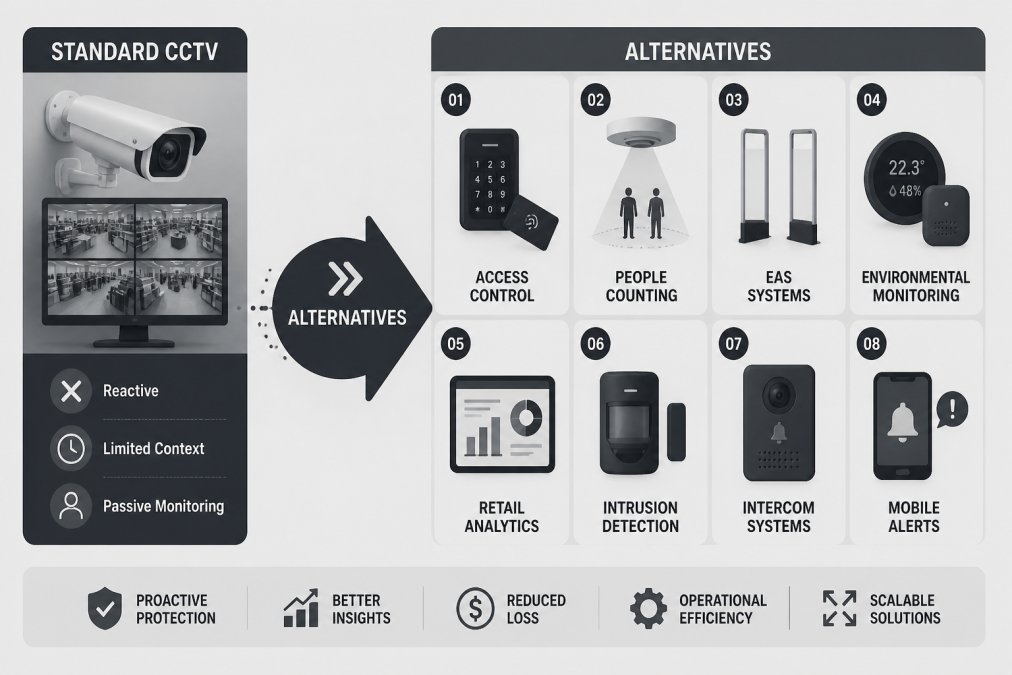
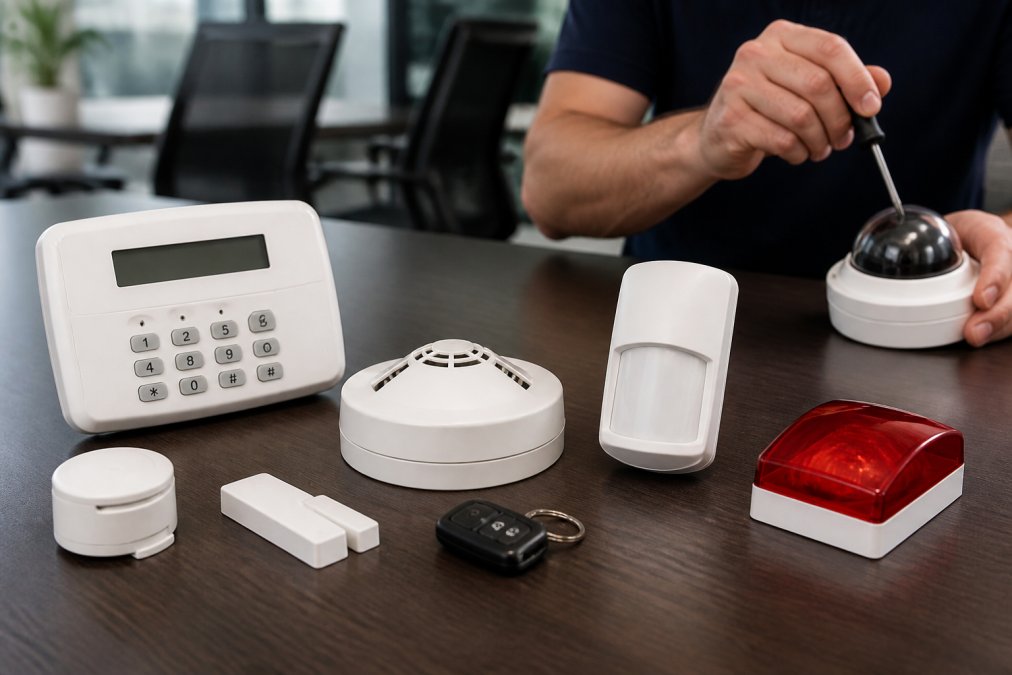
Effective commercial alarm systems combine detection, verification, communication, and response coordination. Intrusion detection forms the foundation through motion sensors, door and window contacts, and glass break detectors. For retail environments, pressure-sensitive floor mats detect movement in high-value areas after hours.
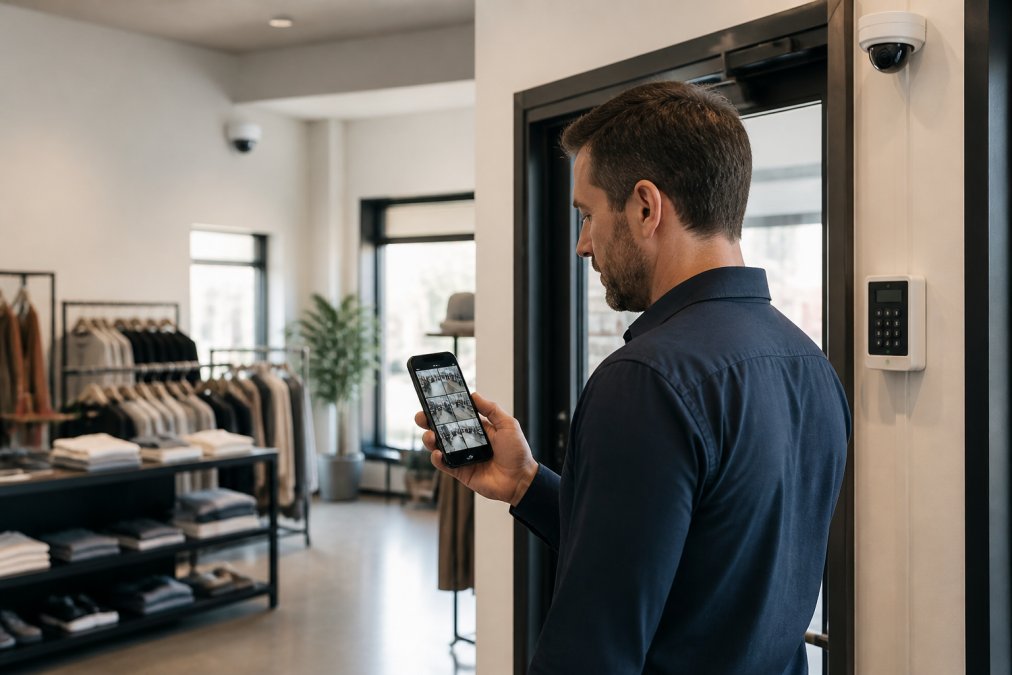
Communication redundancy ensures alarm signals reach the monitoring centre even if primary connections fail. Dual broadband and cellular backup is standard. CCTV integration allows monitoring staff to verify alarms visually before dispatching response. Access control integration provides auditable entry logs with timestamped records of every card swipe or biometric scan. Remote system management via mobile app or web portal lets authorised users arm/disarm systems and review alerts without calling the provider.
How to Choose the Right Provider for Your Business
Selecting a commercial security alarm provider requires evaluating technical capability, local responsiveness, and genuine integration rather than just comparing prices.
Start by defining your actual requirements. What are you protecting, inventory, equipment, information, or personnel safety? What are your genuine threats, opportunistic break-ins, targeted theft, unauthorised access? A provider conducting a proper risk assessment will ask these questions before recommending solutions.
Evaluate local responsiveness. If you're in South-East Queensland, a provider with a Silkstone depot and local patrol vehicles responds faster than a national provider routing your alarms through a distant operations centre. Check whether the provider offers genuine integration or just bundled services. Can the monitoring centre access CCTV footage during alarms? Does access control integrate with alarm verification?
Request references from existing customers in your industry. Ask specific questions: What were actual response times? Did the system integrate smoothly with existing infrastructure? Were there unexpected costs after installation? Compare total cost of ownership, not just monthly fees.
Choosing the right commercial security alarm service requires looking beyond marketing claims to genuine capability. Tupper Security stands out for South-East Queensland businesses because they combine rapid local response from their Silkstone depot, tailored system design based on actual site risk assessment, and integrated CCTV and access control that work as a cohesive ecosystem. Their multi-class licensed operators, established track record since 2014, and documented shrinkage reporting for retail loss prevention address the real operational challenges businesses face. Get started with Tupper Security and request a free site risk assessment to understand your specific security needs and response capabilities.
Frequently Asked Questions
What should I look for in a commercial security alarm system?
Prioritise 24/7 monitoring capability, rapid alarm response times, integration with CCTV and access control, mobile app notifications, and compliance with AS/NZS 2201 standards. For retail or multi-site operations, look for providers offering documented incident reporting and loss prevention features. Verify the provider holds a current Queensland security licence and ask about their average response time to your location.
How much does commercial alarm monitoring cost in Australia?
Commercial alarm monitoring costs vary based on system complexity and response requirements. Back-to-base monitoring typically ranges from $36-$75 per month depending on check-in frequency and technology. Installation costs for a complete system range from $1,500-$5,000 for small to medium businesses. Pricing depends on your location, number of zones, integration needs, and contract terms. Contact your local provider for a tailored quote.
What is the difference between back-to-base and self-monitored alarms?
Back-to-base alarm monitoring providers operate 24/7 monitoring centres that respond to alarms, verify incidents, and dispatch emergency services or mobile patrols when needed. Self-monitored systems send alerts to your phone but require you to respond and contact emergency services manually. Back-to-base offers faster professional response but incurs monthly fees. Self-monitoring eliminates ongoing costs but demands your constant availability and decision-making during emergencies.
What are the Australian Standards for alarm systems (AS/NZS 2201)?
AS/NZS 2201 is the Australian and New Zealand Standard for electronic security systems, including alarm systems. It sets requirements for design, installation, testing, and maintenance of intrusion detection systems. Compliance ensures your system meets industry safety and performance benchmarks, uses quality components, and is installed by competent technicians. Most professional security providers design systems to meet or exceed AS/NZS 2201 to protect your investment and ensure insurance recognition.
Why is rapid alarm response time critical for commercial businesses?
Fast alarm response minimises loss from theft, vandalism, or unauthorised access. Delays of even 30 minutes can result in significant asset loss or damage. Providers with local depots or mobile patrol teams typically achieve response times of 15-20 minutes in urban areas. Ask prospective providers for their average response time to your specific address and confirm they maintain adequate staffing to meet guaranteed response windows, especially during peak hours.
This article was written using GrandRanker