 listicle
Alternatives to Standard CCTV for Retail Stores
Table of Contents
- Why Retailers Are Moving Beyond Standard CCTV
- AI-Powered Retail Video Analytics: Detection Without Traditional Monitoring
- Electronic Article Surveillance (EAS): Physical Deterrence and Shrinkage Control
- Foot Traffic Analytics and People Counting Systems
- Privacy Compliance for Retail Surveillance: Legal Considerations and Implementation
- Retail Loss Prevention Strategies: Combining Technology with Operational Practices
- Cybersecurity of Surveillance Networks: Protecting Your Data
- Conclusion: Choosing the Right Alternative for Your Store
- Frequently Asked Questions
Last Updated: September 3, 2026
Why Retailers Are Moving Beyond Standard CCTV
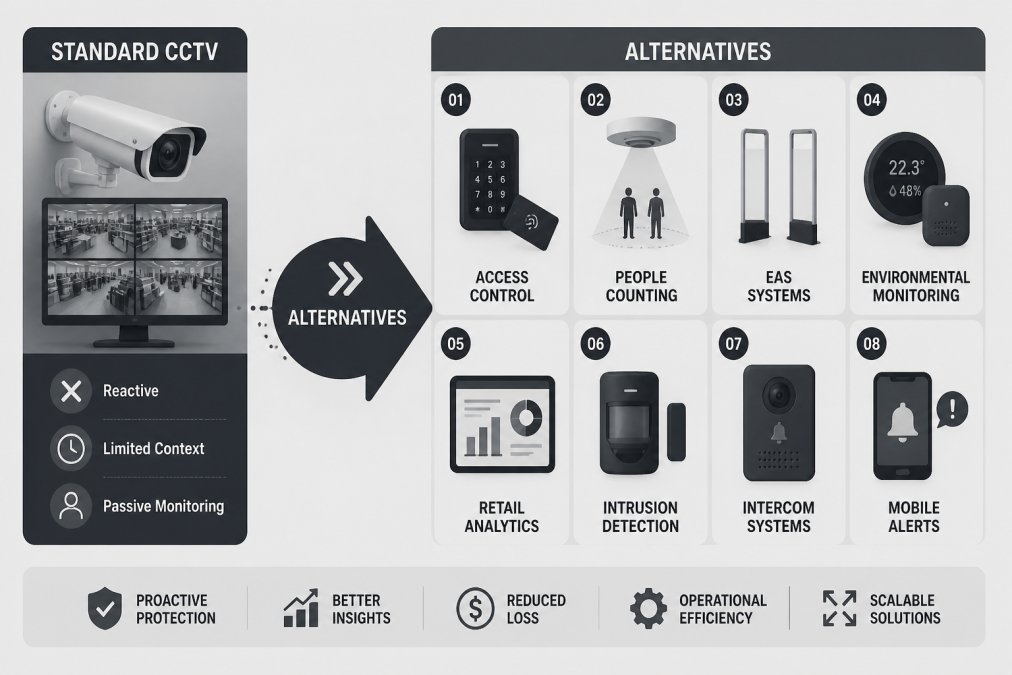
Standard CCTV systems are reactive, not proactive, they record what happened but don't stop what's happening now. Shrinkage costs retailers billions annually, and traditional surveillance alone isn't cutting it (peer-reviewed research). Modern retail loss prevention demands systems that detect threats in real time, protect customer privacy, comply with regulations, and integrate seamlessly with operations.
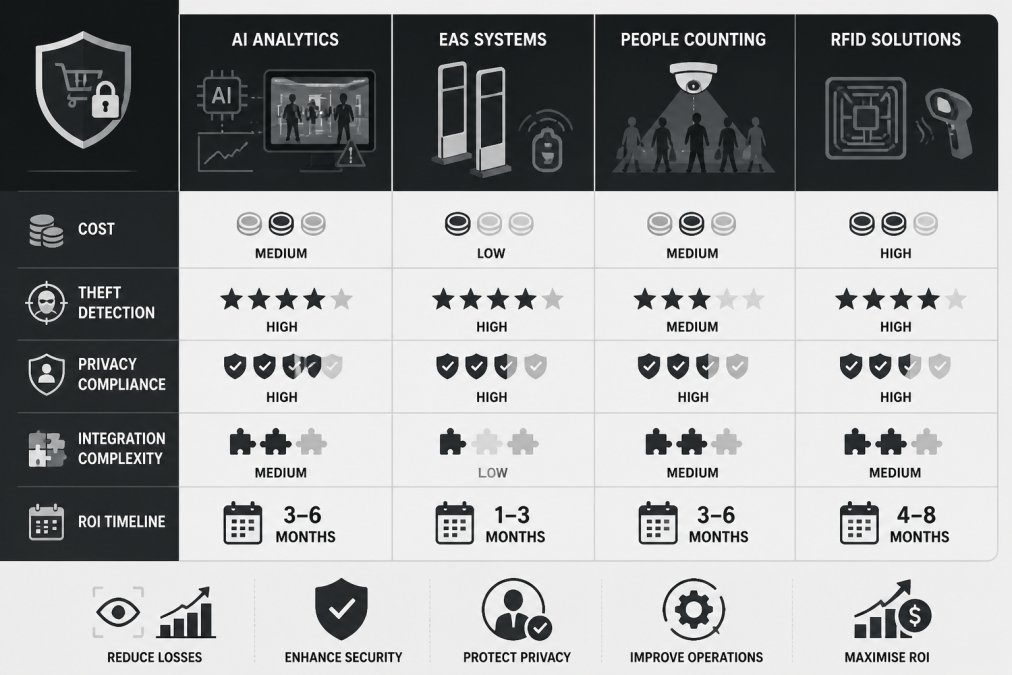
AI-powered analytics, electronic article surveillance, thermal people counters, and RFID systems now deliver measurable results that justify their investment. Combining multiple approaches yields better outcomes than relying on CCTV alone.
This guide explores the most effective alternatives to standard CCTV for retail stores, how they work, where they excel, and how to choose the right combination for your operation.
AI-Powered Retail Video Analytics: Detection Without Traditional Monitoring
AI-powered video analytics transforms existing CCTV infrastructure into an active loss prevention tool. Intelligent agents analyse camera feeds in real time and flag suspicious behaviour the moment it occurs.
Real-Time Behaviour Detection
Systems like Veesion and Smokeshield use machine learning to identify theft indicators: concealment, loitering in high-value areas, skip-scanning at self-checkout, and unusual dwell times. When suspicious activity is detected, staff receive instant alerts with video clips, enabling immediate intervention.
A security guard watching screens misses most incidents. An AI system monitors every aisle simultaneously, learns your store's normal traffic patterns, and flags deviations that warrant attention. The trade-off is straightforward: effectiveness depends entirely on camera placement and quality. Poor angles or low resolution undermine detection.
Integration with Existing Infrastructure
AI analytics shine for retailers with established CCTV. You're adding a software layer on top of existing hardware, so your capital investment stays in place while loss prevention capability increases significantly. Most AI solutions integrate with standard IP cameras and NVRs.
Integration requires reliable internet connectivity for real-time alerts. A network outage means you lose active monitoring. Ensure your store has redundant internet or failover options if uptime is critical.
Electronic Article Surveillance (EAS): Physical Deterrence and Shrinkage Control
Electronic Article Surveillance prevents theft in the first place. Unlike CCTV, which documents theft after it happens, EAS tags merchandise with security devices that trigger an alarm when they pass through exit gates without proper deactivation at checkout. The physical presence of visible tags and gate sensors acts as a powerful deterrent.
How EAS Technologies Work
Three main technologies dominate: Acousto-Magnetic (AM), Radio Frequency (RF), and RFID. Each has different performance characteristics, cost profiles, and integration requirements.
Acousto-Magnetic systems excel at preventing external theft. They're reliable, generate few false alarms when properly maintained, and work with hard tags and labels. The downside is they require physical gate infrastructure at exits.
Radio Frequency systems offer a middle ground. They're less expensive than AM, work with a wider range of tag types, and integrate well with self-checkout environments. False alarms occur more frequently than AM, particularly in areas with electromagnetic interference.
RFID systems like those from Datascan Australia provide the most sophisticated functionality. They enable real-time inventory tracking, catching discrepancies immediately rather than at cycle count. RFID tags can be embedded in packaging, making them less visible than hard tags. The investment is higher, but retailers using RFID report dramatically improved inventory accuracy and faster theft detection.
For most retailers, a hybrid approach works best: AM or RF at store exits for immediate theft prevention, combined with RFID on high-value items for inventory precision.
Foot Traffic Analytics and People Counting Systems
Understanding customer flow is foundational to retail loss prevention. Thermal people counting sensors and AI-powered foot traffic systems provide this data without collecting personally identifiable information.
Systems like V-Count Nano and TPS Thermal Counter track customer movement, queue formation, and zone occupancy in real time. The data feeds directly into loss prevention strategy. You identify your highest-traffic areas and position staff or security cameras accordingly. You spot abandoned checkout lanes where self-checkout theft occurs most frequently. You detect unusual after-hours activity that might indicate break-ins or internal theft.
Beyond security, foot traffic data optimises staffing, merchandising, and marketing. Privacy compliance is built in, thermal and AI-based people counting systems don't capture faces, identities, or personal characteristics, just movement and occupancy.
Privacy Compliance for Retail Surveillance: Legal Considerations and Implementation
Surveillance in retail operates within a strict legal framework. The key regulatory consideration in Australia is the Privacy Act 1988 (Cth), which governs how personal information, including images and video recordings, can be collected, used, and stored (legislation.gov.au).
Practical compliance means:
- Displaying clear signage that surveillance is in use
- Limiting camera coverage to areas where there's a legitimate business need
- Storing footage securely and deleting it within a reasonable timeframe (typically 30 days unless investigating an incident) (oaic.gov.au)
- Restricting access to footage to authorised personnel only
- Having a documented policy on how footage is used and retained
Privacy-by-design systems like thermal people counting and AI analytics that don't identify individuals offer a compliance advantage. You gain operational and security insights without collecting personal data, which simplifies your regulatory obligations.
If you're implementing CCTV or upgrading your system, consult with a legal advisor familiar with retail privacy obligations. Tupper Security integrates privacy compliance into every system design, ensuring your security infrastructure protects both your business and your customers' rights.
Retail Loss Prevention Strategies: Combining Technology with Operational Practices
Technology alone doesn't prevent shrinkage. The most effective retail loss prevention combines surveillance and detection systems with operational discipline, staff training, and documented response protocols.
Integrated Approach: When to Use Multiple Systems
A small boutique with low shrinkage might rely on visible EAS tags and a single CCTV camera at the register. A mid-sized store typically benefits from layered protection: EAS on high-value items, AI analytics on self-checkout areas, thermal people counting to optimise staff placement, and access control on stockrooms.
Large retailers or multi-location operators need comprehensive integration. Tupper Security designs these systems by conducting a detailed site risk assessment. We analyse your current shrinkage patterns, identify where losses occur, map your physical layout, and recommend a technology stack that addresses your specific vulnerabilities.
The integration matters as much as the individual components. When AI analytics, EAS, people counting, and access control systems share data through a unified platform, you see patterns that individual systems miss.
Cost-Benefit Analysis: DIY Versus Professional Installation
Many retailers assume they can install and manage surveillance systems themselves to save costs. In practice, DIY approaches often underdeliver and create hidden expenses.
A professionally designed system starts with a thorough site assessment. Tupper Security's team evaluates your store layout, identifies optimal camera placement, assesses network infrastructure, and designs access control workflows that match your operational reality. Installation quality matters enormously. Poor camera placement renders AI analytics ineffective. Inadequate network infrastructure causes latency and alert delays.
Professional installation includes staff training, system documentation, and ongoing support. For retail stores in South-East Queensland, Tupper Security offers local expertise and rapid response. Our Silkstone depot means we can conduct site assessments quickly, install systems with minimal disruption, and respond to issues within hours.
If shrinkage is costing you 2-3% of sales annually, even a modest reduction from professional loss prevention pays for the system within months.
Cybersecurity of Surveillance Networks: Protecting Your Data
Modern surveillance systems collect sensitive information: video footage, access logs, customer behaviour data, and inventory records. This data must be protected from unauthorised access, theft, and misuse.
Cybersecurity starts with network design. Professional surveillance systems should operate on a segmented network isolated from your general business systems. Your NVR and cameras should have strong authentication, regular firmware updates, and encrypted connections.
Cloud storage introduces both convenience and risk. Ensure any cloud provider you use encrypts data in transit and at rest, maintains strict access controls, and complies with Australian data protection standards.
Access control is critical. Only authorised personnel should view footage or export data. Implement role-based access: frontline staff might see live alerts but not historical footage, while management can access full records. Log all access attempts so you can audit who viewed what and when.
Regular security audits identify vulnerabilities before they're exploited. A professional security provider like Tupper Security can assess your surveillance network, test for common attack vectors, and recommend hardening measures.
Conclusion: Choosing the Right Alternative for Your Store
Alternatives to standard CCTV for retail stores aren't about abandoning video surveillance, they're about building a comprehensive loss prevention strategy that addresses your specific vulnerabilities, complies with privacy regulations, and delivers measurable ROI.
AI analytics, EAS systems, RFID inventory tracking, and thermal people counting now offer retailers sophisticated tools. The question isn't whether these alternatives work, it's which combination works best for your operation.
Start with a clear assessment of your current shrinkage patterns and operational challenges. Where are you losing inventory? What causes the most disruption? Once you understand your specific situation, you can design a system that addresses those challenges without over-engineering or creating unnecessary expense.
Tupper Security specialises in designing tailored loss prevention systems that integrate AI analytics, access control, and CCTV into a cohesive strategy matched to your store's actual operations. Our multi-class licensed operators conduct detailed site risk assessments, recommend the right technology combination for your needs, and manage installation and ongoing support from our Silkstone depot.
Whether you're a small boutique looking to reduce shrinkage or a multi-location retailer needing consistent security across your network, we'll help you choose the right alternatives to standard CCTV and implement them effectively. Request a quote today and let's build a loss prevention strategy that protects your business and your customers.
Frequently Asked Questions
What are the most effective alternatives to traditional CCTV for retail loss prevention?
AI-powered video analytics, Electronic Article Surveillance (EAS) systems, RFID asset tracking, and people-counting sensors each address specific loss prevention needs. AI analytics enhance existing cameras with real-time theft detection. EAS systems provide physical deterrence and shrinkage control through tagging. RFID enables real-time inventory visibility. The best choice depends on your store layout, merchandise type, and budget. Many retailers combine multiple technologies for comprehensive protection rather than relying on CCTV alone.
How does AI-powered video analytics differ from standard CCTV?
Standard CCTV records footage passively; AI-powered retail video analytics actively monitors feeds in real time, detecting suspicious behaviours like concealment, loitering, and skip-scanning as they occur. AI systems send instant alerts to staff, enabling immediate intervention before loss happens. They also reduce the need for constant human monitoring, freeing staff to focus on customer service. AI works best when layered over existing camera infrastructure, making it a cost-effective upgrade.
Are electronic article surveillance (EAS) systems better than cameras for retail?
EAS and cameras serve different purposes. EAS systems excel at preventing merchandise loss through visible deterrence and automatic alarms at exits, making them highly effective for external theft. Cameras document incidents and provide evidence. Many retailers use both: EAS for active prevention and deterrence, cameras for incident investigation and staff accountability. The choice depends on your primary loss driver, external shoplifting, internal theft, or both.
What are the legal privacy considerations when using non-CCTV security tech in shops?
Under the Privacy Act 1988 (Cth) and state-based privacy legislation, retailers must ensure surveillance systems (including AI analytics, thermal sensors, and people counters) are proportionate to the business need and comply with privacy principles. Privacy-by-design solutions like thermal people counters and on-chip AI processing avoid collecting personally identifiable information. Display clear signage about monitoring, limit data retention, and ensure staff access is auditable. Consult local privacy regulators if deploying facial recognition or biometric systems.
Can access control systems replace CCTV in small retail stores?
Access control systems manage who enters restricted areas (staff rooms, stock areas, cash offices) but do not prevent customer-facing shoplifting. For small retail stores, access control alone is insufficient. However, combined with EAS or AI analytics on customer-facing areas, access control provides a layered security approach. It excels at controlling internal theft and auditing staff movement, complementing rather than replacing visual monitoring for loss prevention.
This article was written using GrandRanker