 listicle
24/7 Alarm Monitoring Benefits for Small Business
Table of Contents
- What 24/7 Alarm Monitoring Actually Does for Your Business
- Monitored vs Self-Monitored Alarm Systems: The Real Difference
- Faster Emergency Response When It Counts
- Lower Business Security Insurance Requirements and Premiums
- Cutting Losses from Theft, Vandalism, and False Alarms
- The ROI of 24/7 Alarm Monitoring for a Small Business
- Making the Switch: What to Look for in a Monitoring Partner
- Frequently Asked Questions
Last Updated: September 6, 2026
What 24/7 Alarm Monitoring Actually Does for Your Business
Most small business owners treat an alarm system as a deterrent: a siren that scares off a burglar before they grab the cash drawer. That view misses what professional monitoring actually delivers. 24/7 alarm monitoring is a continuous connection between your property's sensors and a control room that verifies threats, dispatches responders, and documents every event. The benefits of 24/7 alarm monitoring for small businesses extend far beyond the moment an alarm triggers, touching insurance costs, liability, and even staff conduct.
At Tupper Security, we have been installing and responding to monitored systems across South-East Queensland since 2014. The difference between a monitored and an unmonitored alarm becomes obvious the first time a real intrusion happens at 2 AM. A siren in an empty industrial estate alerts no one. A monitoring centre already has an operator assessing the feed and a patrol vehicle moving before the intruder has finished their search.
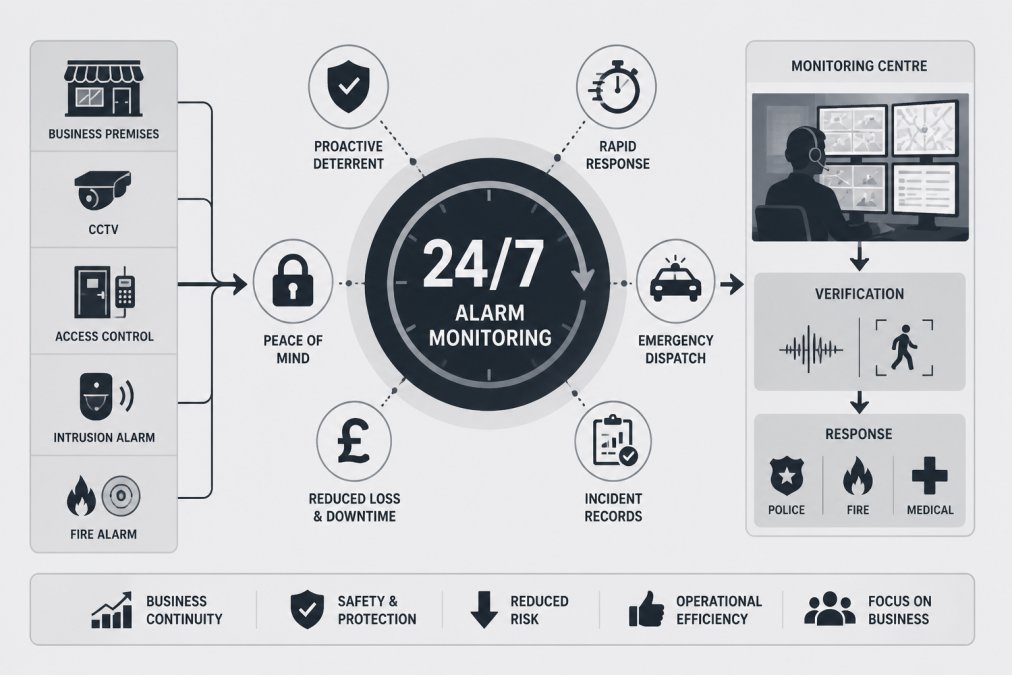
The core value is simple: someone is always watching. Control room operators receive alarm triggers instantly, verify whether a genuine threat exists, and coordinate the appropriate response. This shifts your security from a passive warning system to an active risk mitigation service.
Monitored vs Self-Monitored Alarm Systems: The Real Difference
The distinction between monitored and self-monitored alarm systems comes down to who acts on the alert. A self-monitored system sends a push notification to your phone. You are the responder. If you are asleep, in a meeting, or driving home from a site visit, the response waits for you.
A professionally monitored system routes every alarm trigger to a dedicated monitoring centre. Operators follow a verified protocol: they assess the signal, attempt to contact you or your keyholders, and dispatch emergency services or mobile patrols when the threat is confirmed. This happens regardless of whether you are conscious, contactable, or even in the country.
| Factor | Self-Monitored | Professionally Monitored |
|---|---|---|
| Who responds | You, via phone app | Control room operators |
| Response window | Dependent on your availability | Immediate, 24/7 |
| Threat verification | Manual, after the fact | Operator-led, in real time |
| False alarm handling | You call it in | Operator verifies before dispatch |
| Insurance recognition | Often limited | Generally recognised by insurers |
The practical gap is response latency. When minutes determine whether a break-in becomes a loss, relying on your own availability is a genuine vulnerability that professional monitoring eliminates.
Faster Emergency Response When It Counts
A monitored alarm does not just detect an intrusion; it compresses the time between detection and intervention through a structured chain of events. The moment a sensor trips, the signal travels to the monitoring centre via a dedicated cellular or IP path, not your office Wi-Fi, which an intruder could cut. An operator receives the signal within seconds, assesses the alarm type, and follows a pre-arranged response protocol.
The critical difference from a self-monitored system is the verification step. Instead of dispatching police on an unverified signal, the operator uses audio listen-in, video verification, or a call to your keyholder list to confirm a genuine threat. Only after verification does the operator dispatch emergency services or a mobile patrol. This sequence is why monitored alarms are treated as credible by police and why response times are consistently faster than a business owner waking up to a phone notification and then making the call themselves.
For businesses in areas with a local provider depot, a patrol vehicle can be on site while the intruder is still inside. The response time is measured from the verified alarm, not from the initial sensor trigger. A provider with a local depot can physically interrupt an incident. A provider operating from another state can only call local police and hope for the best.
This speed matters for reasons beyond theft. Consider a duress alarm or panic button installed at a retail counter. If a staff member triggers it during an armed robbery, the monitoring centre can alert police immediately without anyone reaching for a phone. The operator stays on the line, relaying live audio or video to emergency services, giving police real-time situational awareness before they arrive. The same applies to a medical emergency or a fire alarm trigger after hours, the operator can dispatch the relevant service without waiting for a human to notice.
Rapid response also changes the economics of an incident. Vandalism that is interrupted early costs far less to repair. A thief who is disturbed before loading a vehicle leaves with less. Every minute of response time saved is directly proportional to the value of the assets protected. The mechanism is simple: a monitored system converts a passive detection event into an active intervention within minutes, not hours.
Lower Business Security Insurance Requirements and Premiums
Insurers view professionally monitored alarms as a reduction in risk, and they price policies accordingly. Business security insurance requirements often reference alarm monitoring as a condition for coverage on higher-value contents or stock. When you can demonstrate that a monitoring centre verifies and responds to alarm triggers, you present a lower risk profile than a business relying on a standalone siren.
Many policies offer premium reductions for monitored systems because the likelihood of a successful claim drops (iii.org). An intruder who is interrupted mid-break-in causes less damage. A fire that triggers an alarm response limits the extent of the loss. Insurers underwrite for probability and severity; monitoring reduces both.
The documentation trail matters too. A monitoring centre logs every alarm trigger, verification call, and dispatch. If you need to substantiate a claim, that log provides clear evidence of what happened and when. This audit trail is something a self-monitored phone notification simply cannot match.
Cutting Losses from Theft, Vandalism, and False Alarms
Employee theft and internal shrinkage are significant concerns for small businesses. A visible, monitored system changes behaviour. Staff who know an access control system logs every entry and a camera records every till operation are far less likely to test the boundaries. Documented shrinkage reporting gives retail owners hard data on where losses occur.
False alarms are the hidden tax on unmonitored systems. Police forces in many regions now charge fees for repeated false callouts or deprioritise responses to addresses with a history of nuisance alarms (police.qld.gov.au). A monitoring centre reduces this risk through verification. Operators confirm a genuine threat before dispatching emergency services, which keeps your account in good standing with local authorities.
Vandalism after hours is another loss channel that monitoring addresses. A patrol vehicle responding to a triggered sensor can interrupt property damage before it escalates. For construction sites or warehouses with expensive equipment, this intervention is often the difference between a minor repair and a major insurance claim.
The ROI of 24/7 Alarm Monitoring for a Small Business
Calculating the return on investment for monitoring requires comparing the cost of the service against the losses it prevents. A small retail store might face potential annual losses from theft, vandalism, and shrinkage that run into the thousands of dollars. The annual cost of a professional monitoring subscription is a fraction of that figure.
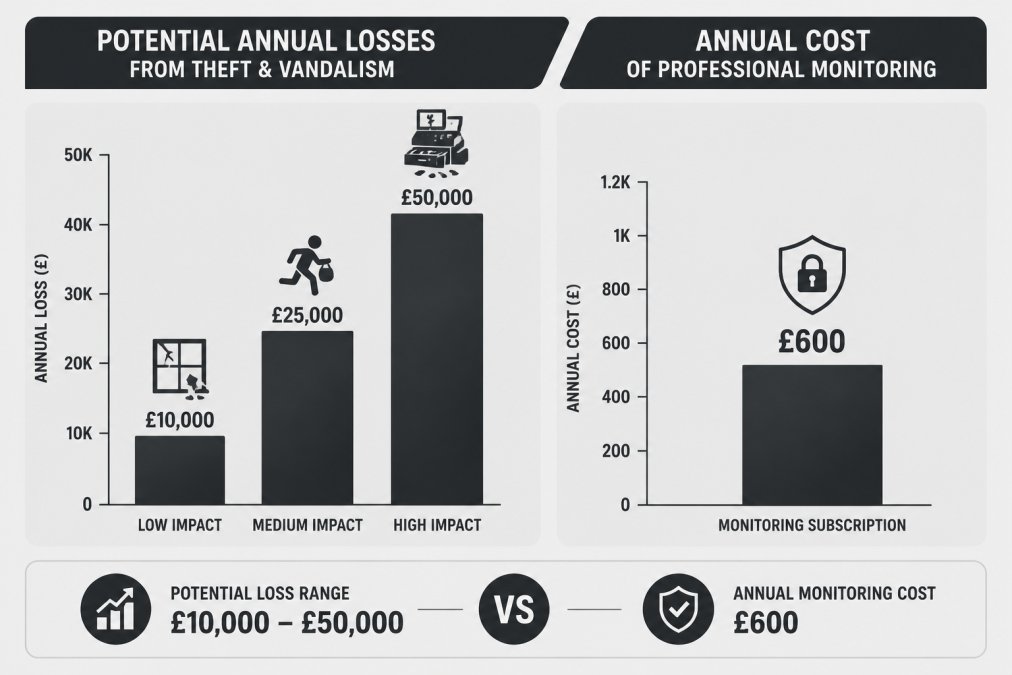
The calculation should include the indirect costs of an incident: downtime while the site is secured, stock replacement, insurance excess, and the administrative burden of a police report. A break-in that closes a shop for three days can cost more in lost revenue than the annual monitoring fee.
There is also the matter of business continuity. A fire that is detected early, or an intrusion that is interrupted before significant damage, keeps your operations running. For businesses that serve multiple sites or manage properties for clients, a single monitoring provider that manages all locations consistently reduces administrative overhead and ensures uniform standards.
Making the Switch: What to Look for in a Monitoring Partner
Choosing a monitoring provider requires more than comparing monthly fees. The quality of the response depends on the local presence of the provider. A company with a depot near your site can offer response times that a provider operating from another state cannot match. Ask prospective partners how quickly they can physically reach your property, and whether they have their own mobile patrol capacity.
Licensing is non-negotiable. In Queensland, security firms must hold the appropriate licences to install monitoring equipment and conduct patrols (qld.gov.au). Verify the provider's credentials and ask who performs their site risk assessments. A genuine assessment is conducted by someone with field experience, not a junior salesperson working from a checklist.
Integration matters. Your monitoring provider should be able to work with your existing CCTV and access control infrastructure rather than forcing a full replacement. The best outcome is a system where cameras verify alarms automatically, access logs are revocable and auditable, and you can view live footage remotely. This integration between the monitored alarm and your broader security stack is what turns a basic alarm system into a complete risk management tool. A provider that understands how your site operates, rather than selling a generic package, will deliver protection that actually fits your workflow.
Small business security is not a one-time purchase; it is an ongoing commitment to protecting your assets, your staff, and your continuity. The challenge is finding a monitoring partner with genuine local response capability and the expertise to tailor a system to how your site operates. Tupper Security combines multi-class licensed operators, a local depot for rapid response, and independent site risk assessments to deliver protection built around your actual operations. Request a quote and put a response team behind your alarm system.
Frequently Asked Questions
Does 24/7 alarm monitoring reduce business insurance premiums?
Yes. Most Australian business insurance providers recognise professionally monitored alarms as a risk mitigation measure. A monitored system with verified response can reduce the risk of large claims, which insurers reward with lower premiums. You should ask your insurer about specific discounts, as requirements vary. You may need to provide a certificate of installation and monitoring to qualify. This is one of the most direct returns on your security investment.
What happens when a business alarm is triggered at night?
When an alarm triggers, the monitoring centre receives the signal immediately. Operators follow your verified response plan: they contact keyholders, assess the situation, and dispatch a response officer if needed. A local provider with 24/7 alarm response services can often have someone on site faster than a distant call centre can coordinate. This rapid, verified response reduces damage and deters criminals from staying on your property.
How does professional monitoring differ from self-monitored systems?
Self-monitored systems send alerts to your phone, and you decide what to do next. That works if you can check your phone at 2 AM and have a plan for who to call. Professional monitoring replaces that uncertainty with a dedicated team. Control room operators verify the alarm, follow your instructions, and dispatch help without you needing to act. For a small business owner, this removes the burden of being on call 24/7.
Is 24/7 monitoring cost-effective for small businesses?
For most small businesses, yes. Calculate the cost of a single break-in: stock loss, damaged doors or windows, downtime, and higher insurance premiums. One incident can easily cost more than a year of monitoring. A monitored system also reduces false alarms. When you factor in potential insurance discounts, the service often pays for itself even if an incident never occurs.