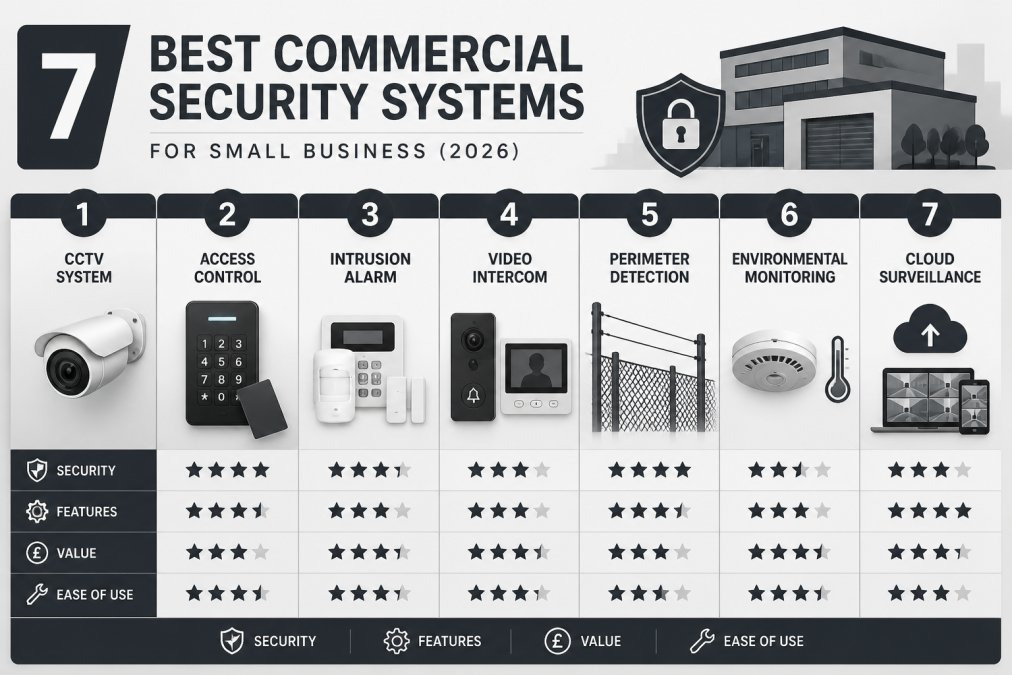
 listicle
7 Best Commercial Security Systems for Small Business (2026)
Table of Contents
- How We Evaluated Commercial Security Systems for Small Business
- Quick Comparison of the 7 Best Commercial Security Systems
- 1. Tupper Security: Best for Tailored Local Protection
- 2. ADT Business: Best for Established Professional Monitoring
- 3. SimpliSafe Business: Best for DIY Flexibility and No Contracts
- 4. Vivint Business: Best for AI-Powered Smart Security
- 5. Lorex: Best for High-Resolution CCTV Without Monthly Fees
- 6. Frontpoint: Best for Customer Support and Cellular Reliability
- How to Verify Alarm Response Times Before You Commit
- Access Control Systems for Commercial Property
- Security System Maintenance Requirements
- Which Commercial Security System Should You Choose?
- Frequently Asked Questions
Last Updated: September 5, 2026
Choosing the right commercial security systems for small business operations is a decision that directly affects your bottom line, your insurance premiums, and your peace of mind. The Australian market offers a confusing mix of DIY camera kits and enterprise-grade providers, and picking wrong means either paying for features you never use or leaving real gaps in your protection. At Tupper Security, we have spent years designing and installing protection for retail stores, warehouses, and multi-tenant sites across South-East Queensland. Below, we break down the seven best options available in 2026 and, more importantly, explain which one fits your specific situation.
The reality is that no single system suits every business. A small retail shop with two staff members has different needs than a construction site with valuable equipment and open boundaries. This guide cuts through the marketing noise to help you make an informed choice.
How We Evaluated Commercial Security Systems for Small Business
We assessed each commercial security system against five criteria that matter most for small business owners: monitoring reliability, installation complexity, contract flexibility, scalability, and total cost of ownership. We also weighed how well each provider handles integration between video surveillance, access control, and alarm response, since a security strategy that relies on disconnected components leaves gaps.
Professional monitoring was weighted heavily because a system that only records footage after a break-in has already failed its primary purpose. The Australian Security Industry Association's guidance on monitoring standards notes that response times and verification processes are critical differentiators between providers. A camera that captures a thief on video is useful for insurance claims, but an alarm that brings a guard to your site in minutes prevents the loss in the first place.
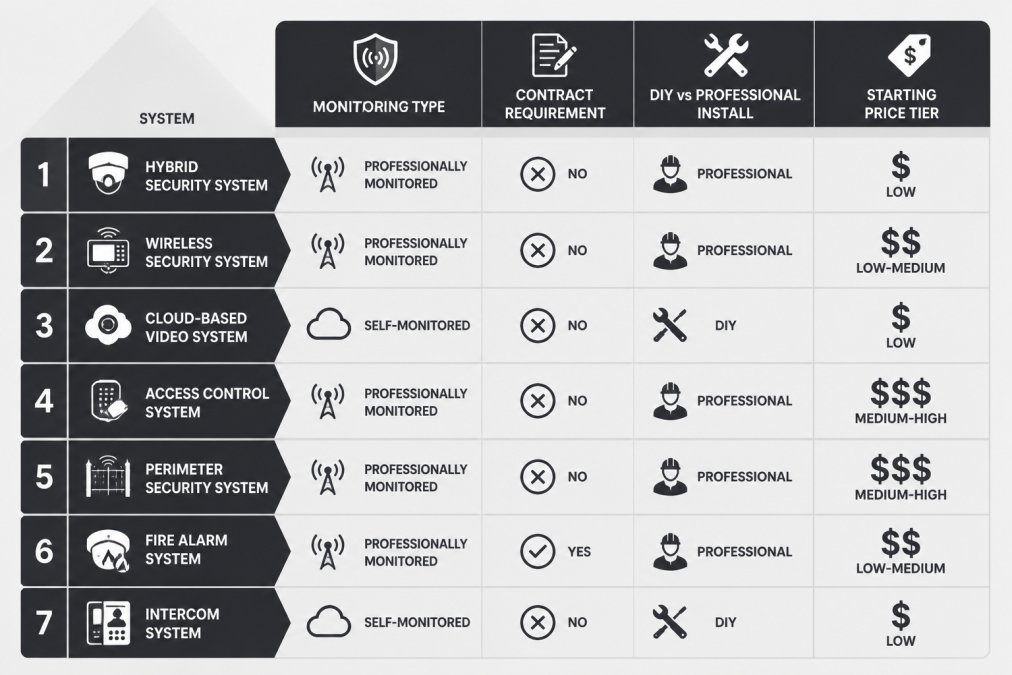
Quick Comparison of the 7 Best Commercial Security Systems
| System | Monitoring Type | Contract | Installation | Best For |
|---|---|---|---|---|
| Tupper Security | 24/7 professional + mobile patrol | Tailored, no lock-in | Professional | Local, tailored protection |
| ADT Business | 24/7 professional | Long-term required | Professional | Established brand reliability |
| SimpliSafe Business | Professional (optional) | No contract | DIY | Budget flexibility |
| Vivint Business | Professional + AI | Contract required | Professional | Smart automation |
| Lorex | Self-monitored | None | DIY | High-res CCTV, no fees |
| Frontpoint | Professional, cellular | Customisable | Professional | Customer support |
| Arlo Pro 5S | Self-monitored | None | DIY | Flexible camera coverage |
1. Tupper Security: Best for Tailored Local Protection
Our top pick is Tupper Security because we build protection around how your site actually operates, not a generic schedule. Unlike national providers that dispatch from distant call centres, our multi-class licensed operators work from a local Silkstone depot, which means faster alarm response in Ipswich and the surrounding corridor. We have protected sites for clients including Orion, Mater Hospital, and USQ since 2014.
What sets us apart is the independent site risk assessment. Before recommending equipment, we walk your property, identify vulnerabilities, and design a system that addresses your specific risks. For retail clients, we provide documented shrinkage reporting that supports loss prevention strategies. For warehouses and multi-tenant sites, our auditable and revocable access control systems ensure you always know who is on site and can revoke access instantly when staff leave.
Pricing depends on your site layout, the number of access points, and the level of monitoring required. Request a quote from Tupper Security for a tailored proposal.
2. ADT Business: Best for Established Professional Monitoring
ADT Business brings decades of industry experience and a comprehensive commercial offering that includes professional 24/7 alarm monitoring, interactive mobile app control, and customisable commercial-grade hardware. For business owners who prioritise an established name and nationwide support infrastructure, ADT delivers consistent, professional monitoring response.
The trade-off is cost and commitment. ADT typically requires professional installation fees and long-term contract commitments, which locks you in even if your needs change. For a single-site retail operation that wants set-and-forget monitoring, this reliability is valuable. For a growing business across multiple sites, the rigid contracts become a limitation.
3. SimpliSafe Business: Best for DIY Flexibility and No Contracts
SimpliSafe Business appeals to small business owners who want professional monitoring without being locked into a multi-year agreement. With no-contract monitoring plans and an easy DIY installation process, it is the most cost-effective entry point on this list. Cellular backup ensures your alarm signals reach the monitoring centre even if your broadband connection fails.
The limitations appear when you need more than basic intrusion detection. SimpliSafe offers limited advanced commercial access control features, and the self-installation model may not suit complex sites with multiple entry points or specific compliance requirements. If you operate a small office or studio where simple alarm coverage suffices, this is a solid choice. If you manage a site with valuable stock and staff turnover, the lack of integrated access control creates risk.
4. Vivint Business: Best for AI-Powered Smart Security
Vivint Business sits at the premium end of the market, offering AI-powered smart camera detection that distinguishes between people, vehicles, and animals, reducing false alarms significantly. Integrated smart locks and lighting control create a seamless automation ecosystem, and the mobile app gives you remote site management from anywhere.
This is the best option for businesses that want a fully integrated smart ecosystem and are willing to pay for it. The higher price point for equipment and mandatory professional installation means Vivint suits businesses where the security budget is less constrained. The AI analytics genuinely reduce the time you spend reviewing false alerts, which is a real productivity gain for busy owners. However, you are tied to their ecosystem, and expanding with third-party hardware is limited.
5. Lorex: Best for High-Resolution CCTV Without Monthly Fees
Lorex takes a different approach: buy the hardware once, own it outright, and pay no monthly monitoring fees. With 4K resolution video recording and local storage options via NVR or DVR, Lorex delivers exceptional image quality for identifying faces and number plates. Weather-resistant camera hardware makes it suitable for outdoor perimeters and sites exposed to the elements.
The significant caveat is the absence of professional alarm monitoring. Lorex is a video surveillance system, not a complete security solution. If someone breaks in at 2 AM, you will get a notification on your phone, but no one will be dispatched to your site. For businesses that already have a separate alarm response arrangement or operate in low-risk areas, Lorex provides outstanding value. For most small businesses, video alone is insufficient.
6. Frontpoint: Best for Customer Support and Cellular Reliability
Frontpoint differentiates itself through customer service quality and 100% cellular connectivity. Every alarm signal travels over the cellular network, which eliminates the vulnerability of cut phone lines or failed broadband connections. Their crash and smash protection ensures that even if an intruder destroys the keypad, the alarm signal has already been transmitted.
Customisable equipment packages mean you only pay for what you need, and the remote mobile app provides full control. Frontpoint's reputation for responsive, helpful support is a genuine advantage for business owners who are not technically inclined. The drawbacks are pricing that runs higher than DIY alternatives and limited physical retail presence, which means you will not be able to visit a local branch if you prefer face-to-face service.
How to Verify Alarm Response Times Before You Commit
This is the question every business owner should ask before signing a monitoring contract, yet most never do. Alarm response times are the single most important metric in determining whether your security system prevents a loss or simply documents one. A common mistake is accepting a provider's marketing claim of "rapid response" without verifying what that means in practice.
Start by asking the provider for their average response time in your specific postcode, not their national average. National figures often mask poor regional performance. Then ask how response is structured: does an alarm trigger a phone call to you first, or does it dispatch a guard immediately? Every minute spent on verification is a minute the intruder has to work. Ask whether the monitoring centre is in Australia or offshore, since local centres have better knowledge of emergency protocols and response infrastructure. Finally, ask what happens if the primary response team is unavailable. The Queensland Government's security licensing requirements outline the obligations licensed security firms must meet, which gives you a baseline for vetting providers.
Access Control Systems for Commercial Property
Access control is the backbone of any serious commercial security setup, yet many small businesses overlook it in favour of cameras. Video surveillance tells you what happened after the fact; access control systems for commercial property prevent unauthorised entry in the first place. Modern systems use biometric authentication, smart locks, and user permissions to ensure only authorised personnel enter specific areas at specific times.
For multi-tenant sites and warehouses, the ability to create audit trails is invaluable. When an incident occurs, you can see exactly who entered a zone, when, and with what credential. This documentation supports both internal investigations and insurance claims. Cloud-based management platforms let you revoke access instantly when an employee leaves, eliminating the security gap that exists between termination and physical key recovery.
Security System Maintenance Requirements
A security system is only as reliable as its maintenance schedule. Many business owners install a system and forget about it until something fails, which is precisely when they need it most. Regular maintenance covers battery replacement in sensors and cameras, firmware updates for network-connected devices, and testing of backup power supplies to ensure the system operates during outages.
Network connectivity is another critical maintenance point. IP cameras and cloud-based management systems depend on stable network connections, and a single configuration change to your router can silently disable your entire camera fleet. Schedule quarterly system checks that verify every camera is recording, every sensor is communicating, and every alarm signal reaches the monitoring centre. The Australian Cyber Security Centre's guidance on securing networked devices recommends regular firmware updates and password changes to prevent unauthorised access to your security infrastructure, a threat vector many small businesses ignore.
Which Commercial Security System Should You Choose?
The right choice depends on your risk profile, your budget, and your tolerance for self-management. If you want the strongest protection with local, rapid response and a system designed around your specific site, Tupper Security is the clear recommendation. If you need a recognised national brand with established monitoring, ADT Business works, provided you accept the contract commitment. Budget-conscious owners who are comfortable with DIY installation will find SimpliSafe the most flexible option, while those prioritising video quality over monitoring should consider Lorex.
The common thread across all options is that monitoring and response matter more than hardware. A $2,000 camera system with no one watching is less effective than a $500 alarm system that brings a guard to your door. Evaluate providers on their response infrastructure, their local presence, and their willingness to put response time commitments in writing.
Frequently Asked Questions
What is the best security system for a small business?
The best system depends on your site's specific risks, budget, and whether you need professional monitoring. For small businesses seeking a tailored approach with rapid local response, a provider like Tupper Security offers integrated CCTV, access control, and 24/7 alarm response. National providers like ADT offer established infrastructure, while DIY options like SimpliSafe suit low-risk sites. Start with a site risk assessment to match the system to your actual exposure.
What is the difference between residential and commercial security systems?
Commercial systems are built for higher usage, more complex layouts, and specific operational needs. They typically include features like access control systems for commercial property, integration with fire and life safety protocols, and audit trails for incident reporting. Residential systems focus on entry point detection. Commercial setups must also consider scalability for multiple sites or future growth and often require professional installation to meet insurance and compliance standards.
Is a back-to-base monitoring system necessary for small businesses?
It is strongly recommended for most small businesses. A back-to-base system ensures an alarm triggers a response even if no one is on site. The key is verifying the provider's actual response times. Ask how their dispatch process works, where their monitoring centre is located, and what their documented average response time is for your area. This differs from a self-monitored system where you are responsible for responding to alerts.
How much does a professional commercial security installation cost?
Installation costs vary widely based on the size of your premises, the number of sensors and cameras, and the complexity of the access control integration. Some providers bundle installation into a service agreement, while DIY systems remove labour costs but require your own setup. For an accurate figure, request a quote based on a site risk assessment. This will also reveal any costs for ongoing system maintenance requirements.
Choosing a commercial security system for your small business does not need to be overwhelming, but it does require asking the right questions about monitoring, response, and integration. The Tupper Security team brings multi-class licensed operators, local depot response, and independent site risk assessments to every project, ensuring your protection is built around your actual operations. Request a quote today and see the difference that a genuinely tailored security design makes.
This article was written using GrandRanker