 how-to
Improving Response Times for Warehouse Alarms: A Step-by-Step Guide
Table of Contents
- Why Warehouse Alarm Response Times Matter
- How to Measure Your Current Alarm Response Performance
- Reducing False Alarm Dispatches to Speed Response
- Video Verification for Warehouse Alarms: Faster Incident Confirmation
- Compliance with AS/NZS 2201 Standards for Faster, Auditable Response
- Seven Steps to Improving Warehouse Alarm Response Times
- Step 1: Audit your current alarm infrastructure
- Step 2: Integrate CCTV with motion detection and alert systems
- Step 3: Establish direct communication with local emergency services
- Step 4: Deploy 24/7 professional monitoring with real-time dispatch
- Step 5: Implement AI-driven verification to eliminate false triggers
- Step 6: Document post-incident response for continuous improvement
- Step 7: Schedule quarterly system maintenance and staff retraining
- Network Infrastructure Requirements for Low-Latency Alarm Dispatch
- Post-Incident Response Audit: Learning from Every Alarm
Last Updated: August 3, 2026
Why Warehouse Alarm Response Times Matter
Improving response times for warehouse alarms protects your assets before loss occurs. At Tupper Security, we've tracked hundreds of incidents across South-East Queensland warehouses: every second of delay between alarm trigger and response directly correlates with greater loss exposure. An alarm triggering a response in 8 minutes often prevents the incident entirely, while one taking 45 minutes may discover a break-in already underway.

Slow alarm response extends beyond immediate theft. False alarms waste emergency services' time, reducing responsiveness to genuine threats. Regulatory bodies like the Queensland Police Service scrutinise alarm management, and sites with slow response protocols face compliance issues. Insurance underwriters increasingly include response-time clauses that directly affect premiums and claim eligibility.
The real problem most warehouses face is that alarm systems are disconnected from the decision-making and dispatch workflows that drive response speed. A CCTV camera taking 30 seconds to load footage defeats a motion sensor triggering in milliseconds. A monitoring service that phones the site manager instead of dispatching directly adds 10 minutes to response time. This guide addresses the structural bottlenecks that slow response and shows you how to eliminate them.
How to Measure Your Current Alarm Response Performance
You cannot improve what you don't measure. Most warehouse operators have no documented baseline for actual alarm response times and assume their system works because they've never tested it under realistic conditions.
Key metrics to track
Response time begins when an alarm condition occurs, not when someone notices the alert. Break measurement into four distinct phases:
Detection to alert latency measures how quickly your alarm sensor transmits a signal to your monitoring centre or control panel. Modern systems should achieve this in under 2 seconds; exceeding 5 seconds indicates a network or sensor configuration problem.
Alert verification time is how long it takes a human operator or AI system to confirm the alarm is genuine. Manual verification typically takes 30-90 seconds; AI-driven video verification reduces this to 5-15 seconds.
Dispatch decision to dispatch time measures how quickly the monitoring centre decides to dispatch and executes it. A professional 24/7 service with pre-authorised protocols should achieve this in under 3 minutes; requiring site manager approval adds 10-15 minutes.
Dispatch to arrival time is pure travel time from the nearest response resource to your site. For Ipswich and the immediate corridor, Tupper Security's Silkstone depot achieves average arrival times of 12-18 minutes for priority calls.
Establishing your baseline
Document a full week of alarm incidents with timestamps at each phase using your alarm system's event log, monitoring centre records, and security team dispatch notes. Calculate the average for each phase. Run a controlled test during business hours with a supervisor present to timestamp each phase. This reveals whether documented times reflect reality or hidden delays in your workflow. Most warehouses discover their actual response time is 40-60% slower than assumed, primarily due to verification and dispatch decision delays.
Reducing False Alarm Dispatches to Speed Response
False alarms waste resources, train teams to deprioritise genuine alerts, and erode credibility with emergency services.
Common causes of false alarms in warehouses
Motion detectors trigger on dust clouds, reflections from vehicle headlights, or temperature-induced air currents. Door and window contacts fail when hinges wear or frames settle. Vibration sensors on roller-shutter doors false-trigger when heavy vehicles drive past. Environmental factors compound the problem: poor climate control causes temperature swings triggering thermal detectors; proximity to railway lines or highways causes vibration-sensor false alarms; pest activity and birds trigger motion detectors.
Verification protocols that cut wasted dispatch time
Video verification is the industry standard: when an alarm triggers, a trained operator watches live CCTV footage of the triggered zone for 10-30 seconds before authorising dispatch. Dust clouds or reflections mean no dispatch; genuine unauthorised entry triggers immediate dispatch.
Implement a two-stage verification rule: motion detection triggers an alert, but dispatch requires operator confirmation of movement in the CCTV feed. This typically reduces false dispatches by 60-75% while keeping response time to genuine incidents under 5 minutes. For perimeter sensors, use confirmation logic: require two separate sensor triggers within 30 seconds before escalating to dispatch.
Document every false alarm with root cause analysis. After three false alarms from the same sensor, have a technician inspect it. Worn contacts, misaligned detectors, and environmental interference are fixable problems.
Video Verification for Warehouse Alarms: Faster Incident Confirmation
Video verification transforms alarm response from reactive guessing into data-driven decision-making. Instead of dispatching based on sensor triggers alone, your monitoring centre can see exactly what triggered the alarm and decide whether dispatch is warranted.
How video verification reduces response latency
Video verification actually speeds up response to genuine incidents. Without video, operators must assume every alarm is real and dispatch immediately, then investigate on arrival. With video, operators confirm within 10-15 seconds whether the alarm is genuine; if it is, dispatch happens with full situational awareness. For false alarms, video verification eliminates dispatch entirely, freeing response resources for genuine threats.
Verification latency is minimal: modern IP cameras stream with under 3-second delay, and trained operators need 5-10 seconds to assess whether motion represents a genuine threat. Total verification time: 8-15 seconds, compared to 15-30 minutes saved by avoiding false dispatch.
Integration with real-time alert systems
Video verification requires CCTV integration with your alarm system and monitoring centre's dispatch platform. When motion detection triggers, the monitoring centre should see live video from the triggered zone, event timeline, building layout, and pre-authorised dispatch protocols.
This requires integration at three levels: sensor to alarm panel, alarm panel to CCTV system, and CCTV system to monitoring centre. Test integration quarterly by simulating an alarm trigger and measuring how long live video appears on the monitoring centre's screen. Exceeding 10 seconds indicates a network latency or configuration problem.
Compliance with AS/NZS 2201 Standards for Faster, Auditable Response
Australian Standard AS/NZS 2201 defines security alarm system requirements, including response protocols and documentation. Compliance is not just regulatory; it's a framework for speed.
What AS/NZS 2201 requires for alarm response
AS/NZS 2201 requires documented response procedures, defined roles and responsibilities, and clear escalation pathways. It mandates that monitoring services maintain records of all alerts, verification attempts, and dispatch decisions. It requires regular testing and maintenance logs, and response procedures be tested at least annually with documented results.
Using compliance as a framework for speed
Compliance documentation exposes inefficiencies. When you document exactly what happens when an alarm triggers, who gets notified, in what order, how long each step takes, and what decision criteria are used, you see the bottlenecks: the site manager taking 8 minutes to answer the phone, the monitoring centre lacking pre-authorised dispatch protocols, the CCTV system not integrated with the alarm system.
Once documented, compliance becomes a speed audit. Every non-compliance finding is an opportunity to simplify response. Tupper Security integrates compliance documentation with performance optimisation, designing response protocols that meet AS/NZS 2201 requirements while minimising response latency.
Seven Steps to Improving Warehouse Alarm Response Times
Improving response times requires systematic change across infrastructure, process, technology, and personnel.
Step 1: Audit your current alarm infrastructure
Document your existing system: sensors, alarm panel, monitoring provider, and communication paths. Many warehouses discover systems are 10+ years old, use outdated technology, and have never been formally tested. Request a full site audit from a licensed security provider including physical inspection of all sensors, communication path testing, monitoring centre protocol review, and current response time documentation.
Step 2: Integrate CCTV with motion detection and alert systems
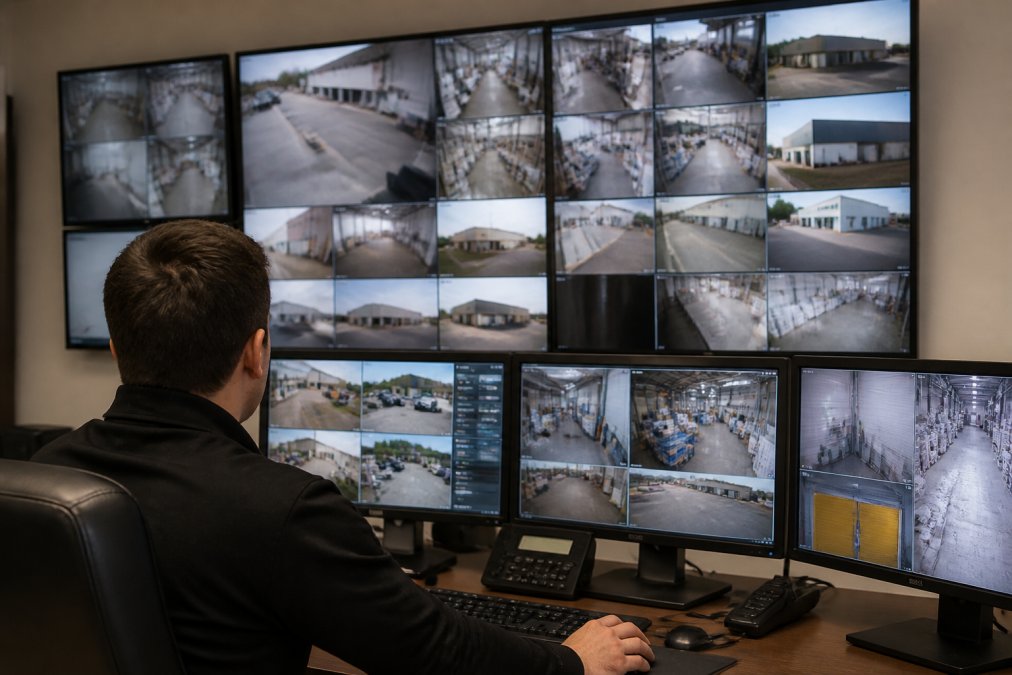
If CCTV is not connected to your alarm system, you're operating with incomplete information. When an alarm triggers, your monitoring centre should automatically see live video from the triggered zone. This requires three integrations: motion detection sensors communicating to your alarm panel, the alarm panel triggering video recording and alerting the monitoring centre, and CCTV streaming live footage to the monitoring centre's dispatch platform. Cost is typically $3,000-$8,000 for a medium warehouse. Test integration by triggering a sensor and confirming video appears on the monitoring centre's screen within 10 seconds.
Step 3: Establish direct communication with local emergency services
Many warehouses rely on their monitoring centre to call emergency services, adding communication layers and delaying dispatch. Contact the Queensland Police Service and your local council to establish a direct alarm notification protocol. Provide emergency services with site contact, building layout, known hazards, and access procedures.
Step 4: Deploy 24/7 professional monitoring with real-time dispatch
If your alarm system is monitored by in-house teams or part-time contractors, you have response gaps. A dedicated 24/7 professional monitoring service with pre-authorised dispatch protocols is essential for consistent response. The monitoring centre should have documented authority to dispatch without calling for approval, eliminating the 10-15 minute delay caused by waiting for manager decisions. Tupper Security provides 24/7 alarm monitoring with real-time dispatch from our Silkstone depot. Our multi-class licensed operators have authority to dispatch immediately upon video verification of genuine threats.
Step 5: Implement AI-driven verification to eliminate false triggers
Modern AI systems distinguish between genuine threats and false alarms with high accuracy, reducing verification time from 30-60 seconds to 5-15 seconds. AI verification learns your site's normal patterns and flags deviations suggesting unauthorised access. Implementation requires CCTV integration and 2-4 weeks of baseline footage for model training. Investment is typically $5,000-$15,000 depending on zones and site complexity.
Step 6: Document post-incident response for continuous improvement
Every alarm should generate a documented incident report including timestamps for each response phase, decision points, and outcomes. Review reports monthly to identify patterns. Are certain sensors generating repeated false alarms? Is there consistent delay in a particular phase? This data is your roadmap for improvement.
Step 7: Schedule quarterly system maintenance and staff retraining
Alarm systems degrade over time. Sensors drift out of alignment, wireless device batteries weaken, network connections become unreliable. Schedule quarterly maintenance with a licensed technician including sensor testing, battery replacement, and network diagnostics. Retraining is equally important. Review security team response protocols quarterly and test them with simulated alarm scenarios to keep staff sharp and identify training gaps.
Network Infrastructure Requirements for Low-Latency Alarm Dispatch
Alarm response speed depends on reliable, fast network connectivity. A broken network link can delay alarm notification by minutes or cause failure.
Bandwidth and latency thresholds
Alarm systems require modest bandwidth; most signals consume less than 1 Mbps. CCTV streaming requires more: a single HD camera typically consumes 2-4 Mbps; multiple cameras require 10-20 Mbps depending on frame rate and resolution.
The critical metric is latency. Latency above 100 milliseconds introduces noticeable delay in real-time video streaming; above 500 milliseconds makes video verification impractical. Most NBN connections in South-East Queensland achieve latency of 20-50 milliseconds to Sydney-based monitoring centres. Test your latency by pinging your monitoring centre's server from your site and document the result in your quarterly maintenance checklist.
Backup connectivity for uninterrupted monitoring
A single internet connection is a single point of failure. Implement backup connectivity using a secondary ISP (typically mobile broadband) that automatically activates if your primary connection fails. This requires dual network ports on your alarm panel and automatic failover configuration. Cost is modest, typically $30-$50 monthly for backup mobile service. Test failover by temporarily disconnecting your primary connection and confirming alarm system maintains connectivity via backup service.
Post-Incident Response Audit: Learning from Every Alarm
Every alarm contains lessons about your response capability. A systematic post-incident audit transforms individual incidents into data driving continuous improvement.
Documenting dispatch timelines and decision points
Within 24 hours of any alarm, your security team and monitoring centre should complete a joint incident report documenting exact trigger time, notification time, verification decision and duration, dispatch decision and time, dispatch time, arrival time, and investigation findings. This timeline reveals where time is spent. Notification-to-verification time above 90 seconds indicates video streaming or operator response problems. Verification-to-dispatch time above 5 minutes indicates authorisation bottlenecks.
Identifying bottlenecks and process gaps
Review incident reports monthly as a team, looking for patterns: repeated false alarms from certain sensors, consistently slow verification time, delayed dispatch authorisation, or arrival times exceeding targets. For each pattern, implement specific corrective action. Replace faulty sensors, improve CCTV integration or operator training, establish pre-authorised protocols, or consider additional response resources.
Track corrective actions and measure their impact. Monitor the next 20 incidents to see if metrics improved. This cycle of measure, identify bottleneck, implement fix, and measure again is how response times improve from 45 minutes to 15 minutes. Tupper Security's approach includes automated timeline generation from alarm panel logs, monitoring centre records, and dispatch data, with monthly performance reports identifying improvement opportunities.
Warehouse alarm response times matter because every minute of delay increases loss exposure. The systems that slow response are documented in incident reports and visible in network logs. Improving response times requires systematic attention to infrastructure, process, and personnel, but the investment pays for itself through reduced loss and avoided false alarm costs.
Tupper Security specialises in precision-installed alarm systems with integrated CCTV, 24/7 professional monitoring, and real-time dispatch from our local Silkstone depot. Our multi-class licensed operators have authority to dispatch immediately upon video verification, eliminating decision-making delays. Request a quote to see how we can reduce your alarm response times while maintaining AS/NZS 2201 compliance.
Frequently Asked Questions
What is a realistic response time benchmark for warehouse alarms in Australia?
Response time benchmarks vary by location and monitoring service, but professional 24/7 monitoring typically aims for dispatch within 10-15 minutes of alarm trigger. Rural or remote sites may experience longer times. AS/NZS 2201 standards require documented response procedures, though specific time guarantees depend on your monitoring contract. Ask your provider for their actual response time data for your postcode, not industry averages.
How does video verification reduce false alarm dispatches?
Video verification allows monitoring operators to visually confirm an actual threat before dispatching emergency services. Instead of sending a patrol for every motion sensor trigger, operators review CCTV footage in real-time, confirming whether the alarm represents a genuine security incident. This cuts wasted dispatch trips by 40-60% depending on your warehouse layout and sensor placement. Fewer false dispatches mean faster response to real threats and lower false alarm fees from emergency services.
What network infrastructure do I need for real-time alarm alerts?
Your alarm system requires stable internet with minimum 2 Mbps upload speed for reliable real-time notifications and video streaming. Redundant connectivity (primary broadband plus 4G backup) prevents gaps if your main connection fails. All CCTV cameras and alarm sensors should connect via a dedicated network segment with UPS battery backup for at least 4 hours of operation. If your warehouse spans multiple buildings, ensure low-latency links between access points to avoid alert delays.
How do I know if my warehouse meets AS/NZS 2201 requirements for alarm systems?
AS/NZS 2201 covers design, installation, and maintenance of security alarm systems. It requires documented response procedures, regular system testing, and auditable access logs. A licensed security consultant can perform a compliance audit of your current system. Key areas include sensor placement, backup power, monitoring centre standards, and incident documentation. Non-compliance can affect insurance claims and response times, so a formal audit is worth the investment before upgrading.
This article was written using GrandRanker