 how-to
How to Compare Security System Service Agreements
Table of Contents
- What to Look for in a Security System Service Agreement
- Security System Contract Duration and Commitment Terms
- Service Level Agreements and Response Time Metrics
- Security System Maintenance vs Monitoring Costs
- Understanding Security System Contract Cancellation Fees
- Hidden Fees and Fine Print Red Flags
- Hardware Ownership, Data Security, and Exit Strategy
- Conclusion
- Frequently Asked Questions
Last Updated: September 27, 2026
What to Look for in a Security System Service Agreement
Security system service agreements are binding contracts between you and your security provider that outline monitoring services, response times, equipment maintenance, costs, and cancellation terms. Before signing anything, you need to understand what you're actually agreeing to, because the fine print often contains surprises that catch property owners off guard.
The agreement sets expectations on both sides. It defines how quickly someone will respond when your alarm triggers, what happens if equipment fails, whether you own the hardware or lease it, and what it costs to exit the contract early. Missing these details before you sign means you could be locked into unfavourable terms for years.
We work with property owners across South-East Queensland who've learned the hard way that a poorly structured agreement can cost thousands in hidden fees and lock you into inflexible service. The best approach is to read the agreement critically before you commit. Look for clarity on response times, maintenance obligations, liability limits, and exit clauses. If the provider won't explain something in plain language, that's a red flag.
Security System Contract Duration and Commitment Terms
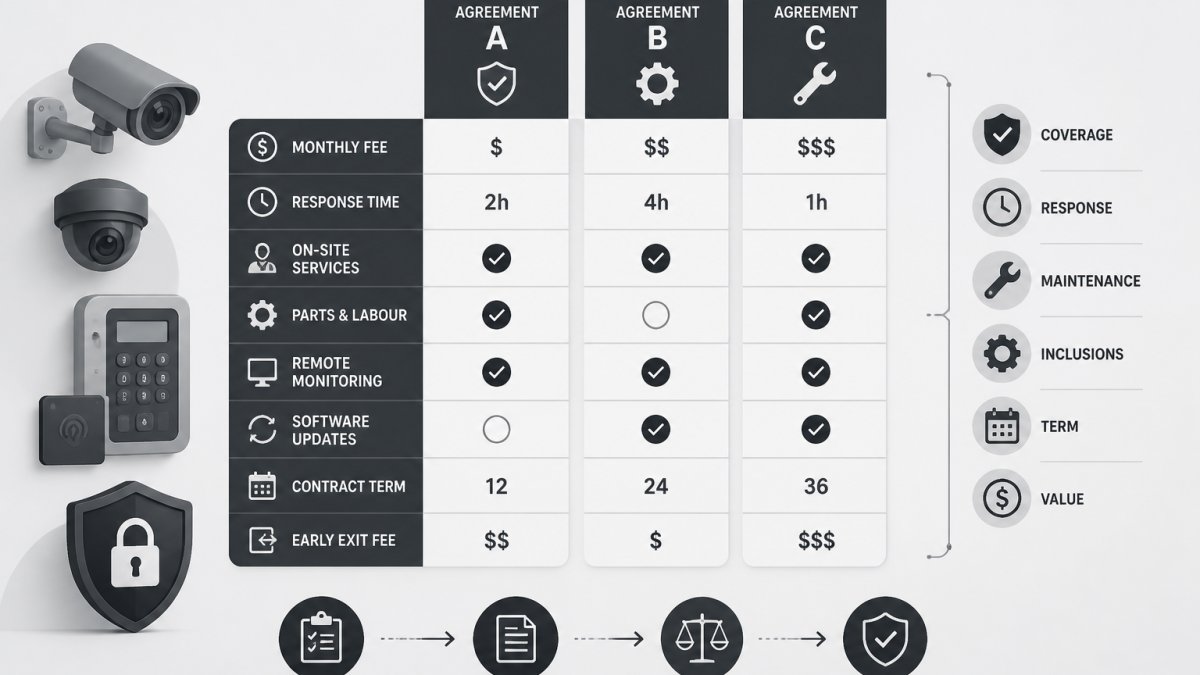
Contract duration is how long you're legally bound to the service. Most agreements run for 12, 24, or 36 months, though some providers offer month-to-month flexibility. The longer the commitment, the lower your monthly cost typically is, but you lose flexibility if your needs change.
A 12-month term gives you more freedom to switch providers or renegotiate. A 24-month or 36-month commitment locks in pricing and service standards but commits you to paying even if you're unhappy. Some agreements auto-renew unless you provide written notice 30-60 days before expiry, which catches many customers off guard.
Pay attention to whether the term is fixed or rolling. A fixed term ends on a specific date. A rolling or evergreen contract renews automatically and can stretch indefinitely unless you actively cancel. Read the renewal clause carefully, some require 90 days' notice to avoid auto-renewal, while others give you only 30 days.
Also check whether the provider can change terms during the contract period. Some agreements allow them to increase monitoring fees or modify service levels with 30 days' notice. That flexibility benefits them, not you.
Service Level Agreements and Response Time Metrics
A service level agreement (SLA) is the provider's commitment to how fast they'll respond to an alarm. Response times typically range from 15 to 60 minutes, depending on your location and the service tier you pay for. Urban areas usually get faster response than remote sites.
The SLA should specify:
- Initial response time: How long before someone calls to verify the alarm
- Dispatch time: How long before security personnel or police are notified
- On-site arrival: How long before someone physically arrives at your property
Most providers commit to 15-30 minute response times in populated areas, but read the fine print. Some SLAs include caveats like "weather permitting" or "subject to availability," which weakens their commitment. Others exclude certain types of alarms or charge extra for faster response.
Ask what happens if they miss the SLA.
Security System Maintenance vs Monitoring Costs
Security agreements typically separate maintenance (keeping equipment working) from monitoring (watching your system 24/7 and responding to alarms). Understanding this split is essential because they're often billed differently and have different coverage terms.
Maintenance costs cover equipment repairs, system updates, and troubleshooting. Some agreements bundle maintenance into your monitoring fee. Others charge separately, especially if you need emergency repairs outside business hours. Check whether maintenance includes:
- Quarterly system testing
- Battery replacement for backup power systems
- Sensor replacement if devices fail
- Software updates and patches
Understanding Security System Contract Cancellation Fees
Cancellation fees (also called early termination penalties) are what you pay if you exit the contract before the term ends. These are often substantial and can range from a few hundred dollars to several thousand, depending on how much of the contract remains.
Hidden Fees and Fine Print Red Flags
Beyond the monthly monitoring fee, security agreements often contain charges that aren't obvious until you read carefully. These hidden fees can add hundreds or thousands to your total cost.
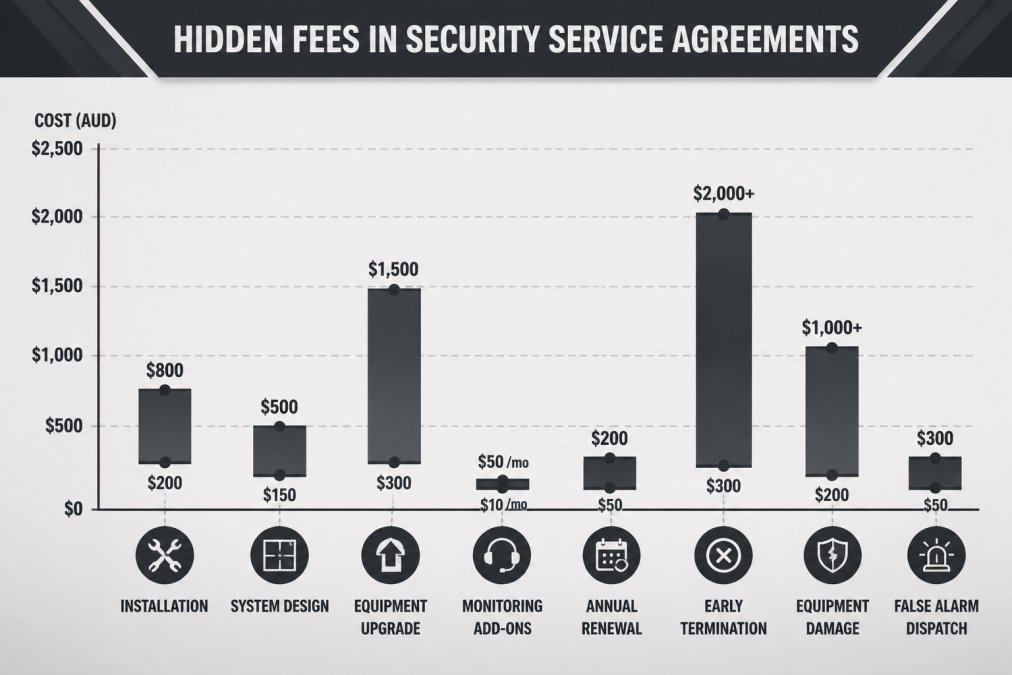
Common hidden fees include:
| Fee Type | What It Covers | Typical Cost | How to Spot It |
|---|---|---|---|
| Installation | Setting up hardware and configuring the system | $200-$800 | Listed separately from monthly fees; sometimes waived for long-term contracts |
| System design or site assessment | Professional evaluation of your property's security needs | $150-$500 | May be called "consultation fee" or "security audit"; sometimes credited toward service |
| Equipment upgrade | Replacing outdated cameras, keypads, or sensors | $300-$1,500 | Triggered automatically if your system reaches end-of-life; check whether provider can force upgrades |
| Monitoring add-ons | Video monitoring, cellular backup, or additional sensors | $10-$50/month | Often optional but presented as necessary; read what's actually included in base monitoring |
| Annual renewal or service charge | Fee to renew your service agreement each year | $50-$200 | Separate from monthly fees; easy to miss in the fine print |
| Early termination or cancellation | Penalty for exiting the contract before the term ends | $300-$2,000+ | Calculated as flat fee or percentage of remaining contract; sometimes waivable under specific conditions |
| Equipment damage or loss | Charge if you damage or lose hardware during the contract | $200-$1,000+ per item | Usually applies only if damage is your fault, not normal wear; check the definition of "damage" |
| Dispatch or false alarm fees | Charge if police or security respond to a false alarm | $50-$300 per incident | Varies by jurisdiction; some areas cap these fees, others don't |
Red flags to watch for:
- Vague language like "fees as applicable" or "charges at provider's discretion"
- Fees listed in a separate pricing schedule rather than in the main agreement
- Automatic charges that require you to opt out rather than opt in
- Penalties for requesting service calls or system checks
- Charges for cancelling or transferring service to a new property
- Undefined "miscellaneous fees" or "other costs"
Hardware Ownership, Data Security, and Exit Strategy
One of the most overlooked aspects of a security agreement is who owns the equipment. This determines what happens when you cancel and what you can do with the system long-term.
Equipment ownership models:
- Leased hardware: You don't own the equipment. You pay a monthly fee to use it. When you cancel, you return everything. The provider maintains and upgrades it. This is simpler but locks you into their ecosystem.
- Purchased hardware: You buy the equipment outright. You own it permanently. You're responsible for maintenance and repairs after any warranty expires. You can upgrade or modify it as you wish.
- Hybrid: You own some components (cameras, keypads) but lease others (monitoring service, central station access).
Data security obligations should cover:
- How the provider stores and encrypts your data
- Who has access to your footage and logs
- How long they retain data after you cancel
- Whether they share data with third parties
- What happens if they suffer a data breach
An exit strategy protects you if you need to switch providers. The agreement should allow you to:
- Export your system configuration and settings
- Retrieve all historical data in a usable format
- Transfer monitoring to a new provider without losing service
- Disconnect from the old provider's system cleanly
Conclusion
Comparing security system service agreements requires you to look beyond the monthly fee. Focus on response time guarantees, maintenance obligations, cancellation penalties, hidden fees, and data ownership. Request complete agreements from multiple providers before you decide, and don't sign anything you don't fully understand.
Frequently Asked Questions
What should be included in a standard security system service agreement?
A solid security system service agreement must cover contract duration, monthly monitoring fees, response time guarantees (SLA), scope of coverage, installation and maintenance responsibilities, cancellation terms and any penalties, data security and privacy obligations, liability limitations, hardware ownership, and system integration details. It should also specify who performs site assessments, what triggers service credits, and how disputes are resolved. Always request a written copy before signing.
How do I identify hidden fees in security system contracts?
Review the contract for installation fees, system design charges, activation costs, equipment upgrades, monitoring add-ons, annual renewal fees, and early termination penalties. Check whether maintenance is bundled or billed separately, if there are charges for service calls outside the agreement scope, and whether price increases are locked or subject to annual adjustments. Ask the provider to itemise all costs in writing and clarify what 'included' services actually cover before committing.
What is the difference between a maintenance agreement and a monitoring contract?
A maintenance agreement covers system upkeep, repairs, and hardware replacement when equipment fails. A monitoring contract covers 24/7 professional surveillance, alarm dispatch, and rapid response services. Many providers bundle both, but they serve different functions. Maintenance keeps the system working; monitoring ensures someone responds when it's triggered. Confirm which services are included in your agreement and whether they can be separated or adjusted independently.
Are long-term security contracts standard practice?
Long-term contracts (2-3 years) are common, but increasingly flexible options exist. Some offer month-to-month plans, others require 12-month minimums. Long-term contracts often provide discounted rates but carry higher cancellation penalties. Evaluate whether the discount justifies the commitment risk, and always check the exit clause terms.
When you're evaluating security providers, you need someone who stands behind their commitments with transparent terms and genuine accountability. Tupper Security offers tailored protection plans with clear service level agreements, rapid alarm response from our local Silkstone depot, and auditable access control systems that give you full visibility into your property's security. Request a quote today and see how our multi-class licensed operators can protect what matters most to you.