 how-to
Integrated Security for Businesses: A 2026 Guide
Table of Contents
- What Is Integrated Security for Businesses
- Integrated Security System Components
- Access Control and CCTV Integration
- Benefits of Integrated Security Systems
- How Integrated Security Works in Practice
- Implementation and Scalability Considerations
- Cybersecurity and Compliance in Integrated Systems
- Frequently Asked Questions
Last Updated: September 22, 2026
What Is Integrated Security for Businesses
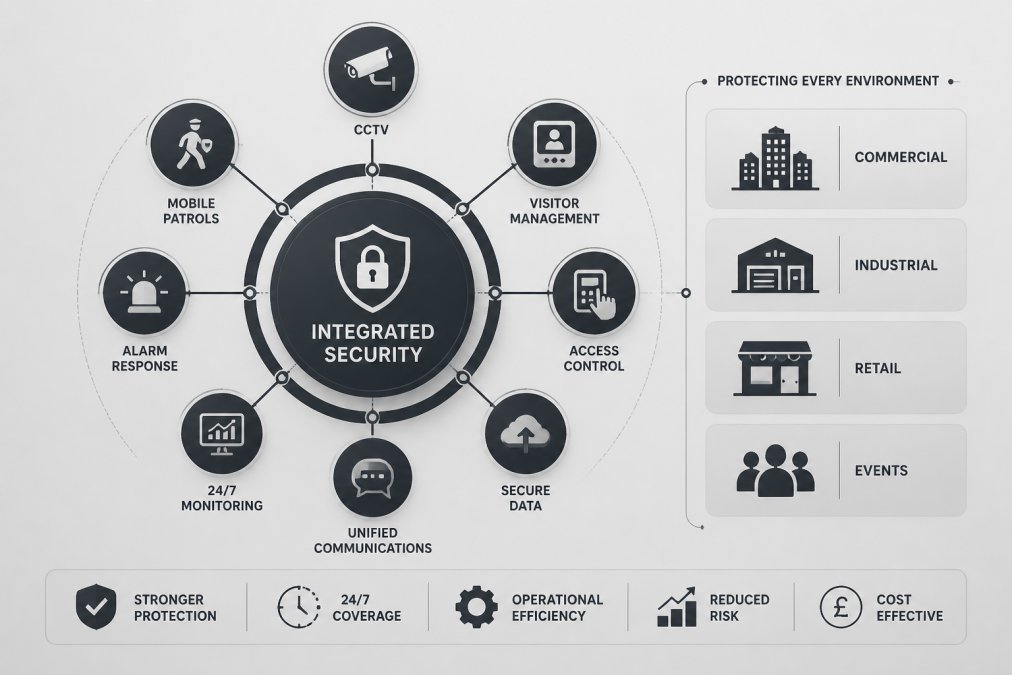
Integrated security for businesses is a unified approach that combines access control, video surveillance, alarm systems, and centralized management into one cohesive platform. Rather than operating separate systems that don't communicate, integrated security businesses connect all physical security components so they work together seamlessly.
Think of it this way: a traditional setup has your CCTV footage stored in one place, your access logs in another, and your alarm alerts going somewhere else entirely. Staff have to jump between systems to piece together what happened. Integrated security eliminates that friction. When motion is detected on camera, the system automatically checks who accessed that area and when. If an alarm triggers, the video footage pulls up instantly. Everything speaks the same language.
This matters because security isn't just about having the right tools, it's about how fast you can respond when something goes wrong. A retail store with integrated security can identify a theft, pull the relevant footage, and cross-reference it with access records in minutes. Without integration, that same investigation takes hours.
Tupper Security helps businesses across South-East Queensland that started with fragmented systems discover the real cost isn't the technology, it's the wasted time and missed incidents that come from systems that can't talk to each other.
Integrated Security System Components
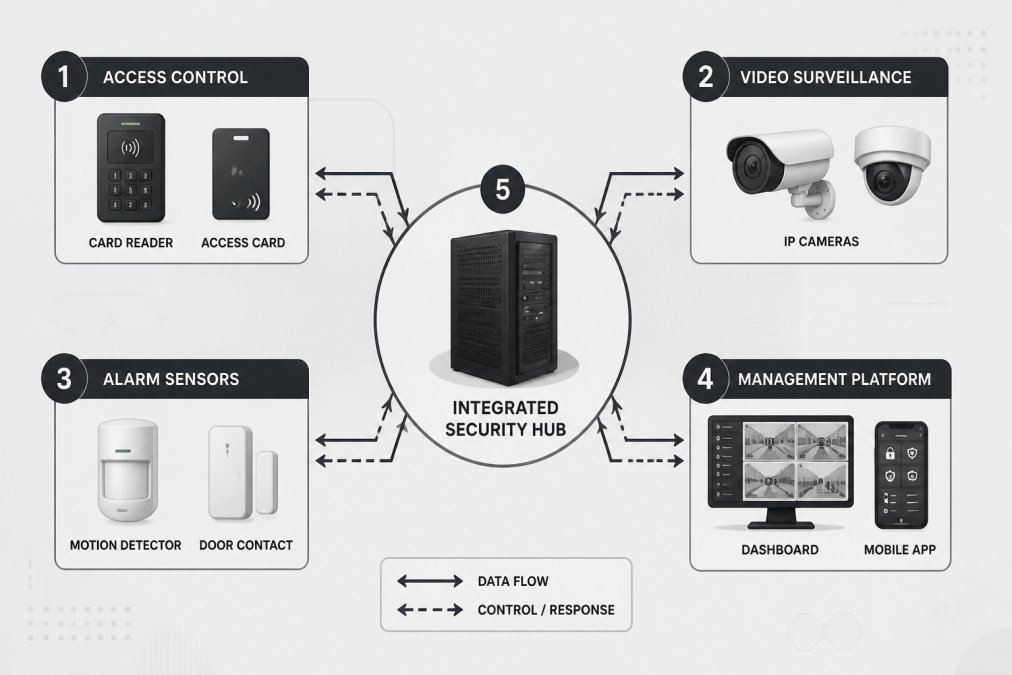
An effective integrated security setup rests on three core pillars: access control, video surveillance, and intruder detection. Each serves a specific purpose, but their real power emerges when they're connected.
Access Control Systems
Access control determines who gets in, where they can go, and when. Instead of traditional keys or basic locks, modern access control uses credential readers, card swipes, biometric scanners, or mobile credentials, that log every entry and exit.
The key advantage is auditability. Every access event creates a timestamped record. If something goes missing from a restricted area, you know exactly who was there. For multi-site operations, you can enforce consistent access policies across all locations. A manager can revoke someone's access instantly from a central dashboard rather than having to physically change locks.
Access control also prevents tailgating, when unauthorised people slip through doors behind legitimate users. Proper access systems require individual authentication, making this nearly impossible.
Video Surveillance and CCTV
CCTV provides the visual record. Modern IP-based surveillance offers high-resolution footage that's remotely accessible, so you can monitor sites in real time from anywhere. Unlike older analogue systems, IP cameras integrate directly into your network infrastructure.
The value goes beyond simple recording. High-quality footage helps verify incidents, supports insurance claims, and provides evidence for law enforcement when needed. Remote accessibility means you can check on a site instantly if an alarm triggers, rather than waiting for someone to arrive on location.
Intruder Detection and Alarm Systems
Alarm systems detect unauthorised entry through door and window sensors, motion detectors, and glass break sensors. When triggered, they alert your monitoring centre, which can dispatch a response immediately.
In isolation, an alarm is just a notification. But integrated with access control and CCTV, it becomes intelligent. The system knows who should be in that area at that time. If motion is detected in a locked room at 2 AM, the system can cross-reference access logs to confirm whether someone with legitimate credentials is present. This eliminates false alarms and speeds up genuine incident response.
Access Control and CCTV Integration
The most powerful combination is linking access control directly to video surveillance. When these two systems talk, you gain context that either one alone cannot provide.
Here's the practical difference: someone accesses a secure room using a valid credential. Moments later, something from that room goes missing. With integrated systems, you pull up the footage from that exact time window automatically, no guessing about when to look. The access log tells you who it was, the video confirms what they did, and you have a complete incident record in minutes.
For retail environments, this integration can help identify internal shrinkage that camera footage alone might miss. A staff member with legitimate access might pocket merchandise. The footage shows them in the area, but without access logs, it can be difficult to prove they weren't supposed to be there. Integration can help reveal patterns, such as accessing the stockroom at times when they weren't scheduled to work.
Multi-site operations benefit enormously. A manager can see access patterns across all locations, spot anomalies, and pull relevant footage without leaving their desk. Consistency improves because policies apply uniformly across every site.
Benefits of Integrated Security Systems
Centralized Management and Real-Time Monitoring
A single dashboard replaces multiple systems. You see access events, alarm status, and camera feeds all in one place. Real-time monitoring means you know what's happening at your site right now, not hours later when you review logs.
This centralization saves time daily. Instead of logging into three separate systems, staff check one interface. It also reduces training burden, new security personnel learn one system, not three.
For businesses spread across multiple locations, centralised management is transformative. Head office can enforce security policies consistently, monitor compliance, and respond to incidents across all sites from one control centre.
Faster Incident Response and Threat Detection
When an alarm triggers, response time matters enormously. Integrated systems eliminate delays caused by staff hunting for relevant information across disconnected platforms.
The moment an alarm fires, your monitoring centre sees the access history for that area and can pull live camera footage simultaneously. They can verify whether an actual breach occurred, assess the threat level, and dispatch the right response immediately. This might be the difference between catching an intruder and losing them in the time it takes to manually search for video footage.
Threat detection improves too. Integrated systems can flag unusual patterns, someone accessing areas they rarely visit, access attempts at odd hours, or repeated failed credential attempts, and alert staff proactively rather than waiting for an incident to occur.
Improved Operational Efficiency
Beyond security, integration simplifies day-to-day operations. Visitor management becomes simpler when access control integrates with your scheduling system. Temporary credentials can be issued for contractors, revoked automatically when their work ends, and logged for compliance purposes.
Staff movement becomes transparent. If someone reports a missing item, you can trace who accessed that area and when without manual investigation.
How Integrated Security Works in Practice
Data Consolidation and System Interoperability
Integration requires systems to share data in real time. This means your access control platform, CCTV system, and alarm monitoring must use compatible protocols, typically IP-based standards that allow them to communicate over your network.
Automated Workflows and Alert Verification
Integration enables automation that would be impossible with separate systems. Rules can trigger automatically: if an alarm sounds in the server room at 3 AM and no one with access credentials is present, immediately alert the monitoring centre and lock down the area.
Implementation and Scalability Considerations
Assessing Your Current Security Infrastructure
Before integrating, understand what you currently have. Do your systems use IP-based technology or older analogue equipment? Are they from the same manufacturer or different vendors? Can they communicate via standard protocols?
Scaling for Small Businesses and Multi-Site Operations
Small businesses often hesitate about integrated security, assuming it's only for large enterprises. In reality, integration scales down effectively. A single-site retail store can start with integrated access control and CCTV, then add alarm monitoring as needs grow. The system grows with you.
Cost-Benefit Analysis and ROI
Integration requires upfront investment in compatible hardware and software, plus professional installation and configuration. The ROI comes from reduced operational costs and improved incident response.
Cybersecurity and Compliance in Integrated Systems
Integration creates new security considerations. When physical security systems connect to your network, they become part of your cyber risk profile (Checking your browser). An attacker who breaches your network might access CCTV footage or modify access control settings.
Frequently Asked Questions
What does integrated security mean for commercial operations?
Integrated security means your access control, CCTV, alarm systems, and visitor management work as one unified platform rather than separate, siloed systems. Instead of checking different software to see who entered a building, what the cameras recorded, and whether an alarm triggered, you see everything in one dashboard. This unified approach reduces response time, eliminates blind spots, and makes it easier to investigate incidents because all data, entry logs, video, alarm records, connects automatically.
Is integrated security cost-effective for small businesses?
Yes, particularly when you're consolidating systems you already own or planning to install new ones. Rather than paying separate monitoring fees, software subscriptions, and hardware maintenance for each system, integrated security reduces operational overhead through centralised management. Small businesses benefit most when they assess their current setup with a professional site risk assessment, often you can integrate existing equipment rather than replacing everything. The ROI comes from faster incident response, reduced false alarms, and fewer staff hours spent managing multiple platforms.
How do integrated security systems improve response times?
When an intruder is detected, an integrated system automatically triggers video playback, sends an alert to your monitoring centre with the entry point and timestamp, and logs the access control data, all simultaneously. Your response team sees the threat in context rather than investigating three separate systems sequentially. This parallel processing typically cuts response time significantly. Documented audit trails also help responders understand the threat immediately, whether it's an unauthorized entry, a breach at a specific access point, or a false alarm that can be cleared without dispatch.
What are the cybersecurity risks of integrating physical security systems?
When systems are networked together, they share a common infrastructure, which means a breach in one can potentially affect others. IP-based security systems (CCTV, access control) are vulnerable to unauthorised remote access if not properly secured with strong authentication and encryption. Integrated platforms must enforce strict security protocols: role-based access, audit trails for who accessed what data and when, regular software updates, and network segmentation. Ensure your provider implements these protections and complies with relevant data protection frameworks before integration.