 how-to
Mobile Security Patrol: How It Works & Why It Matters
Table of Contents
- What Is Mobile Security Patrol?
- How Mobile Security Patrol Services Work
- Mobile Patrol Reporting Procedures
- Mobile Patrol Security Cost Considerations
- Mobile Patrol Security vs Static Guard: Which Approach Suits Your Site
- Key Benefits of Mobile Security Patrols
- Industries and Properties That Benefit Most
- Legal and Liability Implications
- Frequently Asked Questions
Last Updated: September 21, 2026
What Is Mobile Security Patrol?
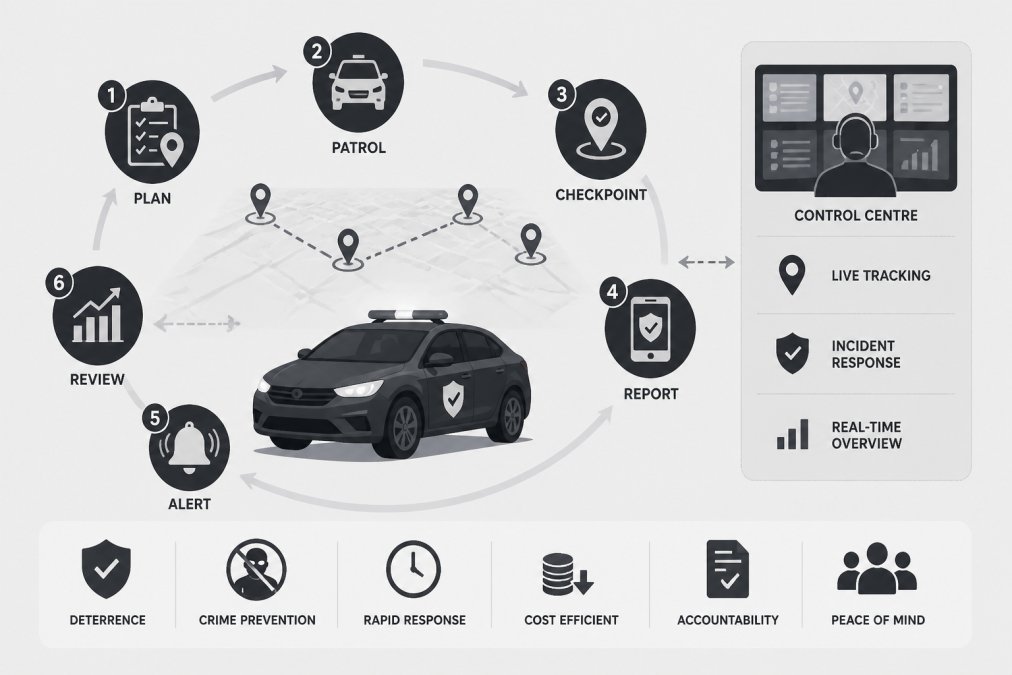
Mobile security patrol is a proactive security service where licensed security officers conduct regular inspections of your property in marked patrol vehicles. Unlike static guards who stay in one location, mobile patrol officers move between multiple sites or across different areas of a single property, creating a visible deterrent and responding to incidents as they arise.
The service combines scheduled inspections with random patrol intervals to keep potential offenders unpredictable about when security will be present. Officers conduct premises monitoring, document findings in detailed patrol logs, and report any security breaches or suspicious activity in real time.
At Tupper Security, we tailor mobile patrol routes to match how your site actually operates. This means patrols focus on high-risk areas during peak vulnerability periods, not generic schedules that miss the threats that matter most to your business.
How Mobile Security Patrol Services Work
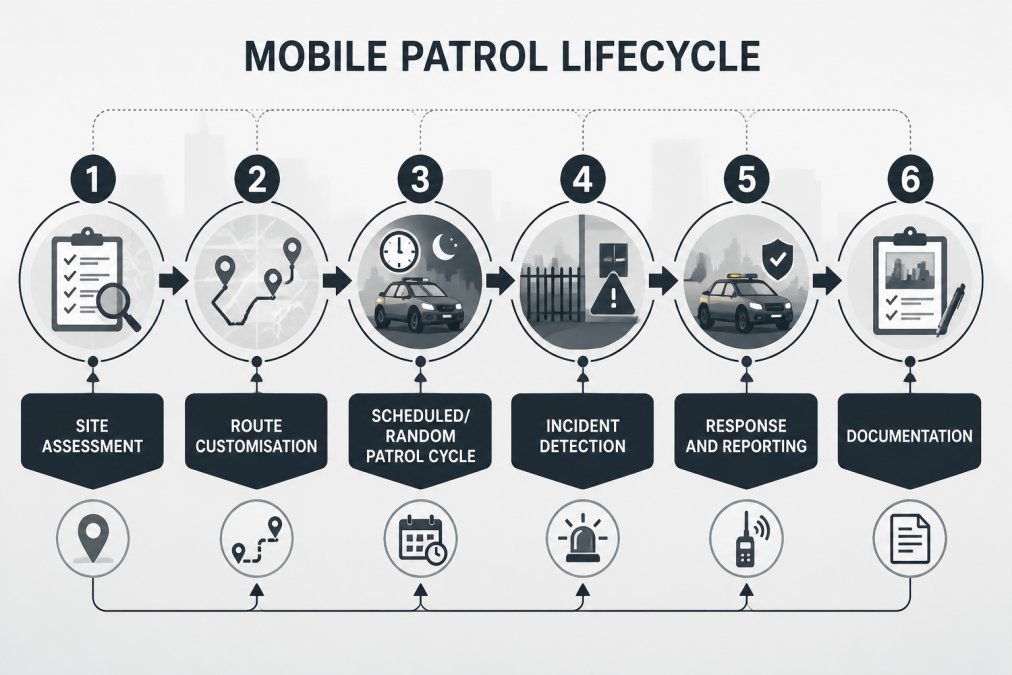
Mobile patrol services follow a structured process designed around your specific site risks and operational needs. The workflow begins long before the first patrol vehicle arrives.
Pre-Deployment Risk Assessment
Before any patrol begins, a thorough risk assessment identifies the vulnerabilities unique to your property. Security professionals evaluate building layouts, identify high-risk entry points, assess lighting and surveillance coverage, and understand your operational schedule.
This assessment determines patrol frequency, route customisation, and which areas require closer attention.
Scheduled vs. Random Patrol Intervals
Most mobile patrol services use a combination of both approaches. Scheduled inspections create routine touchpoints at predictable times, often nightly patrols or specific times when your site is closed. Random intervals add unpredictability.
Real-Time Monitoring and Dispatch
Modern mobile patrol services integrate with your alarm systems and CCTV networks. When an incident occurs, an alarm trigger, motion detection, or a security breach, the patrol vehicle nearest to your property receives immediate dispatch.
Mobile Patrol Reporting Procedures
Every patrol generates documentation. Officers log their arrival and departure times, note any suspicious activity, record equipment condition, and photograph any damage or security concerns. This audit trail serves multiple purposes: it proves patrols occurred, it identifies emerging issues before they escalate, and it provides evidence if a security incident occurs.
Mobile Patrol Security Cost Considerations
Mobile patrol security cost varies based on property size, patrol frequency, vehicle type, and response requirements. A single nightly patrol of a small retail store costs less than multi-site monitoring across three warehouses. Random patrols add complexity but increase effectiveness.
Mobile Patrol Security vs Static Guard: Which Approach Suits Your Site
Mobile patrol security and static guard services serve different needs. A static guard remains on-site, providing continuous presence and immediate response to any disturbance. This is ideal for high-value sites, construction projects with valuable equipment, or venues requiring a visible security presence throughout operating hours.
Key Benefits of Mobile Security Patrols
Mobile patrols deliver several concrete advantages. They create a physical deterrent through marked patrol vehicles and visible security presence. Criminals avoid properties they know are actively monitored.
Industries and Properties That Benefit Most
Retail stores benefit from documented loss prevention and visible deterrence during closing hours. Warehouses and logistics facilities gain cost-effective multi-site monitoring. Construction sites need equipment protection during non-working hours. Multi-tenant commercial properties require consistent premises monitoring across shared spaces.
Legal and Liability Implications
Mobile security patrol services operate within a strict regulatory framework, and understanding the legal boundaries between your responsibilities and your provider's is essential before engaging a service.
Licensing and Regulatory Requirements
In Australia, all security officers conducting mobile patrols must hold a current security licence issued under state-based legislation. In Queensland, for example, security officers must hold a Class 1 or Class 2 licence issued by the Queensland Office of Regulatory Policy, with mandatory training in conflict resolution, emergency response, and legal authority limitations.
Insurance and Indemnity
Your patrol provider must carry two critical insurance policies: professional indemnity insurance (covering negligence or failure to perform) and public liability insurance (covering injury or property damage caused by the security officer). Request certificates of currency for both before signing any contract.
Contractual Protections and Risk Allocation
Your service agreement with the patrol provider should clearly define:
- Scope of service: Exactly which properties, areas, and times are covered. Vague language like "regular patrols" creates disputes if an incident occurs during an uncovered period.
- Response time commitments: What is the guaranteed maximum response time to an alarm? Is it different for scheduled vs. random patrols? What happens if the provider fails to meet the commitment?
- Liability caps: Most providers limit their liability to the monthly fee paid. This means if a $100,000 theft occurs and the patrol service failed to detect it, your recovery is capped at one month's service cost. Negotiate higher caps for high-value properties.
- Exclusions: What situations is the provider not responsible for? (e.g., acts of war, natural disasters, or incidents occurring outside patrol hours).
- Incident reporting timelines: How quickly must the provider notify you of any incident or security breach?
- Data and footage retention: How long does the provider retain patrol logs, incident reports, and any CCTV footage they access? Who owns the data?
- Termination and transition: What happens to your security records and patrol documentation if you end the contract?
Your Duty of Care and Documentation
Engaging a patrol service does not absolve you of your own duty of care. If a security incident occurs on your property, you may face claims from injured parties, employees, or customers. Your defence relies on demonstrating that you took reasonable precautions, which includes:
- Maintaining detailed patrol logs and incident reports (your provider should supply these).
- Keeping CCTV footage and access logs for the relevant period.
- Documenting any known security vulnerabilities and how the patrol service was briefed on them.
- Maintaining records of the provider's licensing, insurance, and training credentials.
- Showing that you reviewed patrol reports regularly and acted on any identified issues.
Specific Risks and Mitigation
Certain scenarios create heightened legal exposure:
- Trespass or false imprisonment: If a patrol officer detains someone they suspect of theft or trespassing, and that person is later found to be innocent, you may face a civil claim. Ensure your contract specifies that officers must contact police before detaining anyone and that they understand their legal authority limits.
- Assault or excessive force: If a patrol officer uses force beyond what is legally justified, both the officer and you (as the property owner who engaged them) may face criminal or civil liability. Verify that your provider has comprehensive training in conflict de-escalation and use-of-force policies.
- Data privacy: If patrol officers access your CCTV footage or internal security systems, they handle personal data. Ensure your provider complies with relevant privacy legislation. Ask how they protect footage and incident data from unauthorised access.
- Failure to respond: If an alarm is triggered and the patrol service fails to respond (vehicle breakdown, miscommunication, or negligence), and a theft or damage occurs, you may have a claim against the provider. However, recovery is often limited to the liability cap in your contract. This is why response time guarantees and penalty clauses matter.
What to Ask Your Provider
Before signing, ask these specific questions:
- Are all officers licensed? Can you provide licence numbers and state regulator confirmation?
- What is your professional indemnity and public liability insurance coverage, and can you provide current certificates?
- What is the guaranteed maximum response time to an alarm, and what happens if you miss it?
- What is your liability cap, and can it be negotiated for high-value properties?
- How do you train officers on legal authority, use of force, and conflict de-escalation?
- How long do you retain patrol logs and incident reports, and who owns that data?
- Do you comply with the Privacy Act 1988 and state privacy legislation? Can you provide a privacy policy?
- What happens if an officer is injured on my property, does your insurance cover it, or do I need additional coverage?
Frequently Asked Questions
What does mobile patrol security actually do on site?
Mobile security patrols conduct scheduled or random inspections of your property, checking for signs of unauthorised access, damage, or suspicious activity. Officers verify access points, monitor CCTV systems remotely, document findings, and respond immediately to alarms or security breaches. Licensed security personnel are trained to assess risk, report incidents in real-time, and escalate emergencies to emergency services if required. The patrol presence itself acts as a visible deterrent to crime.
How do mobile patrol response times compare to static guards?
Mobile patrols cover multiple sites efficiently, reaching each location at scheduled or unpredictable intervals. Static guards remain on one site continuously. Mobile patrols are cost-effective for properties that don't require constant on-site presence, while static guards provide uninterrupted monitoring. Response time depends on patrol route design and proximity, local operators with depots nearby typically achieve faster alarm response than distant competitors.
What qualifications must mobile security officers hold?
In Australia, mobile security officers must hold a current Queensland Security Licence issued under the Security Providers Act 1997. They must complete approved security training, pass background checks, and maintain professional liability insurance. Licensed operators are trained in incident response, legal protocols, and site-specific security procedures. Always verify your security provider holds valid QLD licensing.
Is mobile patrol security more cost-effective than hiring a full-time on-site guard?
Mobile patrols typically cost less than static guards because one team covers multiple properties, reducing per-site labour costs. Pricing depends on patrol frequency, route complexity, property size, and response time requirements. Static guards suit high-risk sites needing continuous presence; mobile patrols suit multi-site operations or properties with intermittent risk periods. Request a quote to compare options for your specific site and operational needs.