 how-to guide
How to Verify Alarm Response Times: A Practical Guide
Table of Contents
- What You Need Before You Start Verifying Alarm Response Times
- Step 1, Understand What Alarm Response Times Actually Measure
- Step 2, Review Australian Standard AS 2201.2 Compliance Requirements
- Step 3, Test Your Alarm System End-to-End With Your Provider
- Step 4, Evaluate Your Monitoring Centre's Verification Process
- Step 5, Use Video Verification Security to Reduce Dispatch Delays
- Step 6, Address False Alarm Reduction to Protect Response Priority
- Step 7, How to Verify Alarm Response Times Across Multiple Sites
Last Updated: July 31, 2026
Knowing how to verify alarm response times is one of the most practical steps a property owner or operations manager can take to protect their site, yet most people accept a provider's claims without testing them. At Tupper Security, we see this gap constantly: clients arrive with contracts promising rapid response but no documented evidence those promises hold up under real-world conditions. Below, we'll show you exactly how to measure, test, and validate every stage of your alarm response chain, from sensor activation to patrol officer arrival.
Here's what most guides get wrong: they focus on average response times. Averages are almost useless for security planning. A single delayed response at 2 AM is the one that matters, and averages hide it.
What You Need Before You Start Verifying Alarm Response Times
Preparation determines whether your verification exercise produces actionable data or just timestamps. Before running any tests, gather:
- Your current monitoring centre contract, including stated response-time commitments and service-level agreements
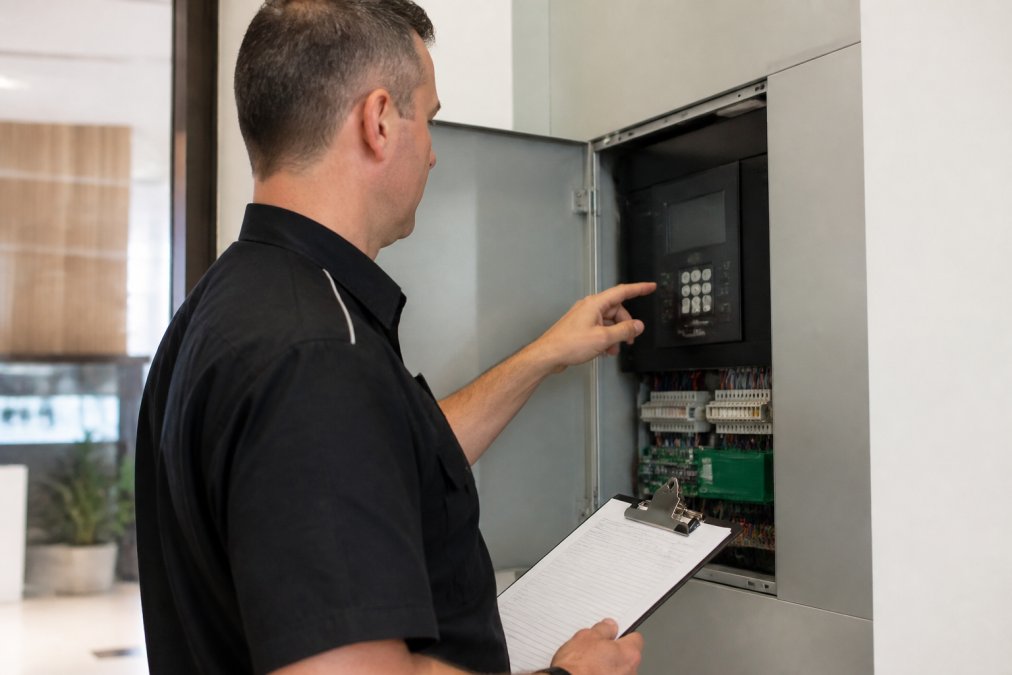
- Your alarm panel's event log access credentials for independent timestamp verification
- Contact details for your monitoring centre's compliance or operations manager
- A copy of your site's security risk assessment
- Any written correspondence where your provider has made specific response-time claims
Key Documents and Access You Should Have Ready
Without independent access to your alarm panel's event log, you are entirely dependent on your provider's self-reported data, a conflict of interest, not verification. Most modern alarm panels store timestamped records locally. Request this access before testing.
Step 1, Understand What Alarm Response Times Actually Measure
Most people assume alarm response time is simply "how long until someone arrives." The reality is a chain of distinct intervals, each with its own failure points.
Signal Transmission and Dialer Delay Explained
Signal latency is the time between an alarm activation at the sensor and the signal arriving at the monitoring centre's alarm panel. On older PSTN-based systems, dialer delay alone can consume 30 to 60 seconds before transmission begins. IP-based and cloud-connected systems reduce this significantly but introduce their own latency risks.
The full response chain:
- Sensor detects an event
- Alarm panel processes the trigger
- Signal transmits to the monitoring centre via dialler, IP, or cellular path
- Monitoring centre receives and acknowledges the signal
- Operator performs incident verification
- Dispatch instruction is issued to a patrol officer
- Patrol officer travels to site
- On-site attendance is confirmed and logged
Worst-case response time is the sum of the slowest realistic value at each stage, not the average.
Worst-Case Response Time vs Average Response Time
Worst-case response time is the maximum elapsed time your system could take to deliver a response agent to your site under normal operating conditions. It is the figure that matters for security planning, not the average.
Average response time is useful for identifying systemic trends. Worst-case response time tells you whether your system will protect you on the worst night of the year. Security engineering frameworks, including those referenced in the Australian Security Industry Association Limited guidance on alarm monitoring standards, consistently recommend designing to worst-case, not average, performance.
| Stage | Typical Duration | Worst-Case Risk Factor |
|---|---|---|
| Sensor to panel | 1-5 seconds | Panel fault or tamper |
| Panel to monitoring centre | 5-60 seconds | Dialer delay, IP outage |
| Incident verification | 30-120 seconds | Operator workload, false alarm screening |
| Dispatch to patrol officer | 1-5 minutes | Officer availability, shift change |
| Patrol travel to site | 5-30+ minutes | Traffic, location, time of day |
| On-site attendance confirmation | 1-3 minutes | Access issues, site complexity |
Step 2, Review Australian Standard AS 2201.2 Compliance Requirements
Australian Standard AS 2201.2 governs the design and installation of intruder alarm systems in Australia and directly informs acceptable response frameworks for monitored security systems.
The standard sets requirements for signal transmission paths, monitoring centre grading, and back-to-base communication protocols. Compliance with AS 2201.2 is not optional for professionally installed monitored systems. According to Standards Australia's AS 2201 series on intruder alarm systems, the standard specifies minimum performance criteria for both alarm system hardware and monitoring centre operations.
Practically: if your provider cannot confirm their monitoring centre operates to AS 2201.2 Grade A or B standards, their response-time commitments are unverifiable against any recognised benchmark. Ask for written confirmation of their monitoring centre's grading before accepting any response-time claim.
Step 3, Test Your Alarm System End-to-End With Your Provider
Theory and documentation only tell you what should happen. A controlled end-to-end test tells you what actually happens.
Coordinate a scheduled test activation with your monitoring centre. Notify them of the test window but not the exact activation time, so their operator response reflects normal conditions rather than staged performance.
How to Run a Standardised Test and Log the Results
Follow this sequence:
- Record the exact time you manually trigger the alarm at the panel, using a time source synchronised to an atomic clock or GPS reference
- Note the time your monitoring centre contacts you for verification
- If a patrol response is included in your contract, record the time the officer notifies you of arrival at the site boundary and again at on-site attendance
- Pull your alarm panel's event log immediately after the test and record the panel-side timestamps
- Request the monitoring centre's signal receipt timestamp and compare it against your panel log to calculate signal transmission latency
- Document all figures in a test log with the date, time, personnel involved, and weather conditions
Run this test at a minimum of three different times: business hours, evening, and overnight. Response performance varies significantly by time of day, particularly for patrol dispatch.
DIY Verification Metrics vs Professional Audit Benchmarks
DIY verification gives you raw timestamps. A professional system audit gives you those timestamps measured against a safety integrity level framework, which assigns acceptable latency thresholds based on your site's specific threat profile. A retail store in a busy precinct has different worst-case response time requirements than an unmanned construction site at night.
DIY testing is a reasonable starting point for any property owner. A professional audit, conducted by a licensed security consultant, produces defensible documentation that satisfies insurer requirements and regulatory scrutiny.
Step 4, Evaluate Your Monitoring Centre's Verification Process
The monitoring centre is where most response delays originate and is the stage least visible to the client.
Verified vs Unverified Alarms and Why the Difference Matters
A verified alarm is one where the monitoring centre has confirmed, through video verification, cross-zone sensor analysis, or audio detection, that an actual threat event is occurring before dispatching a response. An unverified alarm is treated as a potential activation without confirmation.
This distinction has direct consequences for dispatch priority and emergency services involvement. Police deprioritise responses to unverified alarms due to high false alarm rates. An unverified activation may result in a patrol officer attending without police backup, which changes the risk profile of the response entirely.
Video verification security is now the standard approach for reducing dispatch delays on genuine activations. When a monitoring centre operator can view live or recorded footage at alarm activation, they can confirm or dismiss a threat within seconds rather than minutes.
Latency in Cloud-Based Alarm Systems
Cloud-based alarm systems introduce a specific latency risk: the round-trip time for signal data to travel from your alarm panel to a cloud server, be processed, and return a dispatch instruction to the monitoring centre's platform.
Under normal network conditions, this latency is negligible. Under high-load conditions, ISP outages, or cloud platform degradation, it can add meaningful delay. A common mistake is assuming cloud connectivity is inherently faster than traditional back-to-base communication.
Ask your provider whether their cloud-based system includes cellular failover for signal transmission. If the primary IP path fails and there is no cellular backup, your alarm activation may never reach the monitoring centre.
Step 5, Use Video Verification Security to Reduce Dispatch Delays
Video verification security is the single most effective operational change you can make to improve verified response rates and reduce dispatch delays. When a monitoring centre operator can view the activation zone in real time, the incident verification stage shrinks from minutes to seconds.
Your CCTV system must be integrated with your alarm panel so that a sensor trigger automatically pushes the relevant camera feed to the monitoring centre's operator console. A CCTV system operating independently of your alarm panel does not enable real-time monitoring at activation.
High-resolution IP surveillance cameras with remote access capability are the baseline for effective video verification. According to ASIS International's guidance on integrated security systems, integrated security systems that combine alarm, access control, and video verification produce measurably faster verified response outcomes than siloed systems.
Step 6, Address False Alarm Reduction to Protect Response Priority
False alarms are the single biggest threat to your response priority. A site with a high false alarm rate will, over time, receive slower patrol dispatch and reduced police cooperation, regardless of what your contract says.
False alarm reduction is a direct investment in the reliability of your verified response when a genuine incident occurs. Common causes include poorly calibrated passive infrared sensors, alarm panels not updated after site layout changes, staff failing to follow correct procedures, and environmental factors such as air conditioning drafts triggering motion sensors.
False Alarm Penalties Under Queensland Regulations
Queensland property owners should be aware that Queensland Police Service has a formal policy on responses to monitored alarm activations, and repeated false alarms can result in a site being placed on a restricted response list. Sites with documented false alarm histories receive lower dispatch priority, which directly undermines the value of your monitoring contract.
Reviewing Queensland Police Service guidelines on monitored alarm responses will give you the current thresholds and consequences that apply to your site.
The practical implication: false alarm reduction is a security protocol issue that directly affects your worst-case response time.
Step 7, How to Verify Alarm Response Times Across Multiple Sites
Managing alarm response verification across multiple sites requires maintaining consistent standards, documentation, and audit trails across sites that may have different alarm systems, monitoring centres, and patrol coverage areas.
A structured approach requires:
- A standardised test log template used consistently across all sites
- A central register of each site's monitoring centre contract terms and AS 2201.2 compliance grade
- Scheduled test rotations so no site goes more than 90 days without a documented response-time test
- A single point of accountability for reviewing and acting on test results
Multi-site consistency is where most security arrangements break down. Different teams, different standards, and different providers produce incomparable data that makes genuine performance benchmarking impossible.
Traffic, Location, and Patrol Dispatch Factors in South-East Queensland
Patrol dispatch times in South-East Queensland vary significantly by location. A site in central Ipswich with a local depot nearby will receive a materially different worst-case patrol response than a site on the urban fringe of Brisbane's western corridor during peak-hour traffic.
Tupper Security operates from a local Silkstone depot, which means patrol dispatch to Ipswich and the immediate corridor reflects actual local travel times rather than a regional average. When verifying response times across multiple South-East Queensland sites, document the driving distance from your provider's nearest patrol base to each site, and test during peak and off-peak periods separately. The gap between those two results is your real worst-case response window.
Verifying alarm response times requires more than accepting a provider's word. It demands documented testing, independent timestamp comparison, and honest assessment of the entire signal chain from sensor activation to on-site attendance. For property owners and operations managers across South-East Queensland who need that level of accountability, Tupper Security provides 24/7 monitoring and dispatch, multi-class licensed operators, and a local Silkstone depot that makes rapid response claims verifiable rather than aspirational. Request a quote from Tupper Security and get response-time commitments backed by a documented, testable process.
Frequently Asked Questions
What does Australian Standard AS 2201.2 say about alarm response times?
Australian Standard AS 2201.2 covers the requirements for monitoring centres that receive and act on alarm signals. It sets out how back-to-base monitoring operations should handle signal transmission, incident verification, and patrol dispatch procedures. When verifying alarm response times, ask your provider to confirm their monitoring centre is operated in accordance with AS 2201.2, and request documentation showing their compliance status and event logging practices.
How do false alarms affect my security provider's response times?
False alarms reduce the priority assigned to future alarm activations and can result in delayed patrol dispatch. In Queensland, repeated false alarms may attract penalties from Queensland Police Service and lead monitoring centres to downgrade a site's response classification. Effective false alarm reduction, through proper sensor calibration, staff training, and video verification security, helps ensure your alarm events are treated as genuine threats and responded to promptly every time.
What is the difference between verified and unverified alarm response?
An unverified alarm triggers dispatch based solely on the alarm activation signal, with no additional confirmation. A verified response means the monitoring centre has used sensor data, video footage, or audio confirmation to confirm a likely genuine incident before dispatching a response agent or contacting emergency services. Verified responses typically result in faster on-site attendance from police because the alarm is classified as a confirmed threat rather than a possible false alarm.
Can I test my alarm system myself, or do I need a licensed technician?
Basic end-to-end testing, triggering a zone and timing the monitoring centre's call-back, can be done by a site owner after notifying your monitoring centre first. However, a thorough system audit covering signal latency, dialer delay, back-to-base data relay integrity, and compliance with AS 2201.2 should be conducted by a licensed security technician. DIY checks are useful for routine verification, but professional testing provides the documented benchmarks needed for insurance and compliance purposes.
What factors affect alarm response times in South-East Queensland?
Key factors include signal transmission latency from your alarm panel to the monitoring centre, the time taken for incident verification, patrol dispatch routing from the nearest depot, and real-time traffic conditions across the region. Properties in outer corridors such as Ipswich may experience longer travel times than inner Brisbane sites. Choosing a provider with a local depot, such as Silkstone, and a verified response protocol significantly reduces worst-case response time compared to providers operating from distant locations.
How do I evaluate whether a security provider's response time claims are accurate?
Ask for logged response data from recent alarm activations at comparable sites, not just advertised averages. Request a live or witnessed test during the assessment phase and record the time from alarm activation to monitoring centre contact and to patrol on-site attendance. Check whether the provider's monitoring centre complies with AS 2201.2 and ask specifically about their worst-case response time under high-demand conditions. Providers with a local depot and dedicated patrol fleet will generally deliver more consistent results.
This article was written using GrandRanker