 comparison
Local vs National Security Providers: Choose Right
Table of Contents
- Local vs National Security Providers: Key Differences
- Security Guard Service Response Times: What to Expect
- Private Security Licensing Requirements in Queensland
- Commercial Security Risk Assessment and Planning
- Pros and Cons: Local Security Providers
- Pros and Cons: National Security Providers
- How to Choose Between Local and National Providers
- Frequently Asked Questions
Last Updated: September 30, 2026
Local vs National Security Providers: Key Differences
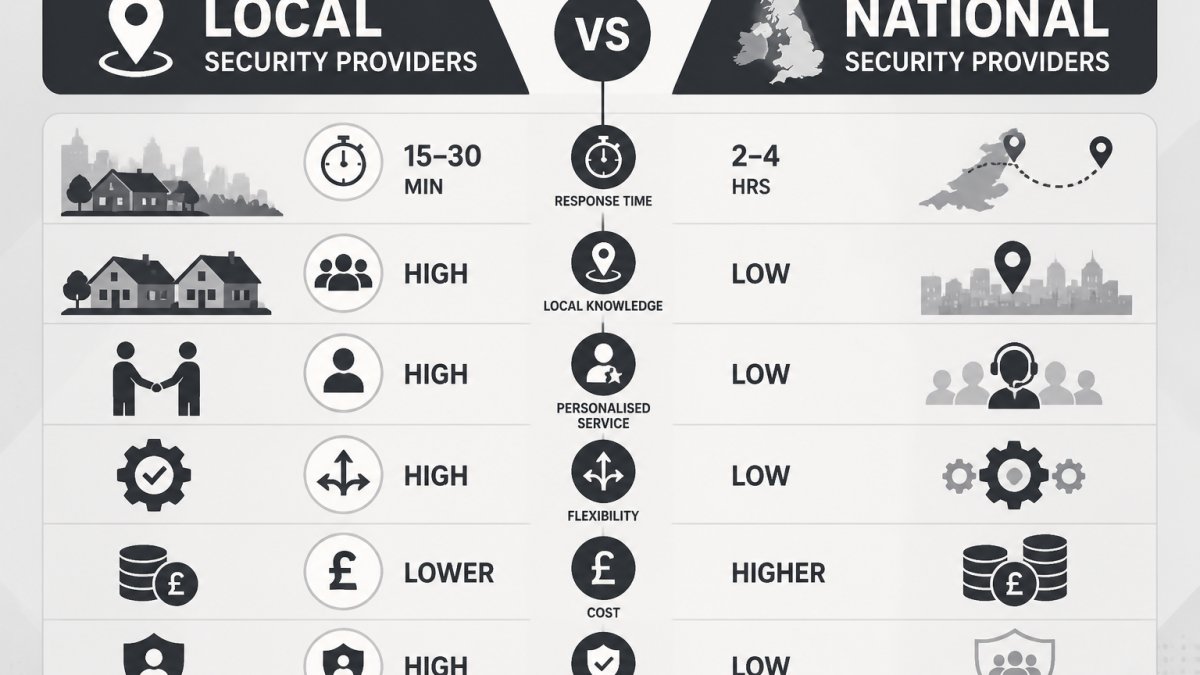
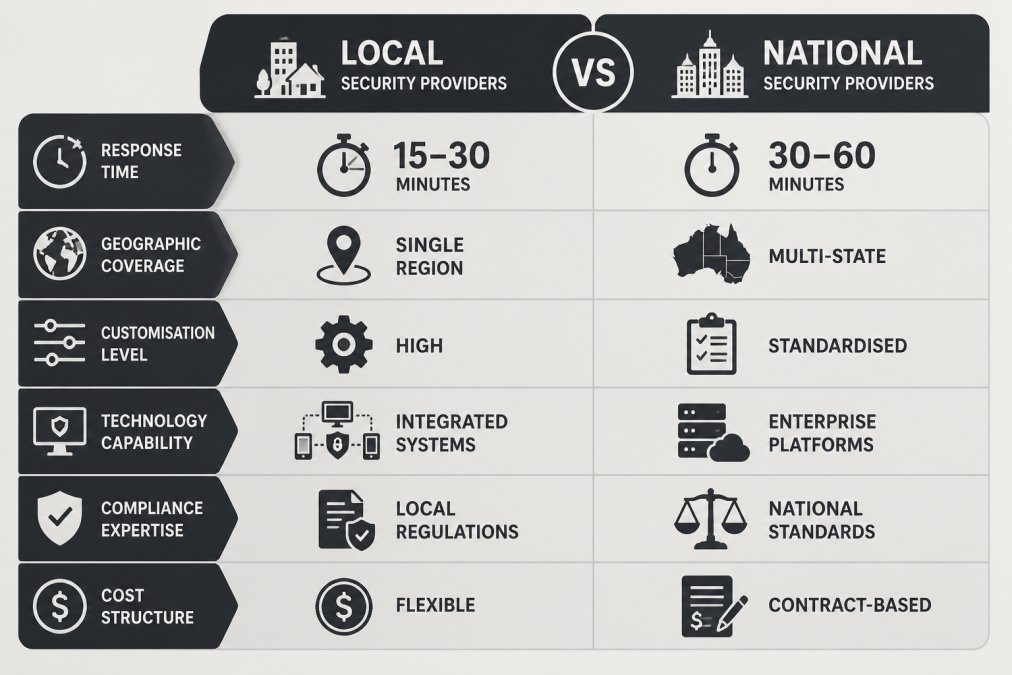
The choice between local and national security providers hinges on response time, customisation, and local knowledge. Local providers operate within a defined geographic area, while national providers maintain infrastructure across multiple states with standardised service models.
This affects response speed and familiarity with local threats. Tupper Security operates from Silkstone with deep knowledge of South-East Queensland; national operators bring multi-state resources and technology integration suited to larger enterprises.
Local providers excel at rapid response and customisation; national providers deliver consistency and advanced technology. The right choice depends on your operation size, footprint, and priorities.
Security Guard Service Response Times: What to Expect
Response time is the most misrepresented metric in security contracts. Understanding what actually drives it is essential to making the right choice.
How Response Time Actually Works
Response time has multiple stages, and providers often quote only the stage that makes them look fastest:
- Detection to dispatch (alarm triggers → operator sends unit): typically 2-5 minutes for monitored systems
- Dispatch to mobile unit arrival (unit leaves depot → arrives on-site): this is where local and national providers diverge dramatically
- Arrival to incident containment (guard assesses situation → takes action): depends on guard training and authority
Quoted response times usually refer to dispatch-to-arrival only, in ideal conditions. Local providers achieve rapid response times from nearby depots; national providers managing multiple states may have longer response times, especially in regional areas.
Local providers often run denser depot networks, positioning units closer to client sites.
What Response Time Actually Costs You
- Retail theft prevention: 15-minute response catches shoplifters on-site; 45-minute response means they're gone. The difference can mean recovery versus write-off.
- After-hours break-ins: Early arrival secures the perimeter and preserves evidence. Delayed response gives offenders time to load and leave.
- Alarm verification: Local providers may offer faster false alarm resets; national providers may take longer, potentially increasing council fines.
- Cash handling: Delayed response to in-progress incidents results in loss. Local rapid response is genuine risk mitigation.
How to Verify Response Time Claims
Ask these specific questions:
- "What is your guaranteed maximum response time to my address, in writing?" Get location-specific commitments, not averages.
- "Does that include dispatch-to-arrival, or time from when I call?" These can differ by 10-15 minutes.
- "What happens if response time is missed?" Legitimate providers offer service credits for missed guarantees.
- "How do you handle peak demand?" Local providers with fewer clients may maintain response time better.
- "What's your actual historical response time for my postcode?" Ask for data: median and 95th-percentile times.
The Hidden Cost of Slow Response
Private Security Licensing Requirements in Queensland
Anyone providing security services in Queensland must hold appropriate licences issued under the Security Providers Act 1993 (View - Queensland Legislation). This is non-negotiable, unlicensed operators expose you to liability and legal risk.
The main licence classes are:
- Class 1: Crowd control and event security
- Class 2: Mobile patrol and response services
- Class 3: Static guarding
- Class 4: Security system monitoring and alarm response
Commercial Security Risk Assessment and Planning
A risk assessment identifies threats specific to your operation and recommends tailored controls. It should cover physical access, cash/asset locations, staff routines, historical incidents, technology gaps, and compliance obligations. The assessment should produce a written report with ranked recommendations. Local providers excel here because they understand regional threat patterns; national providers' standardised approach works better for large enterprises. After assessment, prioritise by impact and cost, a $5,000 access control system might prevent more loss than a $15,000 CCTV upgrade.
Pros and Cons: Local Security Providers
Pros: Rapid response from nearby depots, deep local knowledge, personalised service, customisation flexibility, cost-effective for single sites, easier to audit.
Pros and Cons: National Security Providers
Pros: Extensive resources, advanced AI analytics, multi-site consistency, formal documentation, regulatory compliance, handles major incidents.
How to Choose Between Local and National Providers
The choice between local and national providers isn't abstract, it's a concrete trade-off between speed and customisation on one side, and scale and standardisation on the other. The right choice depends on your operation's specific characteristics and which risks matter most to your bottom line.
Step 1: Map Your Actual Security Needs
Define what security means for your operation:
- Response-critical (retail with high shrinkage, cash handling, high-value inventory): Local providers' faster response directly reduces loss.
- Monitoring and compliance (office buildings, low-risk warehouses): National providers' standardised systems and formal documentation provide better value.
- Multi-site consistency (chain retail, franchises): National providers' single-vendor management reduces coordination overhead.
- Hybrid (some sites response-critical, others compliance-focused): Use local for high-risk sites, national for lower-risk locations.
Step 2: Calculate the Cost-Benefit Trade-Off
| Scenario | Local Provider Cost (Year 1) | National Provider Cost (Year 1) | Break-Even Point |
|---|---|---|---|
| Single site, 12-month contract | $2,400-$5,400 | $3,600-$10,800 | N/A (local cheaper) |
| Three sites, 12-month contract | $7,200-$16,200 | $8,400-$22,800 | N/A (local cheaper) |
| Five sites, 12-month contract | $12,000-$27,000 | $12,000-$28,000 | Roughly equal |
| Five sites, 36-month contract | $36,000-$81,000 | $36,000-$84,000 | Roughly equal |
Step 3: Assess Your Geographic Footprint
- Single region, single site: Local provider wins unless you need advanced technology (AI analytics, complex access control).
- Single region, 2-4 sites within 30 km: Local provider usually wins. Beyond 100 km spread, national provider becomes competitive.
- Multiple regions: National provider necessary to avoid coordination overhead and inconsistent standards.
- Hybrid (one main + secondary sites): Local for primary site, national for secondary sites.
Step 4: Evaluate Technology Requirements
- Basic monitoring and alarm response: Local and national providers equivalent.
- Advanced analytics (AI threat detection, predictive analytics): National providers have better platforms.
- Multi-site dashboard: National providers excel and save time.
- System integration (POS, inventory, HR): National providers have more pre-built integrations.
Step 5: Verify Actual Service Delivery
- Request site assessments from each provider and compare specificity of recommendations.
- Ask for references from similar operations and call them.
- Test responsiveness during sales, slow sales = slow service.
- Get response time guarantees in writing with specific address, time, and penalties for missed windows.
- Review sample incident reports for detail, photos, timestamps, and observations needed for insurance claims.
Decision Matrix
| Factor | Local Provider Advantage | National Provider Advantage | Your Priority? |
|---|---|---|---|
| Response time | 15-30 min vs 30-60 min | , | High = Local; Low = National |
| Cost (single site) | 20-40% cheaper | , | High = Local; Low = National |
| Cost (5+ sites) | , | 30-50% cheaper at scale | High = National; Low = Local |
| Customisation | Site-specific plans | Standardised processes | High = Local; Low = National |
| Technology | Basic integration | Advanced analytics & dashboards | High = National; Low = Local |
| Multi-site consistency | Requires multiple contracts | Single vendor, unified standards | High = National; Low = Local |
| Local knowledge | Deep understanding of regional threats | Generic national approach | High = Local; Low = National |
| Contract flexibility | 12-month terms, easy exit | 24-36 month terms, exit penalties | High = Local; Low = National |
The Real Decision
Frequently Asked Questions
What are the main differences between local and national security providers?
Local security providers typically offer faster response times, personalised service tailored to your specific site, and deeper knowledge of regional threats. National providers deliver consistent standards across multiple locations, advanced integrated technology, and extensive resources for complex security requirements. The choice depends on whether you prioritise rapid, bespoke response or standardised, scalable infrastructure.
How do security guard service response times differ between local and national companies?
Local providers often achieve rapid response times due to proximity and dedicated regional teams. National providers may have longer response times depending on location and current dispatch load, though they offer backup resources across multiple states. Your specific location, time of day, and the provider's depot placement significantly affect actual response times, verify commitments in writing before signing.
What private security licensing requirements apply in Queensland?
All security providers in Queensland must hold a Security Provider Licence issued by the Office of Fair Trading Queensland. Individual security officers require a Security Guard Licence. Providers must comply with the Security Providers Act 1993 and maintain current training in security protocols, incident response, and duty of care. Verify your provider's licence number and check the register to confirm active, unrestricted status before engagement.
Should I choose a local or national provider for a commercial security risk assessment?
Local providers excel at understanding your specific site layout, local crime patterns, and operational workflows, delivering highly targeted recommendations. National providers bring standardised risk assessment methodologies and access to broader threat intelligence. For single-site operations, a local provider's bespoke assessment often delivers better value. For multi-site organisations, a national provider's consistent framework may be more practical.
What should I look for in a security service agreement?
Your agreement must specify response time guarantees with defined consequences for failure, service level agreements (SLAs) for monitoring and dispatch, escalation procedures for incidents, licensing and compliance certifications, technology specifications (CCTV resolution, access control audit trails), and termination clauses. Request written confirmation of response times, geographic coverage limits, and staff continuity plans before signing. Ensure the contract aligns with your actual operational needs, not generic templates.