 how-to guide
CCTV Placement for Retail Stores: A Practical 2026 Guide
Table of Contents
- Step 1: Map Your Store Before You Mount a Single Camera
- Critical CCTV Placement for Retail Stores: Zone-by-Zone Breakdown
- How to Choose Security Cameras for Retail Australia: Specs That Matter
- Australian Regulations CCTV Retail Stores Must Follow
- Retail Loss Prevention Strategies Australia: Beyond Basic Surveillance
- Cost of CCTV Installation Retail Australia: What Shapes the Price
- Common Mistakes to Avoid with Retail CCTV Placement
- Conclusion
Last Updated: August 2, 2026
Getting CCTV placement for retail stores wrong is one of the most expensive mistakes a retailer can make. Poorly positioned cameras create blind spots that shoplifters exploit within days of opening. This guide from Tupper Security covers every placement decision you need to make, from mapping your floor plan before a single bracket goes up, to meeting your obligations under Australian privacy law.
Step 1: Map Your Store Before You Mount a Single Camera
Start with a floor plan, not a camera catalogue. The most effective CCTV placement for retail stores begins with a scaled drawing of your space, marked with every entry and exit, every POS terminal, every stockroom door, and every aisle end-cap.
Identify Blind Spots and High-Risk Zones
Blind spots cluster around tall shelving, fitting room corridors, loading dock alcoves, and corners where customers' backs face away from staff. Walk your store at 2.5 to 3 metres height and identify every line-of-sight obstruction.
High-risk zones follow a consistent pattern:
- Entry and exit points: Most retail theft happens within 3 metres of a door
- POS terminals: Cash handling and card skimming require close-range footage
- High-value merchandise bays: Jewellery, electronics, and liquor deserve dedicated coverage
- Stockroom access doors: Internal theft often originates here
- Loading docks: After-hours access is a primary vector for organised retail crime
Account for Lighting and Environmental Challenges
Lighting is the variable most retailers underestimate. A camera with excellent wide dynamic range will struggle against west-facing shopfronts at 4 PM when direct sunlight floods the entrance and leaves the interior in shadow.
Common environmental challenges include glare from glass shopfronts, fluorescent flicker in older tenancies, air conditioning vibration near camera mounts, and night-time coverage in car parks requiring true night vision or IR illuminators.
Critical CCTV Placement for Retail Stores: Zone-by-Zone Breakdown
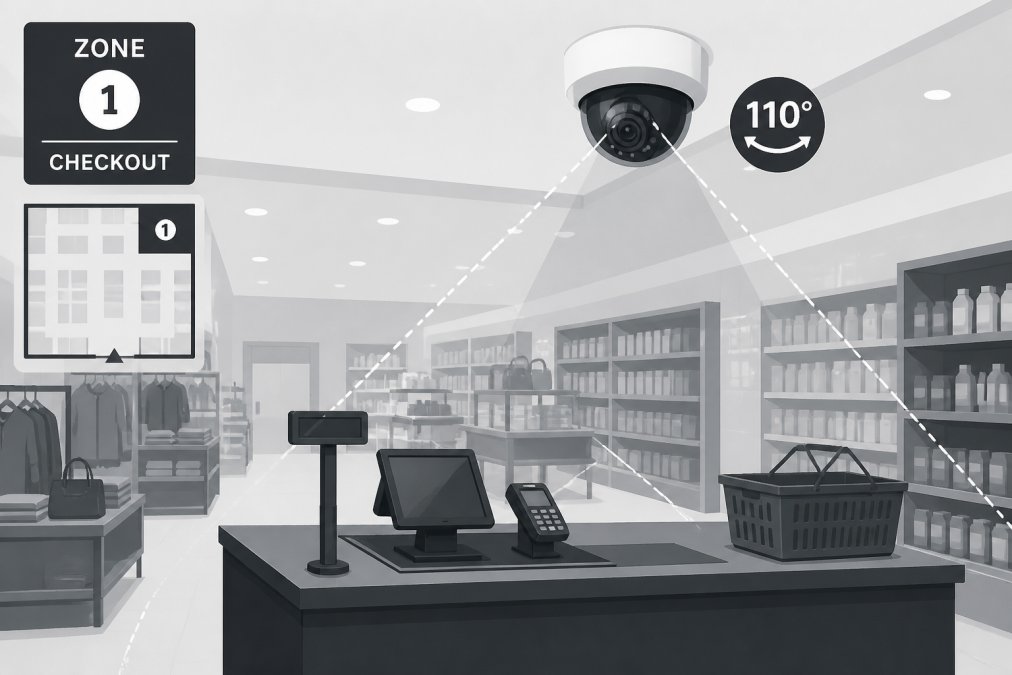
Zone-by-zone placement is the operational core of any retail surveillance design. Each zone has distinct requirements for camera type, mounting height, and field of view.
Entry and Exit Points
Every person who enters or leaves your store should be captured in a clear, face-height image. Mount cameras at approximately 2.5 metres, angled slightly downward, positioned so the frame captures the door threshold. A common mistake is mounting entry cameras too high, which produces top-of-head footage useless for incident investigation.
For stores with automatic sliding doors, use two cameras: one covering inbound traffic and one covering outbound.
Point of Sale Monitoring
POS monitoring serves two purposes: customer-facing theft prevention and internal transaction integrity. Mount one camera to capture the customer's hands and transaction area, and a second to capture the screen display and operator's hands. According to the Australian Retail Association, internal theft at the POS is a significant contributor to total shrinkage, making this dual-angle approach essential.
Stock Room and Inventory Areas
Stockrooms are where organised retail crime often originates. Place cameras to cover every entry and exit door, plus any area where high-value stock is staged before going to the floor. Access control integration creates an auditable record of who entered, when, and for how long.
High-Traffic Aisle Coverage
Use wide-angle or fisheye cameras at aisle ends, supplemented by targeted cameras on high-value bays. A 180-degree wide-angle camera mounted at ceiling height at the end of a 10-metre aisle provides workable coverage without requiring four separate units.
| Zone | Recommended Camera Type | Mounting Height | Primary Purpose |
|---|---|---|---|
| Entry/Exit | Fixed HD or varifocal | 2.4-2.6 m | Facial ID, foot traffic |
| POS Terminal | Fixed HD (dual angle) | 2.0-2.4 m | Transaction integrity |
| Stockroom Door | Fixed HD | 2.2-2.5 m | Access audit trail |
| Aisle End-Cap | Wide-angle/fisheye | 3.0-3.5 m | Situational coverage |
| High-Value Bay | Fixed 4K or varifocal | 2.2-2.8 m | Evidentiary detail |
| Car Park/Loading | PTZ or fixed IR | 3.5-5.0 m | Night vision, perimeter |
How to Choose Security Cameras for Retail Australia: Specs That Matter
Choosing the right camera means matching the spec to the zone's requirements and your network's capacity.
Resolution, Field of View, and Wide Dynamic Range
For entry, exit, and POS zones, 4K resolution is worth the bandwidth cost. For general aisle coverage, 2MP to 4MP is sufficient and significantly reduces storage and bandwidth demands.
Field of view determines how much of a scene a single camera captures. Narrow fields (30-60 degrees) give detailed coverage of small areas; wide fields (90-180 degrees) cover more space with less detail per square metre. Wide dynamic range matters most in mixed-light environments, particularly at shopfronts and near windows.
IP Cameras, Video Management Systems, and Cloud Storage
Modern retail surveillance runs on IP cameras connected to a video management system that organises footage, manages motion detection alerts, controls data retention, and provides remote monitoring. Cloud storage protects footage off-site, providing both security and compliance advantages. Motion-triggered recording, scheduled windows, and variable bitrate encoding reduce bandwidth load without compromising coverage.
Australian Regulations CCTV Retail Stores Must Follow
Australian retailers operate under a layered compliance framework. Getting this wrong exposes you to regulatory action, civil liability, and reputational damage.
Privacy Act 1988, State Surveillance Laws, and Signage Requirements
The Privacy Act 1988 administered by the Office of the Australian Information Commissioner applies to businesses with an annual turnover above $3 million. Under the Australian Privacy Principles, CCTV footage is personal information. You must collect only what is reasonably necessary, store it securely, and not use it for purposes beyond those disclosed to customers.
State-level surveillance legislation adds further obligations. In Queensland, the Invasion of Privacy Act 1971 governs surveillance devices. Retailers must not place cameras in areas where customers have a reasonable expectation of privacy, including fitting rooms and toilets.
Visible signs at every entrance informing customers that CCTV is in operation are standard practice and support your compliance position.
Data Retention, Access Control, and Compliance Audits
Industry practice and insurance requirements typically point to 30 days as a minimum retention period, with 90 days for high-risk environments. Access control to CCTV footage is a compliance requirement; footage should only be accessible to authorised personnel with access logs maintained.
Schedule annual compliance audits to review camera positions against current floor layouts, verify signage is current and visible, confirm data retention settings, test remote monitoring credentials, and maintain access logs.
Retail Loss Prevention Strategies Australia: Beyond Basic Surveillance
Surveillance deters opportunistic theft but does not address organised retail crime, internal theft, or systemic shrinkage. Treat cameras as one layer of a broader loss prevention strategy.
AI-Driven Behavioural Analytics and Real-Time Alerts
AI-driven behavioural analytics identifies specific theft-related behaviours: loitering in high-value bays beyond threshold time, repeated approach-and-retreat patterns at POS terminals, or unusual movement near stockroom doors outside trading hours. These systems generate real-time alerts to mobile devices or monitoring stations, allowing staff to respond before an incident completes.
POS Software Integration and Shrinkage Reporting
Integration of CCTV with POS software is one of the highest-value upgrades a retailer can make. When camera timestamps synchronise with transaction data, every void, refund, no-sale, or discount event can be reviewed against corresponding footage within seconds. Documented shrinkage reporting combines transaction-level footage review with stock variance data to identify where loss occurs.
Cybersecurity of Your Retail Camera Network
IP cameras are networked devices vulnerable to compromise if not properly configured. Common vulnerabilities include default credentials, unpatched firmware, unsegmented networks, and exposed remote access ports. According to the Australian Cyber Security Centre, networked devices including IP cameras should be included in your organisation's asset register and patching schedule.
Cost of CCTV Installation Retail Australia: What Shapes the Price
Pricing for retail CCTV installation in Australia varies based on:
- Number of cameras: More cameras mean more hardware, cabling, and installation time
- Camera specification: 4K IP cameras with wide dynamic range and AI analytics cost more than standard HD units
- Site complexity: Multi-level tenancies, heritage buildings, and sites requiring significant conduit work increase labour costs
- Video management system: Cloud-based VMS subscriptions carry ongoing costs; on-premises NVR systems have higher upfront hardware costs
- Integration requirements: POS integration, access control integration, and alarm system integration add scope
- Ongoing monitoring: 24/7 remote monitoring by a licensed security operations centre is a recurring cost
For current pricing on retail CCTV design, supply, and installation in South-East Queensland, visit the Tupper Security pricing page or request a quote directly.
Common Mistakes to Avoid with Retail CCTV Placement
Mounting cameras too high. For entry and POS cameras, 2.4 to 2.6 metres is the operational sweet spot. Higher mounting produces footage that captures tops of heads rather than faces.
Ignoring lighting changes through the day. A camera position that works at 10 AM may be blinded by direct sunlight at 3 PM. Test positions across a full trading day before finalising installation.
Treating the stockroom as secondary. Internal theft and organised crime exploit under-resourced stockroom coverage. Stockroom coverage deserves the same specification as POS terminals.
Failing to update camera positions after a fitout. New display fixtures, relocated registers, or new merchandise bays can create blind spots in previously well-designed systems. Schedule a coverage review every time your floor layout changes.
Skipping cybersecurity basics. Default credentials, unpatched firmware, and unsegmented networks are actual attack vectors used against retail networks. Address them at installation.
Not documenting the system. A camera map, access control register, and data retention policy are the evidence you need when an insurer, regulator, or court asks you to demonstrate proper system management.
Retail shrinkage is a persistent, controllable cost. The difference between a system that controls it and one that merely records it comes down to design quality. Tupper Security provides precision-installed CCTV and access control systems built around how your site actually operates, with documented shrinkage reporting, high-resolution remotely accessible IP surveillance, and 24/7 monitoring and dispatch from our local Silkstone depot. Request a quote from Tupper Security and get a security design built for your store, not a generic one off a shelf.
Frequently Asked Questions
Where are the most critical areas to place CCTV cameras in a retail store in Australia?
The highest-priority zones for retail CCTV placement are entry and exit points, point of sale terminals, stock rooms, and high-traffic aisles where concealment is easiest. Fitting rooms and toilets are off-limits under Australian privacy legislation. Cameras covering POS terminals and back-of-house access doors address the two most common sources of retail shrinkage: customer theft and internal theft by staff.
What are the legal requirements for CCTV placement in Australian retail stores?
Retail stores must comply with the Privacy Act 1988 (Cth) and relevant state surveillance legislation, such as Queensland's Invasion of Privacy Act 1971. Key obligations include displaying clear signage notifying customers that CCTV is in operation, never recording in private areas such as change rooms or bathrooms, and retaining footage securely with defined data retention periods. The Office of the Australian Information Commissioner provides guidance on handling personal information captured on video.
What types of CCTV cameras are best suited for retail environments in Australia?
IP cameras with at least 1080p resolution, and ideally 4K, are well suited to retail because they produce footage clear enough for incident investigation and compliance audits. Dome cameras deter tampering and cover wide fields of view above aisles. For entry points with strong backlighting, cameras with wide dynamic range prevent washed-out images. Where lighting is poor after hours, night vision capability or infrared models maintain usable footage without additional lighting costs.
How can CCTV placement help reduce retail shrinkage and deter theft in Australia?
Visible cameras at entry points and above POS terminals act as a deterrent before any theft occurs. When cameras are integrated with a video management system and POS software, transaction data can be matched against footage in real time, flagging voids, refunds, or no-sales that correlate with suspicious behaviour. AI-driven video analytics can generate real-time alerts for loitering or unusual movement patterns, allowing staff to respond before shrinkage events complete rather than only reviewing footage after the fact.
What is the recommended mounting height for CCTV cameras in Australian retail stores?
A mounting height of 2.4 to 3 metres is generally recommended for retail CCTV placement. This height captures clear facial detail without distortion from extreme downward angles, keeps cameras out of easy reach to reduce tampering, and provides a field of view wide enough to cover checkout lanes or aisle ends effectively. Cameras mounted too high, above 4 metres, often capture only the tops of heads, which reduces the evidential value of footage for incident investigation or insurance claims.
How does integrating CCTV with POS software improve loss prevention strategies in Australia?
Linking your camera system to POS software creates a timestamped record that pairs every transaction with the corresponding video clip. This makes it straightforward to review suspicious transactions, such as repeated no-sales or large cash refunds, without manually scrubbing hours of footage. Some video management systems flag these events automatically, producing documented shrinkage reports that support insurance claims, staff performance reviews, and compliance audits under Australian retail security standards.
This article was written using GrandRanker