 comparison
Wireless vs Wired Home Security: Which Is Better in QLD?
Table of Contents
- Wireless vs Wired Home Security: The Core Trade-Offs
- Quick Comparison Table: Wired vs Wireless Systems
- Reliability and Signal Stability: Wired Infrastructure vs Wireless Protocol
- Installation Process and Professional Security System Installation Cost
- Security Against Jamming, Interference, and Cyber Threats
- Benefits of 24/7 Alarm Monitoring with a Licensed Provider
- Licensed Security Provider Requirements for QLD Installations
- Which System Should You Choose? A Decision Framework
- Frequently Asked Questions
Last Updated: September 7, 2026
Choosing between wireless vs wired home security systems Queensland homeowners face a genuine dilemma: wireless offers convenience and modern aesthetics, while wired delivers unmatched reliability. At Tupper Security, our licensed team has installed and monitored both across South-East Queensland, and the honest answer is that your property type, internet infrastructure, and tolerance for maintenance should dictate the choice, not marketing hype. The decision ultimately comes down to whether you prioritise installation flexibility or failsafe performance.
Wired home security remains the gold standard for properties where tamper-proof, interference-free protection matters most. A wired system uses physical cabling to connect sensors and alarms directly to a central control panel, ensuring continuous power and data transmission that cannot be disrupted by signal jamming or WiFi dropout. Below, we'll break down the exact trade-offs across reliability, installation, security, and compliance so you can make an informed decision for your Queensland property.
Wireless vs Wired Home Security: The Core Trade-Offs
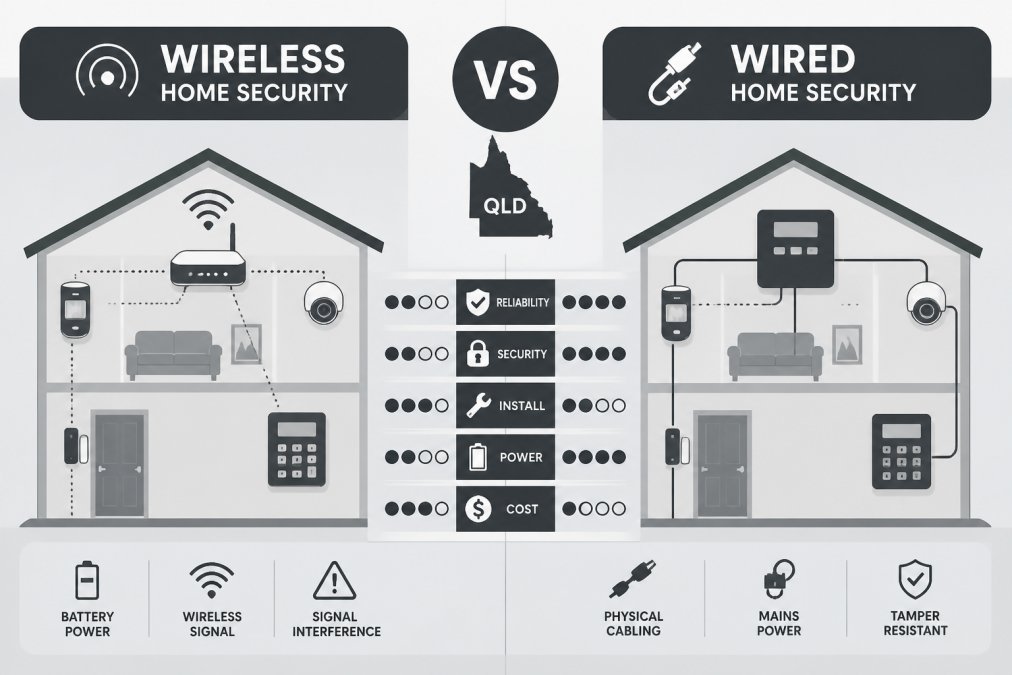
The fundamental difference between wireless and wired systems lies in how they transmit data and receive power. Wireless systems use battery-operated sensors communicating over radio frequency or WiFi protocols, offering flexible placement and renter-friendly installation without drilling. Wired systems rely on physical cabling for both power and connectivity, creating a hardwired infrastructure that remains functional even during network outages.
Signal interference is the wireless system's Achilles heel. Radio frequency congestion from neighbouring devices, thick concrete walls common in Queensland homes, and metal roofing can degrade sensor range and trigger false alarms. Network stability depends entirely on your NBN connection and home router quality.
Wired systems eliminate these variables entirely. With physical cabling, there is no latency, no connectivity dropouts, and no dependence on your home network. The trade-off is installation complexity: running cables through walls and ceilings requires professional expertise and increases the professional security system installation cost.
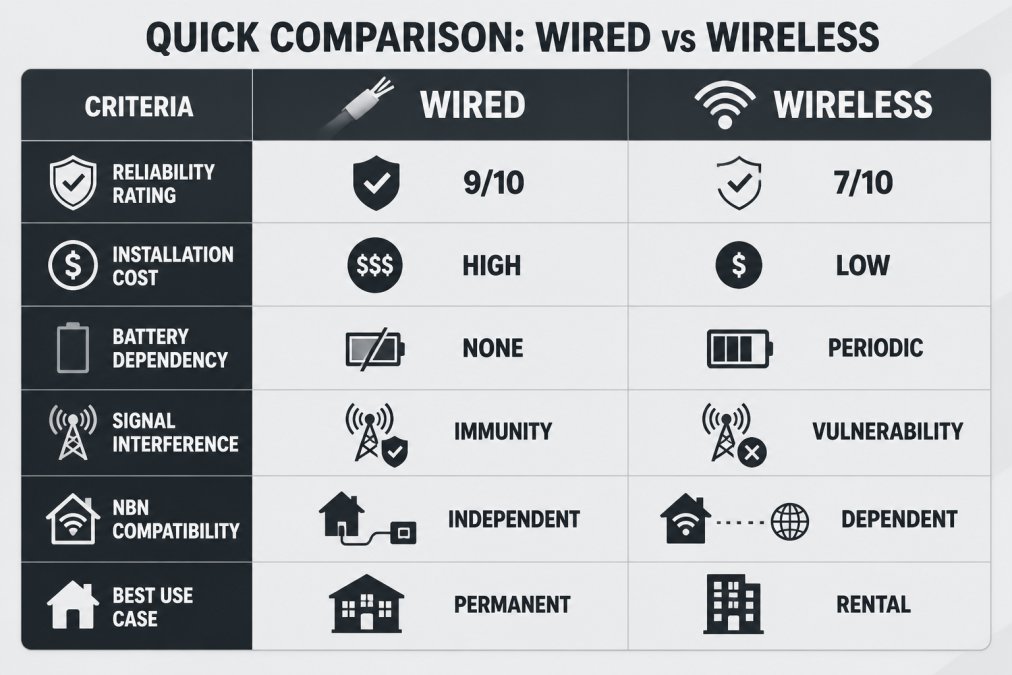
Quick Comparison Table: Wired vs Wireless Systems
| Criteria | Wired Systems | Wireless Systems |
|---|---|---|
| Reliability | Excellent, no signal dropout | Good, subject to interference |
| Installation Cost | Higher upfront, professional required | Lower, DIY or simple install |
| Battery Dependency | None, hardwired power | Full, periodic replacement needed |
| Signal Interference | Immune to jamming | Vulnerable to jamming and congestion |
| NBN/VoIP Compatibility | Fully compatible, independent | Dependent on network stability |
| Best Use Case | Permanent homes, high-security sites | Renters, temporary setups |
Reliability and Signal Stability: Wired Infrastructure vs Wireless Protocol
Wired systems deliver superior reliability because they are not subject to the same failure modes as wireless protocols. A hardwired connection maintains constant sensor range and data transmission regardless of external conditions, making it the preferred choice for properties requiring 24/7 security monitoring without interruption.
Wireless systems have improved significantly, but they remain dependent on battery health and network stability. A flat battery in a door sensor silently disarms that entry point until replaced. WiFi congestion from streaming devices, smart home integration hubs, and neighbouring networks can delay alarm signals reaching your monitoring centre.
The system lifespan also differs. Wired infrastructure typically outlasts wireless hardware by years, with physical cabling remaining functional for decades while wireless sensors may require replacement as battery technology and wireless protocols evolve.
Installation Process and Professional Security System Installation Cost
Installation complexity is where wireless systems clearly win. A wireless setup can be completed with basic tools, making it the obvious choice for renters or those wanting immediate protection.
Wired installation is a different proposition. Running physical cabling through walls, ceilings, and door frames requires drilling, fishing cables, and often coordinating with plasterers and painters. This drives up the professional security system installation cost significantly, particularly for retrofits on existing homes where wall cavities are already sealed.
However, the upfront premium buys long-term value. A professionally installed wired system from a licensed provider includes proper cable management, no visible wiring hazards, and a maintenance schedule that extends system lifespan. Queensland Building and Construction Commission guidance on licensed trades confirms that electrical work must be performed by qualified professionals, adding a compliance layer to DIY ambitions.
Security Against Jamming, Interference, and Cyber Threats
Wireless systems face two distinct attack vectors: physical signal jamming and cyber intrusion. A criminal equipped with a cheap radio frequency jammer can block wireless sensors from communicating with the base station, rendering the entire system blind. While some modern systems detect jamming attempts, the window of vulnerability remains.
Encryption standards matter equally. Wireless systems transmitting over WiFi or proprietary protocols must use strong encryption to prevent interception or replay attacks. Australian Cyber Security Centre guidance on smart device security recommends changing default credentials, enabling two-factor authentication, and keeping firmware updated, all of which add ongoing maintenance burden.
Wired systems sidestep physical jamming entirely because data travels through physical cabling that cannot be interrupted from outside. The tamper-proof nature of hardwired infrastructure means an intruder must physically access the cabling, which typically runs concealed through walls. Cyber threats still apply to the central panel and any networked components, but the attack surface narrows considerably.
Benefits of 24/7 Alarm Monitoring with a Licensed Provider
A monitored alarm system provides protection that extends beyond the hardware itself. When your alarm triggers, a 24/7 monitoring centre receives the signal and dispatches response, whether you are home, at work, or asleep. This continuous security monitoring bridges the gap between detection and intervention.
The response time difference is critical. An unmonitored alarm relies on neighbours hearing the siren and choosing to call authorities, an unreliable chain. With professional monitoring, the signal transmits instantly to a licensed provider who verifies the alert and dispatches mobile patrols or police as appropriate.
For Queensland homeowners, the practical benefit is documented response. Queensland Police Service home security advice emphasises that visible security measures and rapid response capabilities deter offenders. A monitored system with 24/7 dispatch provides that deterrent while ensuring someone is always watching, even during the 2 AM window when most break-ins occur.
Licensed Security Provider Requirements for QLD Installations
Queensland's security industry is one of the most tightly regulated in Australia, and this directly affects your choice between wireless and wired systems. The Security Providers Act 1993 and the Security Providers Regulation 2018, administered by the Office of Fair Trading (OFT), mandate that any person or business installing, maintaining, or monitoring security equipment for reward must hold the appropriate licence. This is not a formality; operating without a licence is a criminal offence carrying significant fines.
There are two distinct licence classes relevant to home security:
- Security Equipment Installer Licence (Class 2A): Required for physically installing, repairing, or maintaining electronic security equipment, including wired alarm panels, sensors, and cabling. This class also covers the programming of the system's logic.
- Security Monitoring Licence (Class 2B): Required for operating a monitoring centre that receives and responds to alarm signals. If you choose a provider that offers 24/7 monitoring, they must hold this class, and their operators must be individually licensed.
A common trap homeowners fall into is assuming a licensed electrician can legally install a full wired security system. They cannot. While a licensed electrician can run the 240V power supply to the control panel, the low-voltage security cabling, sensor connections, and panel programming fall exclusively under the Class 2A licence. Attempting to split the work between an electrician and a handyman often creates compliance gaps that void your insurance.
How Licensing Affects Your Insurance and Warranty
The practical consequence of licensing is accountability. Many home insurance policies include a condition that security systems must be professionally installed and maintained to validate premium discounts or claim payouts after a break-in. If a DIY wireless installation fails because a sensor battery died unnoticed, or a wired system is incorrectly wired by an unlicensed operator, the insurer can deny the claim on the grounds of negligent installation.
A licensed installer is also required to provide a certificate of compliance for the work performed. This document is your proof that the installation meets Australian Standard AS 2201 (Intruder Alarm Systems) and relevant electrical safety acts where applicable. Keep this certificate with your insurance policy; it is the evidence your insurer will request if you ever need to claim.
The Site Risk Assessment Requirement
Under the Security Providers Act, a licensed installer is obligated to conduct a site risk assessment before recommending a system configuration. This is not a sales pitch; it is a documented process that evaluates entry points, sight lines, neighbourhood crime data, and the physical characteristics of your Queensland property, such as concrete slab construction common in newer estates versus timber and tin-roofed Queenslanders. The assessment must be recorded and provided to you, and it forms the basis of the system design.
This regulatory framework is a decisive factor in the wired versus wireless debate. A licensed installer assessing a high-risk rural property with poor mobile reception will typically recommend a wired system with a backup battery and a dedicated phone line or 4G communicator, because wireless sensors relying on WiFi would be a compliance risk. Conversely, for a low-risk townhouse, the same installer may certify a wireless system as adequate, provided it meets the Australian Standard for signal supervision.
Why This Matters for Your System Choice
The licensing requirement adds a cost layer to wired systems that wireless DIY kits appear to avoid. However, that apparent saving is an illusion when you factor in the value of a documented, compliant installation. A wired system installed by a licensed Class 2A operator includes a site risk assessment, a compliance certificate, and a professional warranty, none of which a DIY wireless kit from an electronics retailer provides. For Queensland homeowners who intend to stay in their property long-term, this regulatory compliance is not bureaucracy; it is a tangible asset that protects your insurance position and your family's safety.
Queensland Office of Fair Trading security licence classes and application process
Queensland Building and Construction Commission guidance on licensed trades and compliance
Which System Should You Choose? A Decision Framework
| Your Situation | Recommended System | Primary Reason |
|---|---|---|
| Permanent homeowner, building or renovating | Wired | Hardwired reliability, lower lifetime cost |
| Renter or short-term lease | Wireless | No drilling, fully portable |
| High-value contents or rural isolation | Wired + monitoring | Tamper-proof, continuous 24/7 response |
| Smart home integrator, tech enthusiast | Hybrid | Wired backbone with wireless expansion |
| Budget-constrained, immediate need | Wireless | Lower upfront professional security system installation cost |
The decision framework above cuts through the marketing noise. If you own your property and plan to stay, wired infrastructure with professional installation delivers superior reliability, lower long-term maintenance, and better resale value. If you rent or move frequently, wireless portability outweighs its vulnerabilities.
For most Queensland homeowners, a hybrid approach offers the best of both worlds: a hardwired core for critical entry points and alarm signalling, supplemented by wireless sensors for areas where cabling is impractical. This configuration maintains tamper-proof reliability where it matters most while retaining installation flexibility.
Your property's specific layout, construction type, and risk profile should ultimately guide the decision. A licensed provider can conduct a site risk assessment that identifies whether signal interference, cabling challenges, or security monitoring needs should take priority in your installation.
The choice between wireless vs wired home security systems Queensland homeowners face ultimately reflects your priorities: convenience and portability versus failsafe reliability and tamper-proof operation. For permanent properties where security is non-negotiable, wired infrastructure backed by 24/7 monitoring from a licensed provider delivers the protection that matters when it counts. Tupper Security combines multi-class licensed operators, independent site risk assessments, and a local Silkstone depot for rapid alarm response across Ipswich and South-East Queensland. Request a quote today and let our team design a security solution built around how your property actually operates.
Frequently Asked Questions
Is it better to have a wired or wireless security system?
It depends on your property and priorities. Wired systems offer consistent power and signal stability with no battery changes, making them ideal for larger homes and permanent installations. Wireless systems suit renters or anyone wanting a quick, tool-free setup without drilling. For most Queensland homeowners, a professionally installed wired system with a cellular backup delivers the most reliable protection, but wireless options have improved significantly and are a legitimate choice for smaller properties.
Are wireless security systems vulnerable to signal interference?
Yes, wireless systems can experience signal interference from household WiFi congestion, thick walls, metal roofing, and other radio frequency sources. They also depend on battery power, so sensors can drop offline if batteries run low. Wired systems use physical cabling, which eliminates radio frequency interference entirely. If you choose wireless, a licensed security provider can assess your property layout and recommend sensor placement that minimises these risks.
What security system do burglars hate the most?
Burglars most dislike visible, monitored systems they cannot easily disable. A wired system with physical cabling is tamper-proof in the sense that cutting external lines triggers an alarm, and it cannot be jammed by a wireless signal jammer. When paired with 24/7 alarm monitoring and rapid dispatch, the combination deters break-ins because offenders know police or a mobile patrol will respond while they are still on site. Visible cameras and signage add further deterrent value.
Do I need a licensed technician to install a security system in Queensland?
For DIY wireless kits, no licence is required. However, if your system connects to a monitored alarm or you want professional-grade equipment, Queensland law requires the installer to hold a security firm licence and the individual technician to hold a security equipment installer licence. Using a licensed security provider also ensures the work meets Australian standards, reduces false alarms, and means your monitoring centre can verify the installation is compatible before they take responsibility for dispatch.
Does a wired or wireless system offer better long-term value?
Wired systems typically have a longer system lifespan, often exceeding 15 years, with lower ongoing maintenance since there are no batteries to replace. Wireless systems cost less upfront but may require sensor battery changes every 1-2 years and hardware upgrades sooner. When you factor in professional security system installation cost, wired systems usually deliver better long-term value for owner-occupiers, while wireless makes more sense for renters who may move within a few years.