 comparison
Best Security System for a Residential Home: 2026 Guide
Table of Contents
- Comparison Table: Residential Security Systems at a Glance
- How We Evaluated These Residential Security Systems
- Tupper Security: Local Monitoring, Patrols and Installation
- Professional Alarm Monitoring Services: What 24/7 Response Really Means
- Residential CCTV Installation Costs: What Drives the Price
- The Benefits of Mobile Security Patrols for Homes
- Renters vs Homeowners: Which System Fits Your Situation
- Conclusion
- Frequently Asked Questions
Last Updated: September 25, 2026
Comparison Table: Residential Security Systems at a Glance
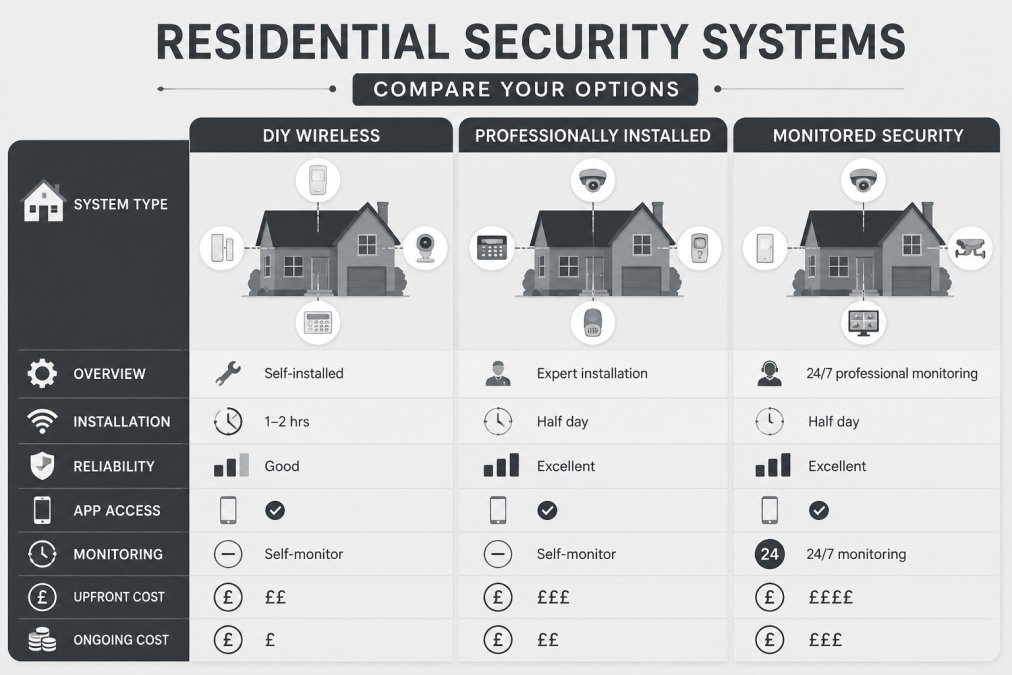
The best security system for a residential home depends on how you want it installed, monitored and managed. Below is a side-by-side look at the main options, from local full-service providers to DIY kits.
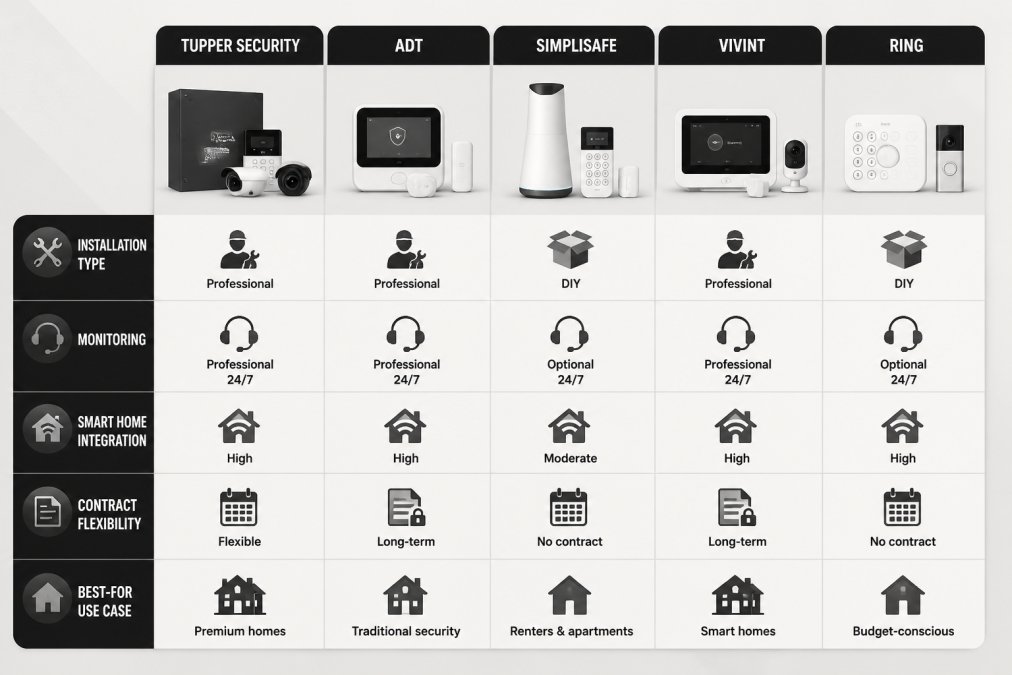
| System | Installation | Monitoring | Smart Home | Contract | Best For |
|---|---|---|---|---|---|
| Tupper Security | Professional | 24/7 local + patrols | Yes | Flexible | Full-service homes, fast response |
| ADT | Professional | 24/7 monitoring | Yes | Subscription | Hands-off reliability |
| SimpliSafe | DIY | Optional | Limited | No lock-in | Budget DIY setups |
| Vivint | Professional | 24/7 monitoring | Advanced | Subscription | Smart home enthusiasts |
| Ring | DIY | Optional | Yes | No lock-in | Video-first monitoring |
How We Evaluated These Residential Security Systems
We judged each option on five factors: installation method, monitoring depth, smart home fit, contract flexibility and how well it suits a real home layout.
- Do you want to install it yourself or have it done properly?
- Do you need 24/7 professional monitoring with a physical response?
- How much smart home automation do you actually want?
Tupper Security: Local Monitoring, Patrols and Installation
The one limitation: it's a local service, not a national DIY brand. If you want to self-install a cheap kit, look elsewhere. For a fully managed residential security system, it's hard to beat.
Professional Alarm Monitoring Services: What 24/7 Response Really Means
- Notification only: an app alert or a call to your phone.
- Monitored dispatch: a centre verifies the alarm and contacts you or emergency services.
- Physical response: a licensed patrol is dispatched to your property.
Modern systems add layers here: cellular backup, encrypted signals and anti-jamming technology so a cut phone line or a jammed signal doesn't silence the alarm. When comparing quotes, ask what happens during a power or network outage. That answer tells you more than the brochure.
Residential CCTV Installation Costs: What Drives the Price
Residential CCTV installation costs depend on camera count, resolution, storage, cabling and whether the system is hardwired or wireless. There is no single figure, because two homes of the same size can need very different systems. What follows is the mechanism behind each cost driver, plus the two factors most quotes quietly omit: network security and ongoing maintenance.
The real cost drivers
- Camera count and type. A basic 1080p bullet camera costs far less than a 4K turret with colour night vision, a wide dynamic range sensor and person/vehicle detection. The jump from 2MP to 4MP or 8MP is not linear, higher resolution means more storage, more bandwidth and often a more capable recorder.
- Storage architecture. An NVR with a local hard drive is a one-off cost. Cloud storage is a recurring subscription, and the tariff usually scales with retention period and camera count. Local storage keeps footage on-site (better for privacy, worse if the recorder is stolen), while cloud storage survives a break-in but depends on your upload bandwidth.
- Cabling and labour. Hardwired systems need cable runs, terminations and often a licensed electrician for mains work. Wireless cameras avoid cabling but still need power or regular battery changes, and Wi-Fi congestion can degrade footage quality. Labour is typically the largest variable in a hardwired quote.
- Access and integration. Remote viewing, two-way audio, smart hub compatibility and integration with an alarm panel all add configuration time. If the cameras must trigger the alarm or a patrol response, that integration is engineering work, not a plug-in.
- Housing and environment. Double-brick walls, long cable runs, heritage overlays and exposed coastal conditions all increase installation time and hardware specification.
What most quotes leave out
Cybersecurity. Every IP camera is a networked device. If it ships with a default password, runs outdated firmware or sits on the same flat network as your laptop, it is a potential entry point. A proper quote should specify: unique credentials per device, firmware update policy, encrypted streams (HTTPS/TLS), and whether the cameras sit on a segregated VLAN or guest network.
Getting a comparable quote
Because pricing depends on your property and layout, the honest answer is to get a quote based on a site assessment. Ask for the quote to itemise: camera models and resolution, recorder and storage size, cabling and labour, configuration and integration, and the first year of any subscription. For an accurate figure on monitored systems and CCTV, request a quote from Tupper Security based on your property layout.
The Benefits of Mobile Security Patrols for Homes
The benefits of mobile security patrols come down to one thing: a visible, physical presence that a camera alone can't provide. A patrol can check a triggered alarm, walk the perimeter and confirm whether anything is wrong.
For homes, patrols add three practical advantages:
- Faster verification: someone confirms the alarm on site instead of guessing from a screen.
- Deterrence: marked patrols and signage push burglars toward easier targets.
- Coverage gaps: patrols protect periods when you're away, travelling or at work.
Renters vs Homeowners: Which System Fits Your Situation
Renters and homeowners need different systems, and the split comes down to permanence, permission and payback. A homeowner can install hardwired cameras and a fixed alarm. A renter usually cannot drill, rewire or modify the property, and even where a lease allows it, the installation becomes a sunk cost the moment they move.
For renters
The practical path is non-invasive and portable:
- DIY, no-contract systems that mount with adhesive, tension rods or removable brackets and leave no permanent marks.
- Video doorbells and wireless cameras that run on battery or USB and move with you to the next address.
- Flexible monitoring you can pause or cancel without penalty, because a 24-month contract outlives most tenancies.
- Check the lease first. Most standard tenancy agreements require written consent for fixtures, and some strata or body corporate rules restrict cameras that overlook common property or neighbours. A doorbell camera aimed at a shared hallway can breach privacy expectations even if the landlord agrees.
- Keep the receipt and the original packaging. If you must remove the system at the end of the lease, you want to leave the property as you found it.
For homeowners
The better long-term value is professional installation, hardwired or well-fitted wireless systems, and full 24/7 monitoring with a physical response. You are protecting an asset you own, so the investment is easier to justify, and you can design for the property rather than working around a landlord's restrictions. Hardwired systems also avoid the battery-replacement treadmill and the Wi-Fi reliability problems that plague many renter-grade kits.
The insurance angle most guides skip
This is the part competitors gloss over, and it can change the maths. Many home and contents insurers offer premium reductions when a monitored alarm and surveillance system are professionally installed. The discount is not automatic, it depends on the insurer, the policy and the specification, but the mechanism is worth understanding:
- Monitored alarm with physical response is typically rated higher than a local siren or an app-only alert, because it produces verification and a documented response.
- Professionally installed systems are preferred over self-installed kits, because the insurer can see a paper trail of installation and maintenance.
- Backup power and cellular signalling matter, because a system that dies in a blackout or when the phone line is cut does not reduce the insurer's risk.
- Documentation counts. Keep the installation certificate, the monitoring contract and the service records. When you lodge a claim or ask for a discount, the insurer will want evidence, not a verbal description.
Conclusion
Choosing the best security system for a residential home is really about the response behind it, not the box on the wall. A cheap kit and a fully managed service can look similar on paper, but only one puts a licensed operator at your door when it matters.
Frequently Asked Questions
Which home security system is best in Australia?
The best system depends on your priorities. For hands-off reliability with professional installation, ADT suits long-term protection. SimpliSafe and Ring appeal to DIY households wanting lower upfront costs. Vivint offers strong smart home integration. For local monitoring, mobile patrols and tailored installation, Tupper Security provides a South-East Queensland option with multi-class licensed operators and a Silkstone depot.
What is the average cost of a home security system in Australia?
Costs vary widely based on hardware, installation and monitoring. Professional installation, additional sensors and camera quality all affect the total. For an accurate figure on monitored systems and CCTV, request a quote from Tupper Security based on your property layout.
Do I need a professional to install my home security system?
Not always. DIY systems like SimpliSafe and Ring are designed for self-installation and suit renters or those on a budget. However, hardwired systems, multiple IP cameras and integrated alarm monitoring often benefit from professional installation to ensure correct placement, encrypted signals and reliable connectivity. Tupper Security offers independent site risk assessments to determine the right setup for your home.
What are the benefits of 24/7 alarm monitoring?
Professional alarm monitoring services provide constant surveillance of your alarm system, with operators ready to dispatch response teams or mobile patrols when an alert triggers. This eliminates reliance on you being available to respond and can reduce false alarms through two-way audio verification. Tupper Security combines 24/7 monitoring with local mobile patrols, offering faster response times for homes in Ipswich, Silkstone and Brisbane.
How do CCTV systems improve residential security?
CCTV systems act as both a deterrent and an evidence-gathering tool. High-resolution IP cameras with night vision and remote access let you check your property from anywhere via a mobile app. Cloud or local storage preserves footage for insurance claims or police reports. Residential CCTV installation costs depend on camera count, resolution and whether you choose wireless or hardwired setups.
Australian Cyber Security Centre guidance on securing smart devices
Scamwatch advice on home security and alarm scams
Australian Competition and Consumer Commission on product safety and consumer guarantees