 comparison
Is 24/7 Alarm Response Worth It for Small Business? 2026 Review
Table of Contents
- The Real Cost of a Break-In vs a Monitoring Contract
- What Business Security Monitoring Costs in 2026
- Self-Monitored vs Professional Security Systems: The Honest Comparison
- The Impact of Security Systems on Business Insurance
- How Professional 24/7 Alarm Response Works on Site
- False Alarm Liability: Who Pays When the Sirens Are Wrong?
- Is 24/7 Alarm Response Worth It for Small Business? The Verdict
- Frequently Asked Questions
Last Updated: September 16, 2026
The Real Cost of a Break-In vs a Monitoring Contract
Insurance treats the two situations differently. Many policies ask about monitoring arrangements at claim time, and the answers affect how the claim is assessed.
What Business Security Monitoring Costs in 2026
Business security monitoring costs in 2026 depend on the site, not a flat rate. A single retail tenancy with one entry point sits at the lower end; a multi-building construction compound with high-value plant and no permanent power sits at the top. Pricing reflects device count, response model, location and patrol frequency.
Providers structure monitoring in three broad ways:
- Back-to-base monitoring: the alarm panel signals a monitoring centre, which verifies the event and dispatches a patrol or emergency services. This is the standard commercial model.
- Mobile patrol response: a licensed vehicle attends the site on alarm activation or on a scheduled route. Suited to remote sites and after-hours coverage.
- Integrated monitoring: alarm, CCTV, access control and intercom feeding one platform, with real-time alerts pushed to a mobile app.
What actually drives the monthly fee
Most business owners compare quotes on the headline monthly figure. That is the wrong comparison. The fee is built from four variables:
- Number of devices and zones. A panel with 8 zones costs less to monitor than one with 32. More zones mean more signals to verify and more potential for false activations.
- Response model. Back-to-base monitoring is the cheapest. Adding mobile patrol response increases the fee because a vehicle and licensed operator are on standby. Scheduled patrols cost more again.
- Site location. Remote or high-risk areas attract higher fees because patrol response takes longer and may require dedicated routing.
- Verification method. Audio verification is cheaper than video verification. Video verification reduces false dispatches but requires compatible cameras and higher bandwidth.
The ROI calculation framework
Run these numbers before you sign anything.
Step 1: Estimate your annual monitoring cost. Multiply the monthly fee by 12, then add any annual service or maintenance contract.
Step 2: Estimate the cost of a single break-in. Add up:
- Insurance excess (typically $500-$2,500 for small commercial policies)
- Lost trading hours (one day of revenue)
- Stock or equipment replacement not covered by insurance
- Forced-entry repairs (door, window, lock)
- Staff downtime and morale impact
- Any increase in future premiums
The false economy of the cheapest quote
The cheapest monitoring quote often dispatches on every unverified activation, burning patrol time and leading your provider to deprioritise your site. The second-cheapest quote with verification built in is usually better value because it protects your response priority.
Self-Monitored vs Professional Security Systems: The Honest Comparison
Self-monitoring is cheaper on paper and weaker in practice. A self-monitored system alerts your phone. A professionally monitored system alerts a centre that verifies the event and dispatches a licensed response, whether or not you are awake.
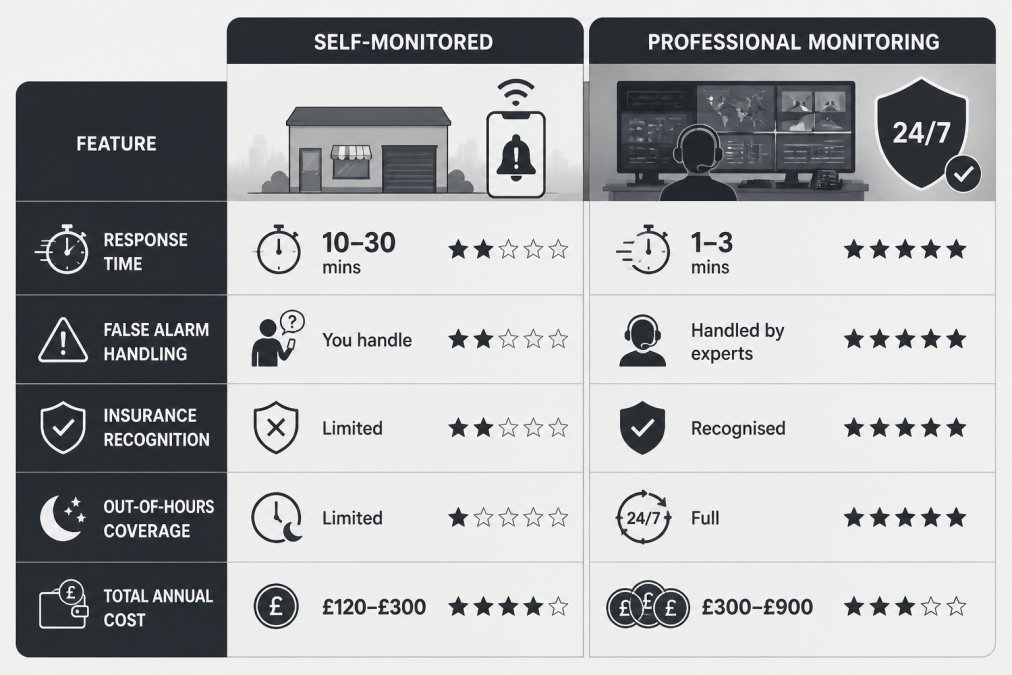
| Factor | Self-Monitored | Professionally Monitored |
|---|---|---|
| Alert destination | Your phone or app | Monitoring centre, 24/7 |
| Response time | Depends on you | Dispatched on verification |
| False alarm handling | You assess it | Centre verifies before dispatch |
| Out-of-hours coverage | None if you're asleep | Full, every night |
| Insurance recognition | Often questioned | Typically recognised |
| Annual cost | Hardware only | Ongoing monitoring fee |
The Impact of Security Systems on Business Insurance
The impact of security systems on business insurance is real but rarely automatic. A monitored, professionally installed system with verified response lowers a site's perceived risk, which can influence premiums at renewal and, more importantly, whether a claim is paid without argument.
How insurers actually assess your security
Insurers do not simply ask "do you have an alarm?" They assess the likelihood and size of a loss. A monitored alarm with verified response reduces both: it lowers the probability of a successful break-in and shortens the time between detection and response, limiting damage and stock loss.
- Is the alarm monitored 24/7 by a monitoring centre?
- Does the system have verified response (audio, video, or guard confirmation before dispatch)?
- Is the system maintained under a service contract?
- Are there any exclusion zones or areas not covered?
- Has the site had prior claims or false alarm incidents?
What a warranty breach actually costs
A warranty is a condition of your policy. Breach it and the insurer may decline a claim entirely, reduce the payout proportionally, require an additional excess, or cancel the policy. The financial impact is not the premium difference, it is the entire claim value. For a small retail business with $80,000 of stock and $30,000 of fit-out, a declined claim is a six-figure event.
A practical checklist for the insurance conversation
- Confirm whether your policy includes an alarm warranty or monitoring condition
- Keep monitoring contracts and service records on file
- Retain evidence of alarm testing and maintenance
- Document any false alarm history and how it was resolved
- Notify the insurer in writing if you change monitoring arrangements
- Ask your broker to confirm in writing that your monitoring arrangement satisfies the policy condition
The unique angle: insurance as a risk-transfer tool
Most guides treat insurance as a discount opportunity. The better framing is risk transfer. You already pay an insurer to carry the financial consequence of a break-in; monitoring keeps that transfer valid. Without it, you self-insure the gap between the alarm sounding and someone arriving, where most of the loss occurs.
How Professional 24/7 Alarm Response Works on Site
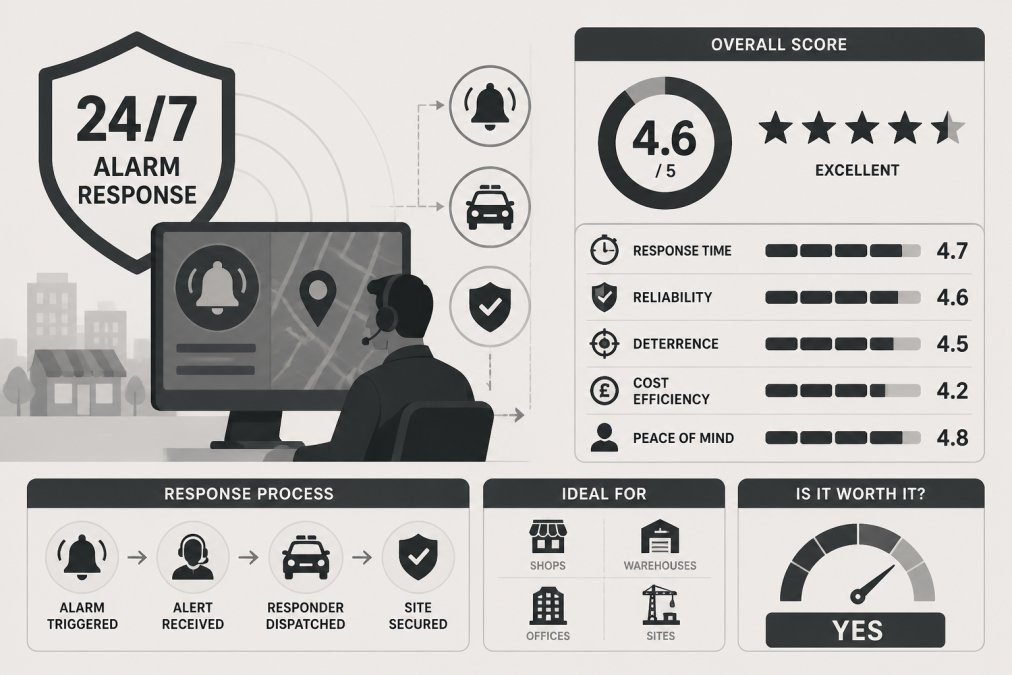
Professional 24/7 alarm response works in four stages: detection, verification, dispatch and documented arrival. The panel detects an intrusion, fire, smoke or duress event and signals the monitoring centre, which verifies it via audio, video or a call to the site. Once verified, a licensed patrol is dispatched and emergency services notified where required.
False Alarm Liability: Who Pays When the Sirens Are Wrong?
False alarm liability sits with the alarm owner, not the monitoring company, in most circumstances. If your system repeatedly triggers without cause, the consequences land on you: wasted patrol time, provider fees, strained neighbour relationships and, in some jurisdictions, penalties for repeated false alarms.
The fix is unglamorous but effective:
- Service the system annually, not when it fails
- Review sensor placement after any fit-out or layout change
- Train staff on correct arming and disarming procedures
- Track every false activation and investigate the cause
- Escalate to your provider if the same zone triggers repeatedly
Is 24/7 Alarm Response Worth It for Small Business? The Verdict
Yes, for most small businesses with physical premises, stock, equipment or after-hours risk, 24/7 alarm response is worth it. It is not worth it for a home office with nothing on site or a business operating entirely online. The dividing line: if a break-in would cost more than a year of monitoring, monitoring pays for itself the first time it works.
| Question | If Yes | If No |
|---|---|---|
| Is there stock or equipment on site overnight? | Monitoring justified | Reassess |
| Does the site sit empty after hours? | Monitoring justified | Lower priority |
| Does your insurer require monitored alarm? | Monitoring essential | Optional |
| Is the site remote or hard to access? | Patrol response justified | Standard monitoring |
| Has the site been targeted before? | Monitoring essential | Standard monitoring |
Frequently Asked Questions
Is 24/7 monitoring actually worth it for a small business?
It depends on what you stand to lose. A monitored alarm triggers a verified response, which matters most for businesses holding stock, cash or irreplaceable equipment after hours. If your premises sit empty overnight and a break-in would cost thousands in stock and downtime, professional 24/7 alarm response usually pays for itself. If you work from a low-risk home office with little to steal, self-monitoring may be enough.
How does professional alarm response differ from self-monitoring?
With self-monitoring, your phone gets an alert and you decide what happens next. If you are asleep, driving or in a meeting, nobody responds. Professional monitoring means a trained operator receives the signal, verifies it against cameras or sensors, and dispatches a licensed patrol or the police. The gap between those two models is the gap between knowing something happened and someone actually attending your site.
Does 24/7 security monitoring reduce insurance premiums for businesses?
Many Australian insurers ask about alarm monitoring when quoting commercial cover, and a monitored, back-to-base system can support a lower premium or better terms than an unmonitored one. The saving varies by insurer, industry and claim history, so ask your broker to quote both scenarios. Treat any premium reduction as a secondary benefit; the primary value is reducing loss and operational downtime.
What are the typical business security monitoring costs?
Monitoring is usually billed monthly or annually, with the figure depending on how many sensors, cameras and sites you need covered, whether you want patrol response, and the contract length. Beware of cheap monitoring that skips alarm verification, because unverified alarms drive false callouts and can attract council or police penalties. Request a written quote that separates hardware, monitoring and response fees.
What happens during a 24/7 alarm response event?
The alarm panel sends a signal to the monitoring centre. An operator checks the zone and any camera feed, then attempts to contact your nominated keyholders. If the alarm looks genuine, a licensed patrol is dispatched to the property and, where required, police are notified. You receive a report afterwards documenting the time, cause and outcome, which is useful for insurance claims and for spotting repeat weak points.