 ultimate-guide
Why Modern Businesses Need Access Control Systems
Table of Contents
- What Access Control Systems Actually Do
- Access Control Compliance Requirements in Your Industry
- Managing Employee Access Levels: Who Goes Where and Why
- Reducing Unauthorised Entry and Physical Security Threats
- Real-Time Monitoring, Audit Trails, and Accountability
- How to Verify Alarm Response Times and System Reliability
- Choosing the Right Access Control System for Your Business
- Frequently Asked Questions
Last Updated: September 17, 2026
What Access Control Systems Actually Do
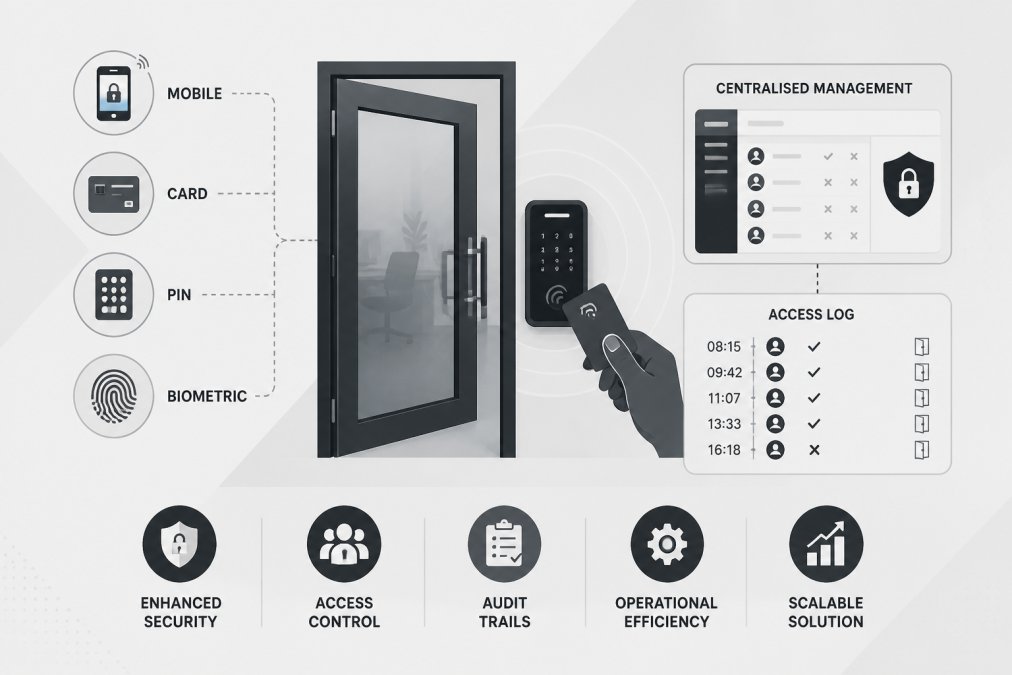
An access control system is a security infrastructure that manages who can enter specific areas of a building or property, when they can enter, and what actions they're permitted to perform. Unlike basic locks and keys, modern access control systems combine physical hardware, software, and credential management to create auditable, revocable entry permissions.
The core function is straightforward: authenticate a person's identity, verify their authorisation level, and grant or deny access in real time. But the real value sits in what happens after entry. Every access event is logged, who entered, when they entered, how long they stayed, and which doors they passed through. This audit trail becomes critical when you need to investigate unauthorised entry, verify compliance with regulatory requirements, or prove that authorised personnel were where they claimed to be.
We've installed access control systems across retail stores, warehouses, and multi-tenant properties in South-East Queensland where the ability to track movement and restrict access has directly prevented losses and simplified operations. The difference between a system that merely controls access and one that creates accountability is the difference between security and security theatre.
Access Control Compliance Requirements in Your Industry
Compliance obligations vary significantly depending on your industry, but several sectors face mandatory or strongly recommended requirements around access control and entry logging.
Healthcare and aged care facilities operate under strict privacy and safety frameworks. The Privacy Act 1988 (Cth) requires organisations holding personal health information to implement reasonable security measures, which regulators interpret to include documented access controls. Aged care providers must comply with the Aged Care Quality Standards, which explicitly require facilities to maintain records of who accessed restricted areas and when. Auditors expect to see access logs reviewed regularly and evidence that unauthorised personnel cannot reach medication storage, resident records, or secure areas.
Retail and hospitality venues handling cash or high-value inventory face insurance requirements that often mandate access control systems. Most commercial general liability policies now include clauses requiring documented access controls on safes, stockrooms, and cash handling areas. If a loss occurs and you cannot produce access logs proving who was in that area, insurers may deny the claim entirely. Some policies specify minimum standards: card-based systems with audit trails, biometric verification for high-risk areas, or real-time monitoring integration.
Construction and mining sites must comply with Work Health and Safety (WHS) legislation, which requires site operators to maintain records of who is on site for emergency response and liability purposes. The Work Health and Safety Act 2011 (Cth) places a duty on site managers to know who is present and to account for all personnel in an emergency. Access control systems that log entry and exit times provide the documented proof regulators expect during investigations.
Financial services and data centres handling sensitive information must meet Australian Prudential Regulation Authority (APRA) requirements or equivalent standards. These typically mandate multi-factor authentication for physical access to secure areas, time-stamped audit trails, and regular access reviews to ensure only authorised personnel retain credentials.
The key compliance pressure comes from three directions: regulatory bodies (such as health and safety authorities or industry-specific regulators), insurance providers (who may refuse cover or increase premiums without documented access controls), and contractual obligations (if you're a tenant in a larger facility, your lease may require you to maintain access control systems that report to the landlord).
What matters operationally is understanding that compliance isn't a one-time checkbox. Regulators expect ongoing evidence: audit trails retained for a minimum period (typically 12 months), regular access reviews to remove lapsed credentials, and documented procedures for responding to access violations. If you're audited and cannot produce these records, the finding is typically classified as a non-compliance that must be remediated within a specified timeframe. Rather than guessing at your specific obligations, consult your industry regulator, insurance broker, or legal advisor directly to confirm what documentation your business must maintain.
Managing Employee Access Levels: Who Goes Where and Why
Role-based access control is the practical foundation of any working system. Different employees need different permissions: a warehouse manager needs access to storage areas, offices, and the loading dock. A retail cashier needs access to the sales floor and stockroom, but not the manager's office or the safe. A visitor might only need lobby access.
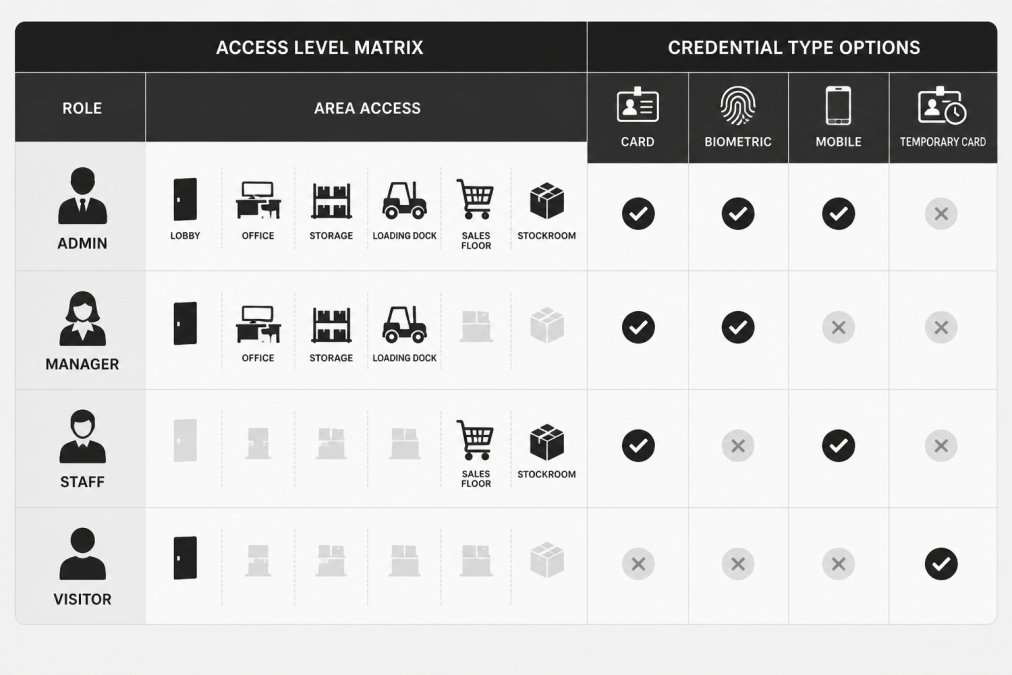
The system enforces these boundaries through credential management. When an employee is hired, you issue them a credential (card, biometric enrolment, or mobile credential). When they change roles, you update their permissions. When they leave, you revoke the credential entirely. This is far more efficient than rekeying physical locks.
[IMAGE: Access level matrix showing role-based permissions: Admin (all areas, card/biometric/mobile), Manager (office + storage + loading dock, card/biometric), Staff (sales floor + stockroom, card/mobile), Visitor (lobby only, temporary card).
Reducing Unauthorised Entry and Physical Security Threats
Unauthorised entry prevention is where access control systems deliver measurable security value. A basic lock can be picked, bypassed, or forced. A keypad code can be shared or compromised. An access control system creates multiple layers: the credential must be valid, the person holding it must match the biometric or card data, and the system must authorise the specific entry point at that specific time.
Real-Time Monitoring, Audit Trails, and Accountability
Every access event creates a permanent record: timestamp, credential used, entry point, and outcome (granted or denied). This audit trail is non-negotiable for compliance, but it's equally valuable for operational accountability.
How to Verify Alarm Response Times and System Reliability
Access control systems don't operate in isolation, they integrate with alarm systems, CCTV, and security monitoring services. When an unauthorised access attempt is detected or an alarm is triggered, the response chain begins. Verifying that this chain actually works is critical.
Choosing the Right Access Control System for Your Business
The choice between cloud-based and on-premise systems, biometric versus card-based credentials, and integrated versus standalone components depends entirely on your operational reality. But the decision framework most businesses use, focusing only on upfront hardware cost, misses the larger financial and security picture.
- Hardware replacement cycles: Card readers, controllers, and biometric devices typically last 5-7 years before requiring replacement. Budget for phased upgrades.
- Credential costs: Each employee card or biometric enrolment has a per-unit cost. Multiply by your headcount and annual turnover rate. High-turnover retail environments face significantly higher credential costs than stable office environments.
- Licensing and software: Cloud-based systems charge per-user or per-door monthly fees. On-premise systems may have annual licensing costs. Factor in growth: if you're planning to expand from 5 doors to 15 doors, licensing costs may increase substantially.
- Integration and customisation: If your system must integrate with your HR software, CCTV, or building management system, budget for integration work. This is rarely included in base quotes.
- Support and maintenance: 24/7 support contracts cost more than business-hours-only support. For security systems, the difference in response time during an after-hours incident can justify the premium.
Your access control system should:
-
Use encrypted credentials: Card data and biometric templates must be encrypted in transit and at rest. Unencrypted systems are vulnerable to credential cloning or interception.
-
Require strong authentication for administrative access: Anyone who can change access permissions or view audit logs must authenticate with multi-factor authentication. A compromised admin account gives an attacker the ability to grant themselves access to any area.
-
Maintain audit logs in a tamper-evident format: Logs should be stored in a way that makes it obvious if they've been altered or deleted. Some systems support write-once storage or cryptographic signing of log entries.
-
Isolate the access control network from general IT infrastructure: Your access control system should operate on a separate network segment from your office computers and internet connection. If your office network is compromised, an attacker shouldn't automatically gain access to your physical security system.
-
Support regular security updates: Ask the vendor about their patch cycle. How often do they release security updates? How quickly can you deploy them? A system that hasn't received a security update in two years is a liability.
-
Mobile credentials: Card-based systems require employees to carry physical credentials. Mobile credentials (using smartphone apps or NFC) reduce friction for flexible workers and provide better audit trails (the system knows which employee used which phone, not just which card was used).
-
Touchless entry: High-traffic areas benefit from touchless access (motion sensors, mobile proximity, or facial recognition) to reduce disease transmission risk and improve flow during peak times.
-
Time-based access rules: Employees working flexible hours need access permissions that reflect their actual schedule. A system that locks everyone out at 6 PM doesn't work if your team works staggered shifts. Look for systems that support time-of-day rules, day-of-week rules, and temporary access grants.
-
Integration with desk booking systems: If you use hot-desking software, your access control system should ideally integrate with it. An employee books a desk for Tuesday; the system automatically grants them access to that desk area on Tuesday only.
Frequently Asked Questions
What are the main benefits of an access control system for a business?
Access control systems restrict entry to authorised personnel, reducing unauthorised access and theft. They create audit trails showing who entered each area and when, which is essential for compliance and incident investigation. Real-time monitoring lets you respond to breaches immediately, while automated workflows eliminate manual key management. For multi-site operations, centralised management means consistent security standards across all locations without managing different teams separately.
How do access control compliance requirements affect my business?
Many industries in Australia must meet specific security standards. Retail operations need documented shrinkage reporting and loss prevention protocols. Healthcare and hospitality venues must comply with visitor management and staff authorisation rules. Warehouses handling sensitive goods require audit trails and perimeter security documentation. Without proper access control systems, you risk regulatory penalties, failed audits, and liability if unauthorised access causes damage or theft. Compliance reporting becomes automated rather than manual.
How do I verify alarm response times before committing to a system?
Ask for documented response time data from your provider's recent jobs in your area, not national averages. Request their standard operating procedures for dispatch and confirm who monitors your system (in-house or third-party). Check their QLD Firm Licence status and ask about their local depot location, proximity directly affects response speed. Ask for references from similar-sized businesses and contact them directly about actual response times they've experienced.
Can access control systems integrate with my existing CCTV and alarm setup?
Modern systems integrate with CCTV, alarm monitoring, and mobile credentials through cloud-based platforms and open API standards. Integration lets you trigger lockdown procedures automatically, cross-reference access logs with video footage for incident investigation, and manage permissions from one dashboard. However, integration quality depends on your existing hardware age and compatibility. A site risk assessment identifies what can be retrofitted versus what requires replacement, and a professional installer can advise on actual ROI rather than ripping everything out unnecessarily.