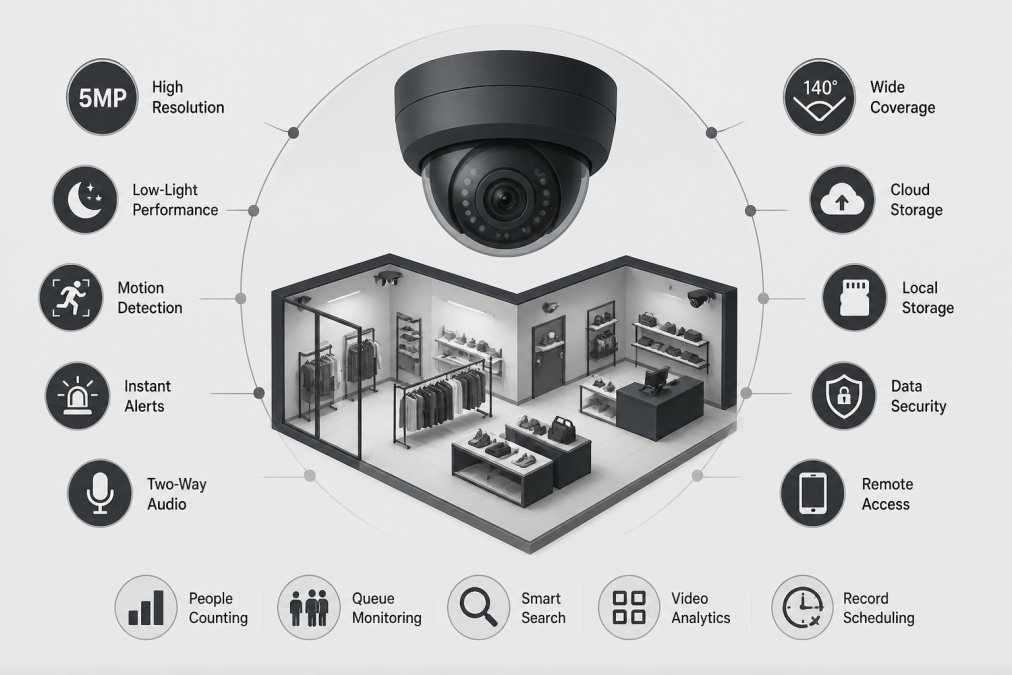
 ultimate-guide
Best Security Camera Features for Retail Stores
Table of Contents
- Why Security Camera Features Matter for Retail Loss Prevention
- High-Resolution Video and Image Clarity
- AI Video Analytics for Retail Detection and Alerts
- Night Vision and Low-Light Performance
- PoE and Connectivity: Stable Surveillance Infrastructure
- CCTV Privacy Laws for Businesses and Compliance
- Retail Loss Prevention Strategies Through Smart Camera Placement
- Remote Monitoring, Storage, and Two-Way Audio
- Frequently Asked Questions
Last Updated: September 24, 2026
Why Security Camera Features Matter for Retail Loss Prevention
Retail shrinkage costs Australian businesses millions annually. The challenge isn't just external theft, internal incidents, operational mistakes, and customer fraud account for a significant portion of losses. This is where the best security camera features for retail stores become essential infrastructure, not optional add-ons.
At Tupper Security, we've worked with retailers across South-East Queensland who discovered that generic CCTV systems captured footage but missed actionable intelligence. The difference between a system that records and one that prevents loss comes down to specific features: resolution clarity that identifies faces, AI analytics that flag suspicious patterns, and remote access that lets you respond in real time.
The best security camera features for retail stores combine hardware capabilities with intelligent software. A 4K camera with poor placement captures nothing useful. Motion detection without person-specific AI generates false alarms. Two-way audio without night vision fails when your store closes. This guide breaks down the features that actually move the needle on loss prevention, compliance, and operational security.
High-Resolution Video and Image Clarity
Image clarity determines whether your footage becomes evidence or just a blur. For retail environments, resolution sits at the intersection of detail capture and storage efficiency.
4K resolution (3840 × 2160 pixels) has become the baseline for serious retail surveillance. It delivers sufficient pixel density to identify faces, read till receipts, and capture transaction details from 3-5 metres away. Lower resolutions, 1080p or 2K, work for perimeter monitoring but fail when you need to prosecute internal incidents or validate disputed transactions.
Frame rate matters equally. Most retail systems operate at 30 frames per second (fps) for normal conditions, which captures smooth motion and prevents the jerky playback that makes identification difficult. High-motion areas, checkout zones, entrances, stockroom access points, benefit from higher frame rates when bandwidth and storage allow it.
Bit rate determines video quality at a given resolution. Systems that compress too aggressively produce artefacts and lose fine detail. Professional retail systems typically allocate 4-8 Mbps per camera for 4K recording, though this varies with compression codec and lighting conditions.
The practical trade-off: higher resolution and frame rate demand more storage and bandwidth. A single 4K camera recording 24/7 consumes roughly 500 GB per week. Most retail operations balance this by recording at full quality during business hours and lower resolution during closed periods, or by using intelligent video management software that prioritizes storage for motion-detected events.
AI Video Analytics for Retail Detection and Alerts
AI-powered analytics transform passive recording into active loss prevention. Instead of reviewing hours of footage manually, modern systems flag incidents as they happen.
Person detection isolates human activity from environmental changes, lighting shifts, shadows, moving signage. This eliminates the false alarms that plague motion-only systems. Unusual activity detection (UAD) goes further, identifying behaviours like loitering in restricted areas, staff removing items without scanning, or customers placing merchandise in bags without paying.
Vehicle detection matters for perimeter monitoring and loading dock security. Automated alerts notify you when vehicles enter restricted zones or remain in parking areas beyond expected durations.
Real-time alerts enable immediate response. A staff member attempting to bypass the till triggers an instant notification to management, allowing intervention before loss occurs. This preventative capability, not just documentation, is what separates systems that reduce shrinkage from systems that simply record it.
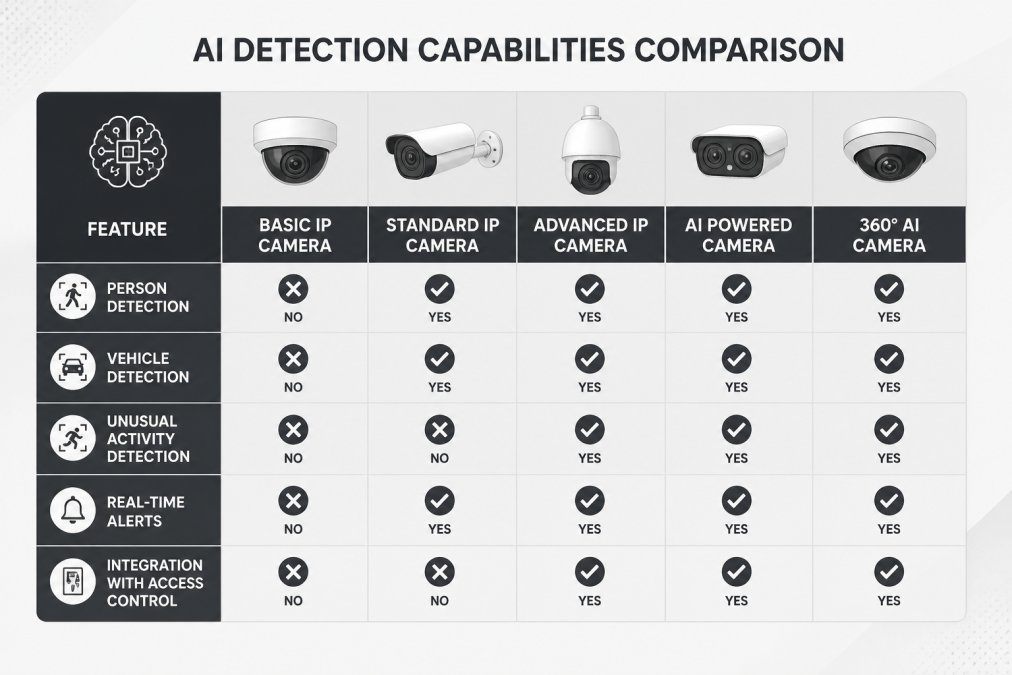
Integration with your point-of-sale and access control systems amplifies effectiveness. When AI detects a transaction anomaly, the system can cross-reference till logs and door access records to build a complete incident timeline. Tupper Security's documented shrinkage reporting ties camera evidence directly to inventory discrepancies, creating an auditable record.
Night Vision and Low-Light Performance
Retail loss doesn't stop at closing time. Break-ins, unauthorised access, and overnight incidents require surveillance capability when ambient light disappears.
Infrared (IR) illumination is the standard approach. Cameras emit invisible IR light and capture the reflected image. This works reliably in complete darkness but has limitations: IR range typically extends 10-20 metres depending on camera quality, and reflective surfaces (glass, mirrors, polished floors) create wash-out zones.
Low-light sensitivity, measured in lux, indicates how well a camera performs in dim conditions before IR activates. Professional retail cameras operate effectively at 0.1 lux or lower. Consumer-grade systems often require 1+ lux, making them unreliable for after-hours surveillance.
Thermal imaging (uncooled microbolometer technology) offers an alternative for perimeter monitoring. It detects heat signatures rather than visible light, so it performs identically in darkness and daylight. The trade-off: thermal doesn't capture facial detail or merchandise specifics, it's better for detecting intrusion than identifying individuals.
For most retail applications, high-sensitivity IR cameras outperform thermal. They preserve detail necessary for evidence and identification while handling complete darkness. Tupper Security typically recommends IR-equipped systems for stockroom access points and loading docks, where the combination of darkness and high-value merchandise justifies the investment.
PoE and Connectivity: Stable Surveillance Infrastructure
Power over Ethernet (PoE) has become the infrastructure standard for professional retail surveillance. A single Cat6 cable carries both data and power to each camera, eliminating the need for separate power runs.
PoE stability matters more than wireless convenience. A wired infrastructure avoids Wi-Fi congestion, interference from retail equipment (microwaves, wireless POS systems), and the bandwidth throttling that occurs when multiple devices compete for airtime. Retail environments are electrically noisy, PoE's shielded cabling and direct connection prevent the dropouts that plague wireless systems.
Bandwidth planning determines how many cameras your network can support. A single 4K camera at 8 Mbps requires significant upstream capacity. Most retail networks need dedicated surveillance VLANs (virtual local area networks) to isolate camera traffic from customer Wi-Fi and POS systems. Network Recording Devices (NVRs) or Network Video Management Software handle this segmentation.
Wireless cameras work for small deployments, a single checkout zone or entrance, but rarely scale to multi-camera retail installations. The convenience of avoiding cabling is offset by reliability issues and the ongoing management burden of maintaining separate Wi-Fi credentials and managing interference. Hardwired infrastructure remains the superior choice for high-traffic environments, just as reliable power management is essential for staff utilizing body camera equipment during extended operational cycles.
Local storage via NVR or NAS (Network Attached Storage) keeps footage on-site and under your control. Cloud storage adds redundancy and remote accessibility but introduces ongoing subscription costs and potential latency issues during peak usage. Most retail operations use hybrid approaches: local NVR for immediate access and forensic review, cloud backup for compliance and disaster recovery.
CCTV Privacy Laws for Businesses and Compliance
Australian privacy law imposes specific obligations on retailers operating CCTV systems. Non-compliance creates liability and undermines the evidentiary value of your footage.
The Privacy Act 1988 (Cth) and Australian Privacy Principles (APPs) establish baseline requirements. Personal Information Protection Principles (specifically APP 1 and APP 3) require that collection of personal information, including footage capturing individuals, must be open and transparent, and limited to what's reasonably necessary.
State-based legislation adds requirements. In Queensland, the Surveillance Devices Act 1999 restricts audio recording in private spaces. Video-only surveillance in retail areas is generally permitted, but audio recording in staff areas, change rooms, or toilets is prohibited. This distinction matters: cameras with two-way audio capability must be configured to disable recording in restricted zones.
Signage is mandatory. Customers and staff must be notified that CCTV is in operation. Clear, visible signs at entrances stating "CCTV in operation" satisfy transparency obligations and reduce privacy complaints. The notice should specify the purpose (loss prevention, staff safety) and indicate how footage is retained and accessed.
Data retention policies must be documented. Most retail operations retain footage for 30 days, balancing storage costs with investigation timelines. Policies should specify deletion procedures and who can access footage. Tupper Security's compliance documentation helps retail clients maintain auditable retention schedules that satisfy both privacy law and insurance requirements.
Employee consent for staff areas requires specific attention. While monitoring customer areas requires only signage, recording staff in break rooms or changing areas typically requires explicit consent or clear operational justification under privacy law. Many retailers use separate systems or restricted zones to avoid this complexity.
Retail Loss Prevention Strategies Through Smart Camera Placement
Camera placement determines what your system actually captures. Poor placement wastes resolution and creates blind spots that loss-prevention incidents exploit.
Entrance and exit zones demand priority.
Remote Monitoring, Storage, and Two-Way Audio
Remote access transforms surveillance from a forensic tool into an active management system. Mobile app integration lets you monitor your retail space in real time, regardless of location.
Frequently Asked Questions
What security camera features are most important for preventing retail shrinkage?
High-resolution 4K video captures fine detail for identifying individuals and tracking merchandise movement. AI-powered person detection flags suspicious behaviour in real time. Wide-angle field of view covers more floor space with fewer cameras, reducing blind spots where theft occurs. Two-way audio lets staff communicate with customers or deter theft remotely. Night vision ensures 24-hour coverage during closed hours when after-hours theft happens. Together, these features create a documented record that supports loss prevention investigations and staff training.
Do retail security cameras need to comply with privacy legislation?
Yes. Under Australian privacy law, retail businesses must comply with the Privacy Act 1988 and state-based workplace surveillance laws. Cameras must be positioned to avoid private areas like bathrooms and change rooms. Signage must notify customers and staff that surveillance is in place. Audio recording is heavily restricted and typically requires explicit consent. Regular audits of camera placement and retention policies ensure compliance. Professional security consultants can assess your system against current privacy requirements specific to your jurisdiction.
Is PoE or wireless better for retail security cameras?
PoE (Power over Ethernet) offers superior stability for retail environments. A single cable delivers both power and data, reducing installation complexity and eliminating Wi-Fi congestion that affects wireless cameras. PoE systems are more reliable during peak hours when customer traffic strains network bandwidth. Wireless cameras suit small retail stalls or temporary setups but depend on consistent Wi-Fi signal strength. For multi-camera retail surveillance, PoE infrastructure provides the consistent uptime and frame rate that loss prevention depends on.
How does AI video analytics improve retail security compared to basic motion detection?
Basic motion detection triggers alerts for any movement, causing false alarms from customers, staff, or shadows. AI video analytics distinguishes between people, vehicles, and environmental changes, filtering out noise. Advanced systems detect unusual behaviour like loitering in high-value areas, rapid merchandise removal, or unauthorised access to stockrooms. Real-time alerts notify staff immediately, enabling faster response. AI also supports post-incident investigation by flagging specific events in hours of footage, reducing manual review time from days to minutes.