 ultimate-guide
Why Business Alarm Systems Are Essential in Queensland
Table of Contents
- Why Business Alarm Systems Matter
- Crime Prevention and Deterrence
- Asset Protection and Loss Prevention
- Commercial Alarm Monitoring Services and Real-Time Response
- Business Security System Cost and ROI
- Security System Compliance and Legal Requirements
- Choosing the Right Alarm System for Your Business
- Frequently Asked Questions
Last Updated: September 23, 2026
Why Business Alarm Systems Matter
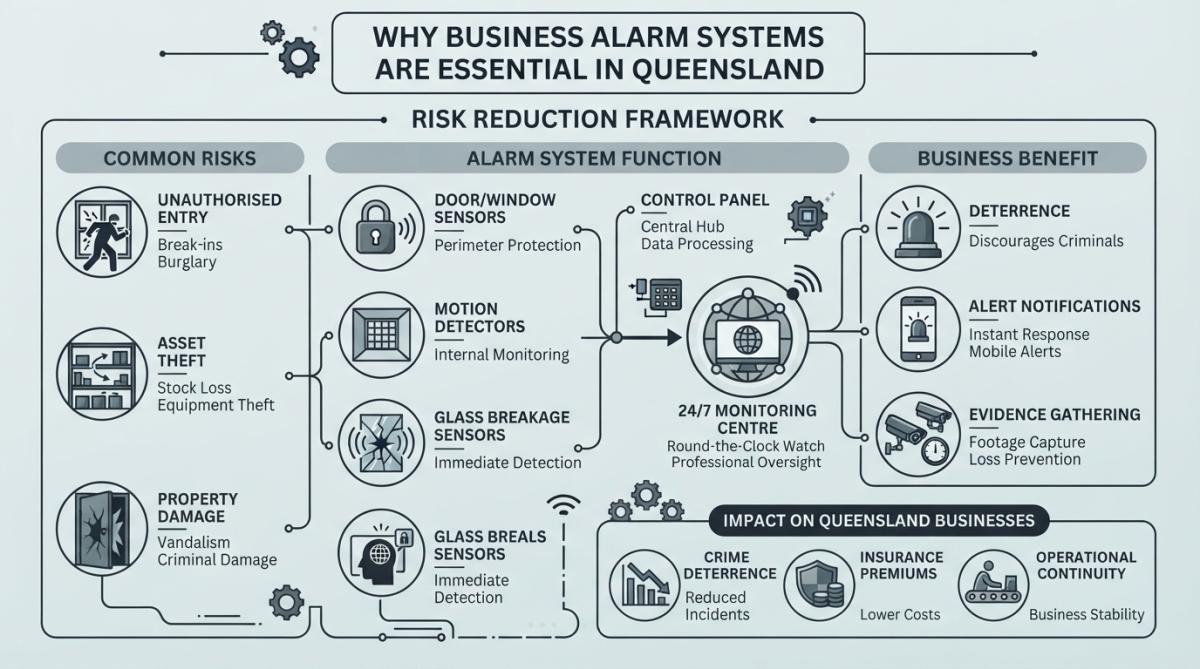
A break-in can cost a business far more than the value of stolen goods. Beyond the immediate loss, there's downtime, damaged property, compromised data, and the erosion of customer trust. This is why business alarm systems have become non-negotiable infrastructure for companies across Queensland.
Businesses with monitored alarm systems experience significantly fewer losses and recover faster when incidents occur, thanks to documented rapid response protocols.
Business alarm systems combine multiple layers of protection: intrusion detection sensors that trigger alerts the moment unauthorised entry occurs, 24/7 monitoring centres that dispatch responders within minutes, and CCTV surveillance that documents every incident. When these elements work together, they create a security infrastructure that deters crime, protects assets, and gives business owners genuine peace of mind.
Modern systems are integrated networks that communicate in real time, alerting security teams and law enforcement simultaneously, a critical difference for high-risk businesses.
Crime Prevention and Deterrence
The deterrent effect of visible security equipment is well documented. Criminals actively avoid targets with obvious alarm systems, CCTV cameras, and monitored signage. A would-be intruder conducting site reconnaissance sees these markers and moves to an easier target. This alone justifies the investment.
A monitored business alarm system with rapid response capability shifts the risk-reward calculation in your favour, criminals understand response times and actively avoid monitored targets.
Panic buttons and silent alarm triggers add another layer. If an employee feels threatened during a robbery or confrontation, they can discreetly activate an alarm that alerts security and law enforcement without alerting the offender. This capability, available through professional monitoring services, transforms your team's safety profile.
Employees feel safer with professional security infrastructure, translating to better focus, reduced anxiety, and lower staff turnover, compounding financial benefits beyond loss prevention.
Asset Protection and Loss Prevention
Retail shrinkage (inventory loss through theft, damage, and error) is a major controllable expense. A business alarm system with access control and CCTV creates accountability that directly reduces it.
Access control systems restrict who can enter restricted areas, when they can enter, and for how long. Every access attempt is logged and auditable. This alone eliminates a massive category of internal theft. When combined with high-resolution IP surveillance that captures faces and details in real time, you have a system that documents every movement through your facility.
For warehouses and multi-tenant properties, auditable access control systems track tenant access by area and time, creating accountability and simplifying dispute resolution.
Timestamped video evidence and access logs support insurance claims, law enforcement investigations, and disciplinary action, and the knowledge of being recorded significantly reduces internal theft.
Commercial Alarm Monitoring Services and Real-Time Response
A monitored business alarm system differs fundamentally from an unmonitored one: trained operators verify alarms, assess situations, and dispatch armed security or police immediately.
Response time is critical: a 10-minute response can apprehend offenders or prevent loss, while a 45-minute response typically fails. Local providers enable faster response than centralised operators.
Modern systems notify owners and managers immediately when alarms trigger, allowing you to provide context to responders and activate additional protocols in real time.
Remote monitoring lets managers access live CCTV feeds, access logs, and system status from anywhere, enabling real-time incident assessment and response decisions.
Business Security System Cost and ROI
A business security system costs $3,000-$8,000 for small retail (plus $40-$80/month monitoring) or $15,000-$40,000 for warehouses (plus $150-$300/month). The true cost is lower when insurance savings and loss prevention are factored in.
Insurance Premium Reduction: The Quantifiable ROI
Insurers may offer premium discounts for certified, monitored systems.
Discount factors may include licensed installation and Australian Standards compliance, 24/7 armed response monitoring, combined intrusion detection and CCTV, and high-risk industries like retail and hospitality.
Contact your insurer before purchasing to confirm which certifications unlock discounts and whether approved installers offer additional savings.
Loss Prevention ROI: The Incident-Based Calculation
A single retail break-in or warehouse intrusion can be costly. Most businesses recover annual system costs if they prevent even one significant incident.
Access control and CCTV can reduce internal shrinkage. A system reducing shrinkage can pay for itself within months.
Additional Benefits: Professional monitoring can accelerate claim resolution, reduce staff turnover costs, and enable faster reputational recovery through documented rapid response.
Request quotes and cross-reference against insurer discounts and historical loss data, the true cost can be lower than headline price when insurance savings are factored in.
Security System Compliance and Legal Requirements
Queensland businesses in certain sectors face specific regulatory requirements; non-compliance risks regulatory penalties, denied insurance claims, and liability exposure.
Work Health and Safety Act 2011 (Qld)
The Work Health and Safety Act 2011 (Qld) requires businesses to ensure, so far as reasonably practicable, the health and safety of workers and others at the workplace.
High-risk venues (retail, hospitality, late-night) must assess threats and implement documented security measures including monitored alarm systems and panic buttons. Restricted areas require access controls with audit trails. Incident response protocols must be documented and tested.
Workplaces with incident history face heightened scrutiny; inability to demonstrate risk assessment and implemented controls risks Prohibition Notices or prosecution. Documented security infrastructure is primary evidence of compliance.
Security Industry Regulation 2017 (Qld)
Systems must be installed by licensed providers under the Security Providers Act 1993 (Qld) and meet Australian Standards AS/NZS 1801 and AS/NZS 2201. Monitoring centres must maintain call logs, response records, and system status reports.
Privacy Act 1988 (Cth) and Queensland Privacy Principles
If your business handles customer data, payment information, or confidential records, you have legal obligations under the Privacy Act 1988 (Cth) and the Queensland Privacy Principles (if you're a Queensland public sector organisation). Physical security, including alarm systems and access control, is a foundational component of data protection compliance.
Specifically:
- CCTV in areas where personal information is processed (reception, administrative offices, payment processing) must be justified by a legitimate security purpose. Signage must notify individuals that CCTV is in operation. Footage retention must be limited to a reasonable period.
- Access control for data storage areas is a mandatory safeguard under the Privacy Principles. If your business stores customer records, payment data, or confidential files, access must be restricted to authorised personnel only. Access logs must be maintained to demonstrate who accessed what information and when.
Insurance Policy Conditions
Insurance policies frequently stipulate security requirements as conditions of coverage. Common requirements include:
- Monitored alarm systems: Many insurers require 24/7 professional monitoring, not just local alarms. An unmonitored system may not satisfy policy conditions.
- CCTV coverage: High-value inventory or cash-handling businesses often face mandatory CCTV requirements. The insurer may specify camera resolution, coverage areas, and retention periods.
- Access control: Facilities with restricted areas may be required to maintain documented access logs.
- System testing and maintenance: Policies often require annual system testing and maintenance records. Failure to maintain these records can result in claim denial.
If an incident occurs and your facility lacks the security infrastructure stipulated in your policy, your insurer may deny the claim entirely. This makes compliance not just a regulatory matter but a financial necessity. Request a copy of your policy's security requirements and cross-reference them against your current system configuration. If gaps exist, upgrading the system becomes a risk mitigation priority.
Industry-Specific Obligations
- Retail and hospitality: Venues serving alcohol or operating late hours face heightened WHS obligations around worker safety and assault prevention. Monitored panic buttons and documented incident response protocols are standard expectations.
- Cash-handling businesses: Businesses handling significant cash (retail, hospitality, gaming venues) often face specific security requirements from their insurer, their bank, and regulatory bodies. Access control, CCTV, and alarm systems are typically mandatory.
- Construction sites: Temporary security infrastructure is required under the Work Health and Safety Act 2011 (Qld) and the Building and Construction Industry (Improving Productivity) Act 2016 (Cth). Monitored alarm systems and access control reduce theft and unauthorised access.
Compliance Assessment and Documentation
A professional security provider should be able to conduct a compliance assessment specific to your industry and facility type. This assessment identifies which regulations apply to your business, which security infrastructure is required, and which system configuration satisfies those requirements. Request this assessment in writing; it becomes evidence of due diligence if a regulator or insurer later questions your compliance.
Tupper Security's team can assess your specific facility against relevant Queensland regulations and advise on security requirements applicable to your industry and operations. A professional site risk assessment identifies compliance gaps and recommends system configurations that meet both regulatory requirements and your operational needs.
Choosing the Right Alarm System for Your Business
Different facility types require different security approaches. A retail storefront needs different protection than a warehouse. A construction site requires different monitoring than an office building. The most common mistake is treating security as a one-size-fits-all purchase rather than a tailored design challenge.
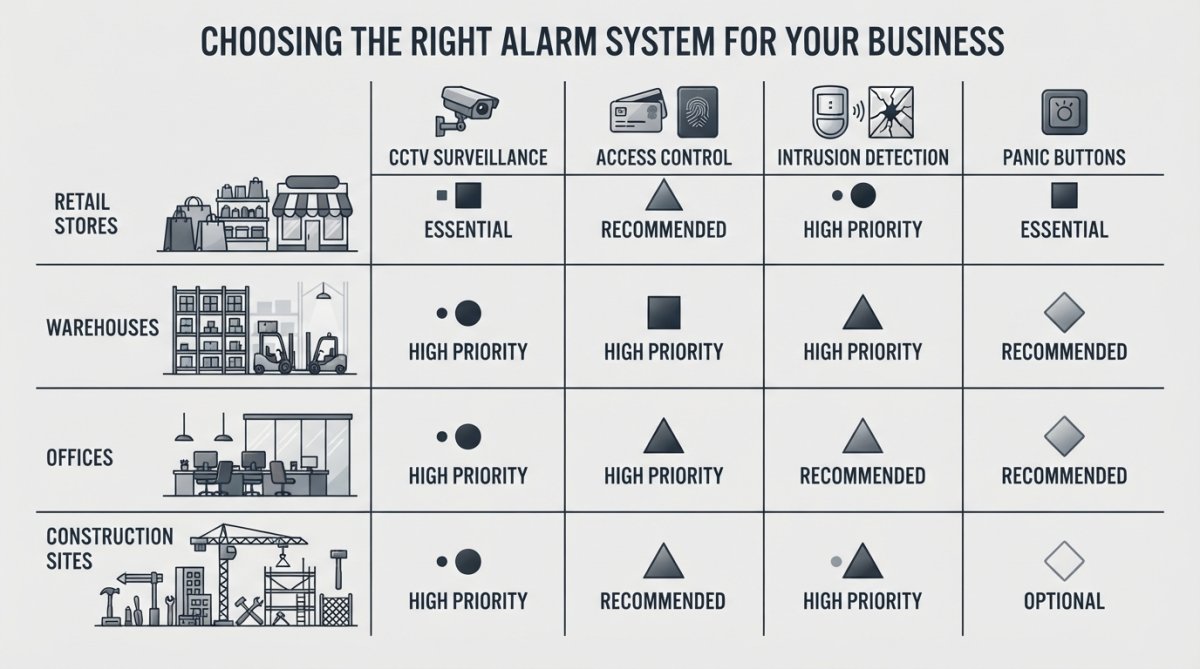
Start with a professional site survey.
Frequently Asked Questions
How do 24/7 alarm monitoring services improve business security?
24/7 commercial alarm monitoring services provide constant surveillance and rapid emergency dispatch. When an alarm is triggered, monitoring staff verify the alert and contact emergency services or dispatch a mobile patrol immediately. This eliminates response delays caused by relying on staff to notice a break-in or theft. Real-time alerts mean unauthorized entry, sensor breaches, or panic button activations are handled within minutes, significantly reducing loss and improving occupant safety.
What are the legal requirements for security alarm systems in Queensland?
Security system compliance in Queensland requires alarm systems to meet relevant Australian Standards for installation and performance. CCTV systems must comply with privacy legislation under the Privacy Act 1988 (Cth) and state-based surveillance device laws. Access control systems handling personal data require compliance with data protection standards. Professional alarm monitoring operators must hold appropriate security licences issued by the Queensland Office of Liquor and Gaming Regulation. Regular maintenance and system testing ensure ongoing compliance and operational reliability.
How much does a business security system cost and what's the return on investment?
Business security system cost varies significantly based on property size, system complexity, monitoring type, and integration requirements. Rather than a fixed price, costs depend on whether you need CCTV surveillance, access control, intrusion detection, or a combination. Many systems may qualify for insurance premium reductions, offsetting installation and monitoring fees over time. A proper security audit identifies which components deliver the highest ROI for your specific risk profile, ensuring you invest in protection that directly addresses your vulnerabilities.
What are the primary benefits of installing a commercial alarm system?
Commercial alarm systems deliver multiple benefits: crime deterrence through visible security infrastructure, rapid emergency response via 24/7 monitoring, documented evidence for loss prevention, reduced insurance premiums, and employee safety through panic buttons and access control. For multi-site operations, centralized monitoring and auditable access logs provide consistency across locations. Integration with smart building technology enables remote management, real-time alerts, and historical reporting, essential for compliance, risk mitigation, and business continuity.