 ultimate-guide
Tailored Security Plans for Businesses: A 2026 Guide
Table of Contents
- Why Tailored Security Plans Matter More Than Off-the-Shelf Solutions
- Conducting a Business Security Risk Assessment
- Using a Business Security Risk Assessment Template
- Integrating Physical Security and Cyber Security
- Aligning Your Plan with AS/NZS ISO 31000 Risk Management Standards
- Security Plan Implementation Checklist and Next Steps
- Measuring ROI and Continuous Improvement
- Conclusion
Why Tailored Security Plans Matter More Than Off-the-Shelf Solutions
Generic security solutions fail because they ignore how your business actually operates. A one-size-fits-all approach might include features you'll never use whilst missing protections for your specific vulnerabilities. The real difference between a security plan that works and one that creates false confidence comes down to alignment, matching your protection strategy to your actual risk landscape, not to what a template suggests.
At Tupper Security, we've seen businesses invest in expensive systems only to discover they're protecting the wrong assets or leaving critical gaps unaddressed. The cost isn't just wasted capital; it's the operational friction of managing systems that don't fit your workflow, and worse, the genuine security gaps that remain hidden.
Tailored security plans address this directly. They start with your business, not with a product catalogue. A proper assessment identifies where threats are most likely to materialise, which assets matter most, and what your team can realistically maintain. The result is a security infrastructure that protects what actually needs protecting, integrates into how you work, and scales with your business without constant overhauls.
This matters whether you're a retail store managing shrinkage, a warehouse protecting high-value inventory, a construction site securing equipment and personnel, or a multi-tenant property managing access across dozens of occupants. The threats differ. The solutions must too.
Conducting a Business Security Risk Assessment
A proper security risk assessment is the foundation of any effective plan. It's not a checkbox exercise or a compliance formality, it's the diagnostic phase that reveals what you're actually protecting against. Without it, you're essentially guessing about your vulnerabilities, and guessing wrong is expensive.
The assessment process examines three interconnected layers: physical infrastructure (buildings, perimeters, access points), operational practices (who has access to what, when, and how), and human factors (training, awareness, response procedures). Most businesses focus on one layer and neglect the others, which is where gaps emerge.

Identifying Business-Specific Risks
Your risks aren't generic, they're tied to what you do, where you operate, and what you hold valuable. A retail store faces shrinkage and customer safety risks. A construction site faces equipment theft and site access control challenges. A multi-tenant warehouse faces tenant isolation and cross-site monitoring complexity. A hospitality venue faces crowd management and patron safety during events.
The first step is cataloguing assets. What needs protecting? This includes obvious items like inventory, cash, or equipment, but also less obvious ones: data systems, intellectual property, personnel safety, brand reputation, and operational continuity. Rank them by impact if lost or compromised.
Next, identify threat vectors. How could someone access what you want to protect? This includes external threats (burglary, vandalism, unauthorised access) and internal ones (employee theft, negligent access control, inadequate training). Consider timing, some threats are highest during off-hours, others during peak operations when oversight is thinner.
Environmental factors matter too. Location affects threat likelihood: a retail store in a high-crime area faces different pressures than one in a quiet precinct. Site layout determines where vulnerabilities concentrate, blind spots in your CCTV coverage, access points that are hard to monitor, areas where people naturally congregate.
Vulnerability Analysis and Threat Mapping
Once you've identified what you're protecting and how it might be threatened, the next phase is mapping specific vulnerabilities. This is where many assessments fall short, they list risks in abstract terms without pinpointing exactly where your security posture is weak.
Vulnerability analysis asks concrete questions: Can someone enter your building without being seen? Are your access logs auditable? Do your CCTV cameras cover all high-value areas, or are there blind spots? Is your alarm response time documented and tested? Are staff trained to recognise and report security concerns?
Threat mapping connects these vulnerabilities to realistic scenarios. If your warehouse has poor perimeter visibility, what's the likelihood of unauthorised access during night hours? If your retail store lacks documented loss prevention procedures, how exposed are you to internal theft? If your multi-site operation has inconsistent access control across locations, what's the risk of a breach at one site affecting others?
The output of this phase is a prioritised list: which vulnerabilities pose the highest risk, which are easiest to address, and which require investment to resolve. This becomes your roadmap for the security plan itself.
Using a Business Security Risk Assessment Template
A structured assessment template ensures nothing gets missed and results are comparable over time. The template should capture asset inventory, threat scenarios, vulnerability findings, and remediation priorities in a consistent format.
The most useful templates follow this structure: asset category (physical, operational, personnel), current state (what protection exists now), identified gaps (what's missing), potential impact (what happens if this vulnerability is exploited), and recommended action (what needs to change, and by when).
Many organisations use the AS/NZS ISO 31000 framework as a foundation for their assessment template, which provides standardised language for risk identification and evaluation. This approach ensures your assessment aligns with broader risk management standards and creates documentation that's auditable and defensible.
A practical template should be specific enough to guide the assessment but flexible enough to accommodate your industry and site type. Generic templates often miss industry-specific risks, a construction site assessment needs different questions than a retail assessment. The template should evolve as your business changes, becoming a living document rather than a one-time exercise.
Integrating Physical Security and Cyber Security
Modern threats don't respect the boundary between physical and cyber security. A burglar might use cyber reconnaissance before attempting physical access. A disgruntled employee might combine physical access to damage systems alongside cyber attacks. A sophisticated threat might use physical vulnerabilities to install surveillance devices that capture data.
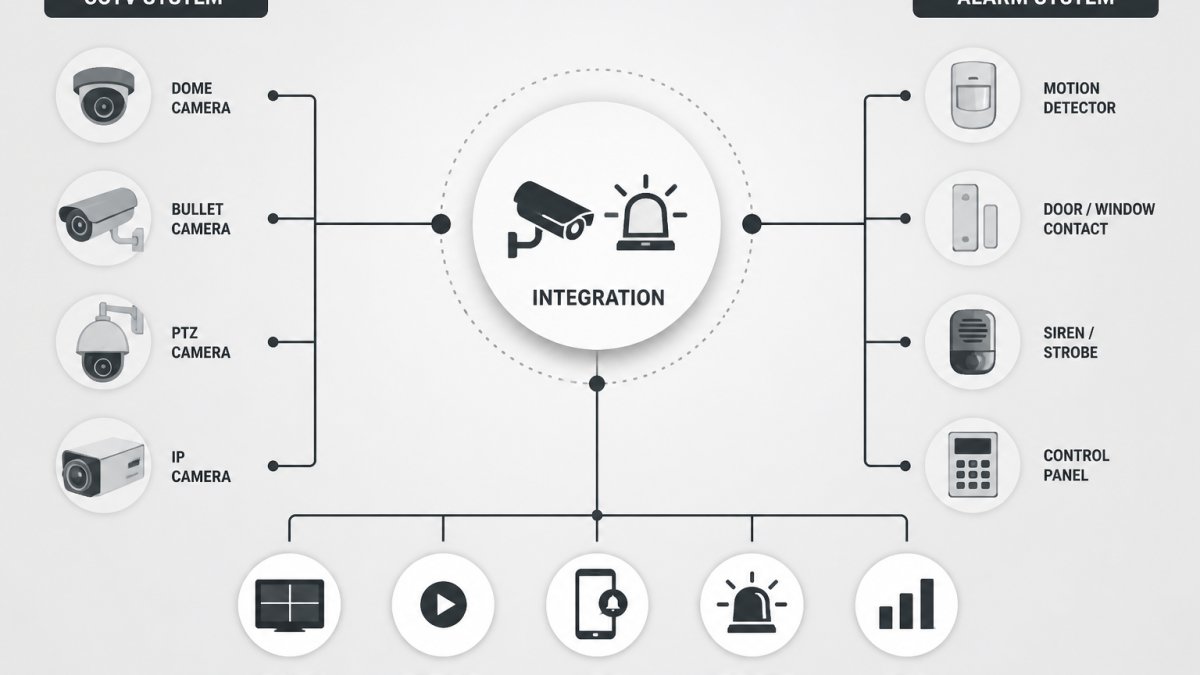
Integration means your security strategy addresses both domains as interconnected systems, not separate silos. Your access control system needs cyber protection, if someone can hack your electronic locks, physical barriers become irrelevant. Your surveillance system needs network security, if your CCTV feeds are unencrypted, someone could intercept them or manipulate recordings. Your alarm system needs both physical sensors and cyber protection against false alarms triggered by system compromise.
Practically, this means your assessment and plan should identify where physical and cyber risks overlap. Where do people with physical access also have access to systems? Where could cyber compromise affect physical security? What happens if your internet connection fails, do your security systems degrade gracefully or fail entirely?
Integration also affects monitoring and response. A comprehensive security operation monitors both physical events (motion detection, door access, perimeter breaches) and cyber events (login attempts, system access, network anomalies) through a coordinated response protocol. When an alarm triggers, responders need to know whether it's a physical intrusion, a cyber incident affecting physical systems, or both.
Aligning Your Plan with AS/NZS ISO 31000 Risk Management Standards
Australian businesses benefit from aligning their security planning with established risk management frameworks. The AS/NZS ISO 31000 standard provides a structured approach to identifying, analysing, and responding to risk that's widely recognised and auditable.
This standard emphasises that risk management isn't a one-time exercise but a continuous process embedded in business operations. Your security plan should reflect this, not as a static document, but as a framework that guides ongoing assessment, adjustment, and improvement.
Alignment with ISO 31000 also matters for compliance and insurance. Many insurers and regulators reference this standard when evaluating whether an organisation has taken reasonable steps to manage risk. A security plan developed using this framework demonstrates due diligence and can reduce your exposure if an incident occurs.
The standard's risk evaluation process helps prioritise your security investments. Not all risks warrant the same response, some require immediate action, others can be managed through monitoring, and some may be accepted as part of doing business. The framework helps you make these decisions consistently and defensibly.
Security Plan Implementation Checklist and Next Steps
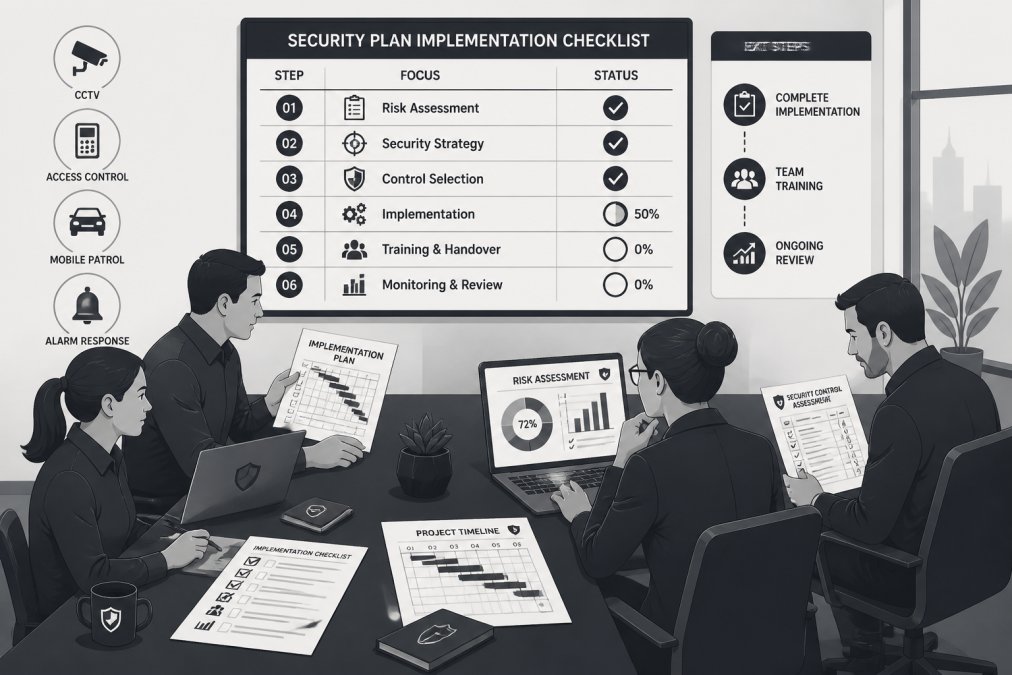
Once your assessment is complete and your plan is designed, implementation is where theory meets reality. A detailed checklist ensures nothing slips through and that changes are tracked and tested before full deployment.
Building Your Security Infrastructure
Your infrastructure includes physical components (cameras, access control systems, alarms, lighting) and operational components (monitoring protocols, response procedures, documentation systems). Implementation should follow a sequence that minimises disruption and ensures each component is tested before the next is added.
Start with perimeter security and access control, these form your first line of defence and affect everything downstream. Test that doors lock and unlock as intended, that access logs are being recorded, that alerts trigger when they should. Then move to monitoring systems (CCTV, motion detection, environmental sensors). Verify coverage, test recording and retrieval, and ensure feeds are accessible to authorised personnel.
Next, integrate alarm response systems and communication protocols. Ensure your monitoring centre receives alerts, that escalation procedures are clear, and that responders know exactly what action to take. Test this with dry runs, simulate an alarm and walk through the entire response chain.
Finally, implement documentation and audit systems. Your security infrastructure is only as strong as your ability to verify it's working and to prove it was working if an incident occurs. This includes access logs, CCTV footage retention, alarm records, and incident reports.
Establishing Security Protocols and Personnel Training
Infrastructure without proper protocols is like having a fire extinguisher but not knowing how to use it. Your team needs clear, documented procedures for every security scenario they might encounter.
Protocols should cover normal operations (how access is granted, how surveillance is monitored, how logs are reviewed) and incident response (what to do if an alarm triggers, how to report suspicious activity, when to escalate to authorities). Each protocol should specify who is responsible, what they should do, when they should do it, and how to document it.
Personnel training is non-negotiable. Your security team needs to understand the systems they're managing and the procedures they're following. Retail staff need to recognise signs of theft or suspicious behaviour. Site managers need to understand access control and know when to question who's on site. Everyone needs to know who to contact if something seems wrong.
Training should be documented and refreshed regularly. A one-time induction isn't sufficient, security threats evolve, new staff arrive, and procedures change. Regular training keeps your team sharp and ensures consistency across shifts and locations.
Post-Incident Response Planning
Even the best security plan won't prevent every incident. What matters is how you respond when something does happen. A post-incident response plan ensures you react quickly, preserve evidence, minimise damage, and learn from the event.
Your response plan should specify: immediate actions (secure the area, contact authorities, preserve evidence), communication (who gets notified, when, and how), investigation (what information to gather, how to document it), and recovery (how to restore normal operations). The plan should be tested regularly, you don't want to learn gaps in your response during an actual incident.
Documentation is critical. Every incident should be recorded: what happened, when, who responded, what was done, and what was the outcome. This documentation serves multiple purposes: it helps you identify patterns (is a particular access point being targeted?), it supports insurance claims, it provides evidence if legal action becomes necessary, and it reveals where your procedures need adjustment.
Measuring ROI and Continuous Improvement
Security investment is often treated as a cost centre with no measurable return. In reality, effective security delivers measurable value: reduced losses, faster incident response, lower insurance premiums, and reduced operational friction from overly restrictive controls.
Measuring ROI starts with baseline data. Before implementing your plan, document your current loss rates (shrinkage, theft, incidents), incident response times, and operational costs. After implementation, track the same metrics. A retail store might measure reduction in shrinkage. A warehouse might measure reduction in unauthorised access incidents. A multi-site operation might measure consistency in response times across locations.
Not all value is financial. Reduced risk, improved staff confidence, faster incident detection, and better compliance documentation all have value. Quantify what you can and document the rest, this becomes your business case for ongoing investment.
Continuous improvement means your security plan evolves. Threat landscapes change. Your business grows or shifts focus. New technologies become available. Your plan should be reviewed annually and adjusted based on what you've learned from incidents, near-misses, and operational experience.
Effective security isn't about buying the most expensive systems or following industry templates. It's about understanding your specific vulnerabilities, building protection that matches those vulnerabilities, and maintaining that protection as your business and threats evolve. A tailored security plan does this systematically.
Tupper Security specialises in exactly this kind of assessment and implementation. Our team conducts detailed risk assessments specific to your operation, designs security infrastructure that integrates with how you actually work, and supports implementation with training and ongoing monitoring. Whether you're a retail store, warehouse, construction site, or multi-tenant property in South-East Queensland, our approach starts with your business, not with a product list. Request a quote to discuss your security needs with our licensed operators.
Frequently Asked Questions
What should be included in a tailored security plan for my business?
A tailored security plan must address your specific risk profile, operational layout, and asset value. Include a vulnerability analysis, access control strategy, surveillance and monitoring systems, incident response procedures, staff training requirements, and compliance obligations under relevant standards. The plan should detail which areas need physical security measures, which require cyber security integration, and how your security personnel will respond to threats. Review it annually and after any significant operational changes.
How do I use a business security risk assessment template effectively?
A business security risk assessment template guides you through identifying assets, potential threats, existing vulnerabilities, and likelihood of incidents. Start by listing all physical and digital assets, then document current security gaps, unlocked doors, poor lighting, outdated CCTV, weak access controls. Rate each risk by probability and impact. Prioritise high-impact vulnerabilities for immediate action. Use the template to create a baseline you can measure progress against and share with your security consultant or team to ensure nothing is overlooked.
Why is compliance with AS/NZS ISO 31000 important for my security plan?
AS/NZS ISO 31000 is the Australian and New Zealand standard for risk management. Aligning your security plan with this framework ensures your risk assessment is systematic, documented, and defensible. It demonstrates due diligence to insurers, regulators, and stakeholders. The standard requires you to identify context, establish criteria, analyse risks, evaluate them against your tolerance, and treat the highest priorities first. Following it protects your business legally and operationally by ensuring no significant threat is overlooked.
How often should I review and update my tailored security plan?
Review your security plan at least annually, or whenever your business operations change, new locations, staff turnover, equipment upgrades, or after a security incident. Changes in the threat landscape or regulatory requirements also trigger a review. Continuous improvement means monitoring how well your current measures perform, updating your incident response procedures based on lessons learned, and adjusting your security infrastructure as technology and risks evolve. Regular reviews keep your plan aligned with your actual business needs.
This article was written using GrandRanker