 how-to
Site Risk Assessment for Businesses: A How-To Guide
Table of Contents
- What Is a Site Risk Assessment?
- Why Your Business Needs a Site Risk Assessment
- Workplace Hazard Identification Examples: What to Look For
- Steps to Conducting a Site Risk Assessment
- Controlling Workplace Risks: The Hierarchy of Controls
- WHS Risk Assessment Template and Documentation
- Consulting with Stakeholders and Verifying Competency
- Common Mistakes to Avoid During Site Risk Assessment
Last Updated: August 16, 2026
What Is a Site Risk Assessment?
A site risk assessment is a systematic examination of your workplace to identify hazards, evaluate the level of risk they pose, and determine appropriate control measures to protect workers and assets. It forms the foundation of occupational health and safety management and is a legal requirement under work health and safety legislation.
The process involves walking your site, documenting potential dangers, assessing how likely harm is to occur and how serious it would be, then implementing solutions to eliminate or reduce those risks. A proper site risk assessment isn't a one-time tick-box exercise, it's an ongoing practice that evolves as your operations change.
At Tupper Security, we conduct independent site risk assessments as part of our tailored security design reviews. We examine not just physical security infrastructure, but operational vulnerabilities that could expose your business to loss, liability, or safety incidents.
Why Your Business Needs a Site Risk Assessment
Workplace incidents cost businesses time, money, and reputation. Beyond immediate costs of injury or damage, there's lost productivity, regulatory scrutiny, insurance claims, and potential prosecution if a hazard was foreseeable and unaddressed.
A site risk assessment prevents these outcomes by creating a documented record that you've identified hazards and acted responsibly. This demonstrates your duty of care, a legal obligation to take reasonable steps to protect people on your site from harm.
For retail operations, the assessment reveals loss prevention vulnerabilities. For construction sites, it identifies fall hazards, equipment risks, and environmental dangers. For multi-tenant properties, it ensures consistent safety protocols across all areas. For event venues, it addresses crowd control, emergency egress, and security integration.
The assessment also improves operational efficiency. When you understand where risks actually exist, you can allocate resources strategically rather than implementing blanket policies that slow down work without adding real protection.
Safe Work Australia's guidance on conducting risk assessments outlines the legislative framework. Most businesses find that conducting a proper assessment early prevents far more costly problems later.
Workplace Hazard Identification Examples: What to Look For
Hazard identification is the critical first step. You're looking for anything that could potentially cause harm, obvious physical dangers and less visible operational and psychosocial risks.
Physical hazards on your site
Physical hazards include slips, trips, and falls from wet floors or debris; electrical hazards from exposed wiring or damaged equipment; manual handling injuries from lifting incorrectly; and machinery hazards from unguarded moving parts.
In warehouses, stacked items that could collapse, forklift traffic in pedestrian areas, and inadequate lighting create overlapping risks. Construction sites present fall hazards from heights, excavation dangers, and moving vehicle hazards.
Check for worn equipment, missing guards, poor housekeeping, inadequate signage, and areas where workers are rushing or taking shortcuts. These often indicate the physical environment itself is creating pressure to work unsafely.

Environmental and operational hazards
Environmental hazards include exposure to heat, cold, noise, dust, or chemical substances. Poor ventilation creates air quality issues; temperature extremes pose heat stress or hypothermia risks.
Operational hazards arise from how work is done: fatigue from long shifts without adequate breaks, time pressure encouraging unsafe shortcuts, inadequate training, and communication breakdowns. Seasonal or cyclical changes matter too, peak periods bring more staff, longer hours, and temporary workers, shifting hazards significantly.
Psychosocial and security-related hazards
Psychosocial hazards are increasingly recognized as serious workplace risks: workplace violence or aggression, bullying or harassment, excessive workload or unrealistic deadlines, lack of control over work decisions, and inadequate support or resources.
For retail and hospitality sites, customer aggression toward staff is a genuine hazard. For sites with public access, there's risk of theft, vandalism, or security breaches. Security-related hazards include unauthorized access, inadequate monitoring of high-risk areas, and poor emergency communication, these are workplace safety issues because they create conditions where incidents can occur unchecked.
Steps to Conducting a Site Risk Assessment
A structured approach ensures you capture all hazards and implement proportionate controls.
Step 1: Assemble your assessment team and gather site information
Form an assessment team with diverse perspectives: a site manager or operations lead, frontline workers, a health and safety representative if available, and ideally someone with risk assessment experience.
Gather baseline information: site layout plans, current safety policies, records of past incidents or near-misses, equipment maintenance logs, staff rosters, and any previous assessments or audit findings. This preparation prevents missing context where hazards combine or emerge only during certain operational conditions.
Step 2: Identify all hazards through workplace inspection
Walk the site systematically, section by section. Look at what's present (equipment, substances, structures), what people are doing (tasks, procedures, interactions), and the conditions they're working in (lighting, temperature, noise, crowding).
Ask workers directly: "What's the hardest part of your job? What do you worry about? What have you seen go wrong?" Frontline staff often identify hazards that management misses. Document everything with photos and precise locations without jumping to solutions yet.
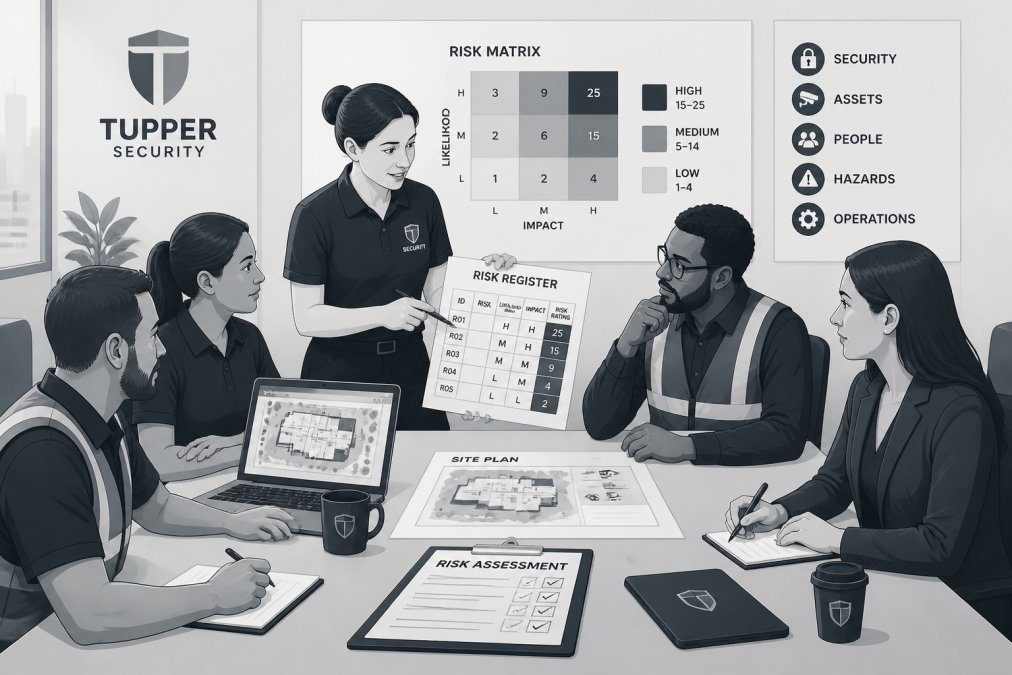
Step 3: Evaluate the level of risk using a risk matrix
Assess each hazard using a risk matrix that considers likelihood and consequence. Likelihood ranges from rare to almost certain; consequence ranges from negligible to catastrophic.
A hazard with high likelihood and high consequence (e.g., fall from height on a construction site) is critical and requires immediate control. A hazard with low likelihood and low consequence is low priority. The matrix helps you allocate resources to the risks that matter most.
Step 4: Determine suitable control measures
For each significant risk, identify control measures using the hierarchy of controls: elimination (remove the hazard entirely), substitution (replace it with something safer), engineering controls (isolate the hazard), administrative controls (change how work is done), and personal protective equipment (last resort).
For a slipping hazard, elimination might mean removing the wet process; substitution might mean using a different material; engineering controls might be improved drainage or anti-slip surfaces; administrative controls might be more frequent cleaning; PPE would be slip-resistant footwear as a last resort.
Ensure controls are practical and won't create new hazards.
Step 5: Document findings and record actions
Create a risk register listing each hazard, the level of risk before controls, the control measures implemented, the residual risk after controls, and who's responsible with target completion dates.
This documentation demonstrates to regulators that you've met your duty of care, provides a reference point for future assessments, and creates accountability. Update the register as controls are implemented and verify they're actually reducing risk.
Controlling Workplace Risks: The Hierarchy of Controls
The hierarchy of controls is the framework guiding which solutions to implement, based on the principle that some control types are inherently more effective than others.
Elimination is the gold standard. If you can remove the hazard entirely, the risk disappears. This might mean redesigning a process to avoid a dangerous substance or rerouting traffic to separate vehicle and pedestrian movements. Elimination is often expensive upfront but eliminates ongoing risk management costs.
Substitution replaces a hazard with something safer, using a non-toxic cleaning product instead of a toxic one, or a quieter machine instead of a loud one.
Engineering controls isolate the hazard so people aren't exposed: machine guards prevent contact with moving parts; ventilation systems remove dust or fumes; barriers separate pedestrians from vehicle traffic. These controls work regardless of human behavior.
Administrative controls change how work is organized: rotating workers to limit exposure to repetitive strain, scheduling maintenance during low-traffic periods, limiting shift length to reduce fatigue. These depend on consistent implementation but are often lower cost.
Personal protective equipment is the last resort, hard hats, safety glasses, gloves, high-visibility clothing. PPE only protects the wearer, doesn't eliminate the hazard, and depends on consistent correct use.
Most effective risk management uses multiple layers. A construction site might eliminate fall risk where possible, substitute high-risk tasks with safer alternatives, use guardrails and safety nets as engineering controls, implement work procedures as administrative controls, and require harnesses as PPE. This layered approach is called defense in depth.
WHS Risk Assessment Template and Documentation
A functional risk assessment template captures the information you need without becoming unwieldy. Include fields for hazard description, location, who might be affected, likelihood and consequence ratings, risk level, control measures, responsible person, target date, residual risk, and verification that controls are working.
What to include in your risk register
Your risk register is the living document of your assessment. Be specific: rather than "slipping hazard," write "wet floors in production area during cleaning cycles, 6 AM to 7 AM daily, affecting production and maintenance staff." Rather than "implement controls," specify "install anti-slip floor coating in production area by 30 September 2026, cost $4,500, assigned to Facilities Manager."
Include the date of assessment, who conducted it, and when it was last reviewed. This creates an audit trail and ensures you're not relying on outdated information.
Recording residual risk and corrective actions
After implementing controls, assess the remaining risk. This is almost never zero, but it should be significantly lower than the original risk level.
Document corrective actions separately if controls aren't achieving the intended reduction. Track completion of actions, a corrective action without follow-up is just a promise. Assign someone to verify that controls are actually working as intended.
Consulting with Stakeholders and Verifying Competency
A risk assessment conducted in isolation misses critical information. Workers, supervisors, contractors, and safety representatives all have insights that improve accuracy and buy-in.
Consult with workers about what they experience daily. They'll identify hazards that management doesn't encounter and can flag controls that won't work in practice. This consultation also signals that you take their safety seriously.
If you use contractors or temporary workers, ensure they understand your site-specific hazards and controls. Verify that the person conducting the assessment has relevant competency, they should understand hazard identification principles, risk evaluation methods, and control hierarchy. For complex sites or specialized hazards, external expertise is worthwhile.
Tupper Security conducts independent site risk assessments with trained security professionals who evaluate both operational hazards and security vulnerabilities. We consult with your team to understand how your site actually operates, then provide recommendations grounded in both safety principles and practical feasibility.
Common Mistakes to Avoid During Site Risk Assessment
The most common mistake is treating the assessment as a compliance checkbox rather than a genuine effort to understand and manage risk. This leads to generic assessments that don't reflect your actual site and controls that aren't implemented.
Another mistake is identifying hazards but failing to implement controls or delaying implementation indefinitely. An assessment without action creates a documented record that you identified a risk and did nothing about it, which strengthens a regulator's case if an incident occurs.
Underestimating psychosocial and security hazards is increasingly common. These risks are less visible than physical hazards but equally serious. Workplace violence, bullying, fatigue from unrealistic workload, and security breaches all create conditions where incidents happen.
Failing to update the assessment when operations change is critical. If you introduce new equipment, restructure work processes, hire significantly more staff, or change shift patterns, the hazards and risk levels shift too.
Finally, many organizations underestimate the importance of worker involvement and communication. Controls implemented without understanding from frontline staff are often circumvented. Workers who understand why a control exists are far more likely to use it consistently.
A site risk assessment is your foundation for protecting people and assets. It transforms vague concerns into specific, documented hazards with proportionate controls. The effort you invest upfront prevents far more costly problems: incidents, regulatory action, litigation, and lost trust.
Start with a clear team, walk your site systematically, evaluate risks honestly, implement layered controls, and maintain your documentation as operations evolve. If your site is complex or you're uncertain about your approach, Safe Work Australia's risk assessment resources provide detailed guidance, and external expertise from security and safety professionals can accelerate the process and improve outcomes.
Tupper Security can conduct an independent site risk assessment tailored to your operations. We evaluate physical hazards, security vulnerabilities, and operational risks, then provide specific recommendations with implementation guidance. Request a quote to discuss your site's unique needs.
Frequently Asked Questions
What are the main steps in conducting a site risk assessment?
A site risk assessment follows five core steps: assemble your team and gather site data, identify all hazards through workplace inspection, evaluate risk using a risk matrix (likelihood and consequence), determine suitable control measures using the hierarchy of controls, and document all findings in a risk register. Each step builds on the previous one to create a comprehensive risk management plan that addresses both immediate and residual risks.
What's the difference between a hazard and a risk in a workplace context?
A hazard is anything with the potential to cause harm, such as a wet floor, faulty equipment, or an unsecured load. A risk is the likelihood and severity of that harm actually occurring. For example, a wet floor is a hazard; the risk depends on foot traffic volume and whether warning signs are in place. Understanding this distinction is essential for effective risk assessment and designing appropriate control measures.
How often should a site risk assessment be reviewed?
A site risk assessment should be reviewed at least annually or whenever significant changes occur, such as new equipment, process changes, staffing shifts, or after an incident. Many businesses review quarterly or after each safety audit. Regular review ensures your risk register remains current, control measures stay effective, and your site-specific safety protocols reflect actual operational conditions.
What should a WHS risk assessment template include?
A WHS risk assessment template must capture the hazard description, location, affected workers, current control measures, likelihood and consequence ratings, overall risk level, recommended control actions, responsibility assignment, and completion date. It should also include sections for residual risk evaluation after controls are implemented, incident prevention strategies, and stakeholder consultation notes. Documentation is critical for demonstrating duty of care and compliance with occupational health and safety requirements.
This article was written using GrandRanker