 how-to
How to Select Security Guards for Construction Sites
Table of Contents
- Why Selecting the Right Security Guards Matters for Construction Sites
- Construction Site Security Guard License Requirements
- Conducting a Construction Site Risk Assessment Checklist
- Static Guards vs Mobile Patrols: Which Suits Your Site
- Understanding the Cost of Hiring Construction Security Guards
- WHS Compliance and Security Guard Training Standards
- Evaluating Response Times and Incident Protocols
- Making Your Final Selection
Last Updated: August 18, 2026
Why Selecting the Right Security Guards Matters for Construction Sites
Construction sites face unique security challenges: material theft, equipment loss, unauthorised access, and safety incidents. Poor security costs more than replacement value, it causes project delays, insurance claims, and reputational damage. Selecting guards for construction sites differs fundamentally from general security hiring. Construction operations run on tight schedules with constantly changing layouts, requiring guards who understand site protocols, recognise construction-specific threats, and respond without halting productivity.
At Tupper Security, we've worked with construction operations across South-East Queensland long enough to see what separates effective site protection from box-ticking exercises. It comes down to evaluating your actual needs, verifying provider credentials, and aligning capabilities with specific vulnerabilities.
Construction Site Security Guard License Requirements
A licensed security guard in Queensland must hold a valid security licence issued under the Security Providers Act 1997. This is a legal requirement; hiring unlicensed guards creates liability for the site.
Queensland-Specific Licensing Standards
Queensland security licences vary by work type. Construction site security typically requires Class 1B (general security) or Class 2 (crowd control) licences. Class 1B permits static guarding, mobile patrols, and access control, core construction site activities.
To hold a Class 1B licence, a guard must be at least 18 years old, pass a criminal history check, complete approved security training, demonstrate knowledge of relevant legislation including WHS obligations, and pass a competency assessment. Licences are valid for three years and must be renewed before expiry. Licensed guards must maintain professional indemnity insurance and comply with the Security Providers Code of Conduct.
How to Verify a Provider's Credentials
Never assume a security company is properly licenced. Request proof: a copy of their firm licence, current Class 1B licences for assigned guards, professional indemnity insurance evidence, and WHS induction proof. You can verify a firm's licence status through the Queensland Office of Fair Trading licensing register. If a company resists verification, move on.
Conducting a Construction Site Risk Assessment Checklist
Before briefing any security provider, understand your own vulnerabilities. Identify what needs protecting, where gaps exist, and what security presence makes sense.
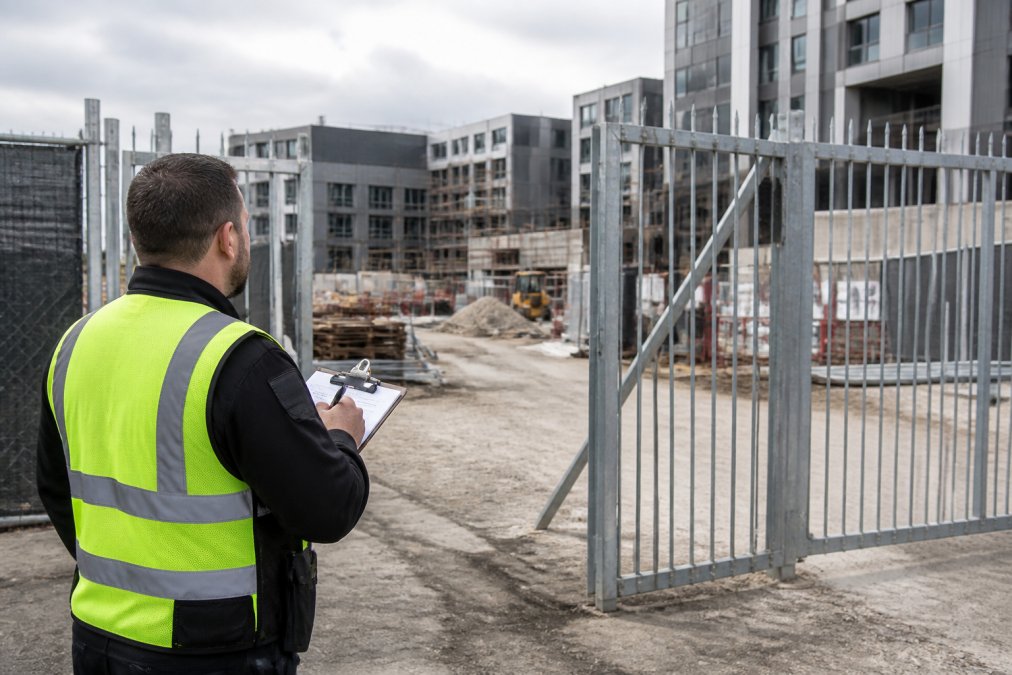
Map your site: What assets are most at risk? High-value plant, equipment, materials, fuel, tools, and copper wiring are common targets. Where are they located? How many entry and exit routes exist? How visible are they from the main work area?
Key Vulnerabilities to Identify
Perimeter security. Is your site fully fenced? Are there gaps or broken sections? Are gates properly secured and monitored?
Access control. Who needs entry, when, and through which gates? Do you have a visitor log? Can you distinguish authorised workers from unauthorised personnel?
Lighting and visibility. Are dark perimeter areas lit? Can guards see what's happening at night?
High-value asset storage. Where are materials and equipment stored? Are they locked or secured to discourage theft?
Site communication. How do workers report suspicious activity? Is there a clear incident reporting process?
WHS hazards. What safety risks exist? Unauthorised personnel on site create accidents and liability.
Using Assessment Findings to Brief Your Security Team
Translate vulnerabilities into specific requirements. Don't say "we need guards", say "we need two static guards at the main gate during business hours to monitor the visitor log, and mobile patrols three times per night to check the perimeter fence and equipment storage area." Provide your security provider with a site map, asset list and locations, shift patterns, and access protocols. Specific briefs enable better threat identification.
Static Guards vs Mobile Patrols: Which Suits Your Site
This decision depends on site size, asset distribution, and budget. Neither is universally better; they serve different purposes.
When Static Guarding is Essential
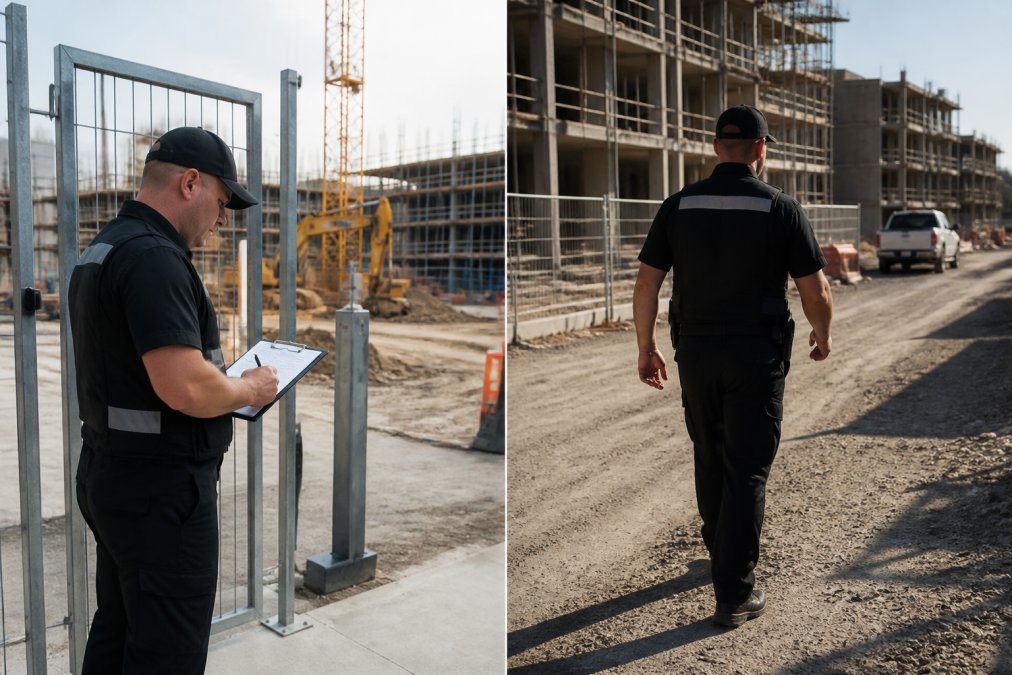
Static guards positioned at a fixed location, typically the main gate, manage access control. They check IDs, maintain visitor logs, prevent unauthorised entry, and provide visible deterrence. Static guards also provide immediate response capability and work best for sites with defined main entrances, high traffic, regular deliveries, or where visitor management is primary.
When Mobile Patrols Add Value
Mobile patrols inspect perimeter fencing, check equipment storage, monitor less-visible areas, and respond to specific concerns. They're valuable for larger sites where a static guard can't see everything. Patrols also provide psychological deterrence, unpredictability discourages opportunistic theft. Mobile patrols work best for large sites with multiple asset locations, extended perimeters, unauthorised access risks away from the main gate, or 24-hour operations.
Many operations benefit from both: a static gate guard during business hours and mobile patrols at night and shift changes.
Understanding the Cost of Hiring Construction Security Guards
Security pricing depends on several factors. Understanding what drives cost helps evaluate whether a quote is reasonable.
Factors That Influence Guard Pricing
Guard classification and experience. Guards with Class 1B and Class 2 licences, WHS induction, and construction experience cost more than entry-level guards. Experience matters.
Shift length and frequency. Overnight shifts typically cost more than day shifts. Weekend and public holiday work costs more.
Site location and travel time. A site 30 minutes from a provider's depot costs less than one 90 minutes away.
Specialised requirements. CCTV monitoring integration, access control system management, or specific incident reporting protocols add cost and value.
Contract length. Long-term contracts (12 months) typically offer better per-week pricing than short-term arrangements.
Calculating ROI on Security Investment
Security is an investment in loss prevention. If your site holds $500,000 in materials and equipment with 10% historical shrinkage ($50,000 potential loss), a $600-per-week guard ($31,200 annually) preventing 30% of losses saves $15,000. Insurance premiums often decrease with documented security measures, offsetting guard costs further.
WHS Compliance and Security Guard Training Standards
WHS obligations apply to everyone on construction sites, including security guards. Guards should have general WHS induction covering site-specific hazards and emergency procedures, understanding of construction site protocols and exclusion zones, knowledge of incident response without creating additional hazards, and training on safe worker interaction.
Ask your security provider what WHS training they provide. Reputable providers have documented training programs and evidence that assigned guards completed site-specific induction.
Evaluating Response Times and Incident Protocols
When incidents occur, theft, trespassing, equipment damage, or safety issues, response time matters. A 45-minute response is useless; a 10-minute response might prevent loss.
What to Ask About Alarm Response
Clarify response protocol with your security provider: How quickly will they respond to alarms? How do they verify genuine alarms versus false triggers? What's their communication protocol? What happens if they're on another call? Do they have backup resources?
Tupper Security operates from a local Silkstone depot, enabling rapid response times for South-East Queensland sites. Ask providers about their physical location relative to your site.
Incident Reporting and Documentation
After incidents, you need documentation: what happened, when, who was involved, what was taken or damaged, and what action was taken. This matters for insurance claims, police reports, and identifying patterns.
Ask your security provider: What incident reporting system do they use? How quickly will you receive written reports? What detail level is included? Can you access incident logs online or in real-time? How long do they retain records?
Making Your Final Selection
Selecting security guards comes down to: Do they have current, appropriate licences? Can they address your specific vulnerabilities? Do response times and incident protocols match your needs? Can they integrate with existing systems and site protocols?
Get proposals from at least two providers. Compare not just pricing but what you're actually getting. Ask for references from other construction sites and call them with specific questions about punctuality, protocol understanding, and incident handling. Request site visits from each provider to assess their vulnerability identification.
Tupper Security provides site risk assessments and tailored security solutions designed around how your site operates. Our multi-class licensed operators understand construction environments, WHS compliance, and construction-specific threats. We respond quickly from our local depot and maintain documented incident protocols.
The goal isn't finding the cheapest option, it's finding the provider that understands your site, has appropriate credentials and capabilities, and will actually prevent loss.
Frequently Asked Questions
What qualifications should construction site security guards have?
Security guards on construction sites must hold a current Queensland security licence issued under the Security Providers Act 1993. They should have completed security guard training, understand WHS obligations, and ideally have experience with access control, CCTV systems, and incident reporting. Verify their licence through the Queensland Office of Regulatory Services and confirm they have completed site induction and any project-specific safety training required by your site manager.
How do I verify a security provider's licence and credentials?
Request the provider's Queensland Firm Licence number and cross-check it with the Office of Regulatory Services database. Ask for proof of individual guard licences, insurance coverage, and references from previous construction projects. Confirm they maintain current WHS training and have documented incident reporting protocols. A reputable provider will supply this information readily and allow you to contact previous clients for feedback on response times and service consistency.
Is it better to use mobile patrols or static guards for construction sites?
The choice depends on your site layout, asset value, and threat patterns. Static guards work best for high-risk assets, restricted access points, and sites with valuable equipment left overnight. Mobile patrols suit larger dispersed sites, multi-location operations, and projects where visible security presence deters theft and vandalism across wider areas. Many sites benefit from a hybrid approach: static guards at entry points combined with mobile patrols covering perimeter and equipment zones throughout the day and night.
What should be included in a construction site risk assessment before hiring guards?
A thorough risk assessment identifies site vulnerabilities, access points, asset locations, and threat patterns. It should map perimeter security, evaluate lighting and CCTV coverage, document unauthorised personnel entry routes, and assess WHS hazards affecting guard operations. The assessment informs guard placement, patrol schedules, and access control requirements. A professional security provider will conduct this assessment independently and use findings to design a tailored security solution rather than applying a generic schedule to your site.
Effective construction site security starts with understanding what you're protecting and selecting a provider whose capabilities match your actual needs. Verify credentials, conduct a proper risk assessment, clarify response protocols, and choose a team that treats your site like their own operation. That's how you move from hoping security works to knowing it does.
This article was written using GrandRanker