 how-to
Prevent Retail Theft Without Visible Guards
Table of Contents
- Why Visible Guards Can Be a Problem
- Retail Loss Prevention Strategies That Start with Store Layout Design for Security
- Electronic Article Surveillance Systems: The Silent Deterrent
- Retail Staff Training for Loss Prevention: Your Eyes on the Floor
- The Psychology of the 'Invisible' Deterrent
- Budget-Friendly Retail Theft Prevention for Small Businesses
- Legal and Privacy Considerations
- Build a Layered Theft Prevention Strategy
- Frequently Asked Questions
Last Updated: September 9, 2026
Retail theft prevention often conjures images of uniformed guards at every exit, yet many store owners find a heavy security presence creates an unwelcoming atmosphere that drives away paying customers. Preventing retail theft without visible guards is increasingly relevant as the focus shifts to environmental design and technology.
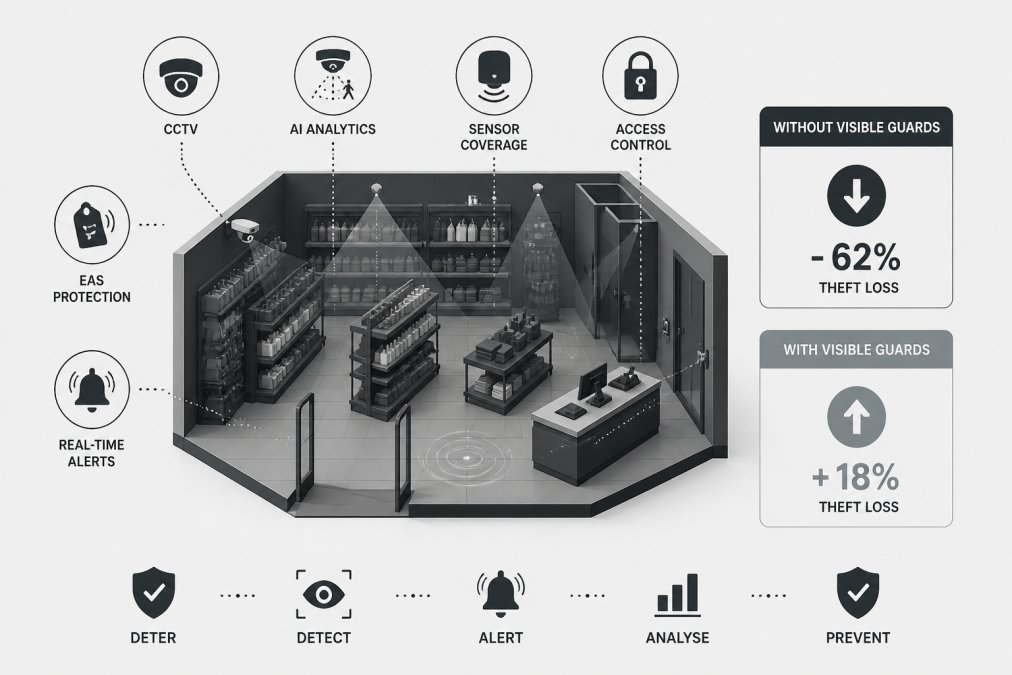
Discreet, layered systems often outperform overt force in retail loss prevention. Retail theft prevention reduces inventory shrinkage through store design, electronic surveillance, staff protocols, and psychological deterrents that do not rely on uniformed personnel.
Why Visible Guards Can Be a Problem
Uniformed guards can signal that a store expects trouble, discouraging browsing and reducing dwell time. For retailers selling premium goods or serving family demographics, visible security contradicts the brand experience they cultivate.
A visible guard also creates a single point of failure. When staff and customers know where security is located, they direct attention away from other areas, and thieves operate in the blind spots a static guard cannot cover.
Guards are expensive, and their effectiveness depends on individual vigilance, which wanes over long shifts. A more reliable approach distributes security responsibility across the entire store environment.
Retail Loss Prevention Strategies That Start with Store Layout Design for Security
Store layout optimisation is the foundation of any effective retail loss prevention strategy. The goal is to eliminate blind spots and create natural sightlines that let staff observe the entire floor without appearing to monitor anyone.
Map your floor plan and identify areas where staff at the counter cannot see clearly. Rearrange high shelving and fixtures so sightlines run diagonally across the store, giving staff the longest possible view. Keep high-value items away from exits and within direct line of sight of the checkout.
Convex mirrors positioned in corners eliminate blind spots and let a single staff member monitor aisles that would otherwise require a physical presence. The mirror itself deters because shoppers cannot tell whether someone is actively watching.
Electronic Article Surveillance Systems: The Silent Deterrent
Electronic article surveillance systems, or EAS tags, protect merchandise without any visible human presence. Tags attached to items trigger an alarm at exit points if not deactivated or removed at the point of sale.
The effectiveness of EAS goes beyond the alarm. Tag visibility is the primary deterrent; a potential thief must weigh the risk of setting off an alarm against the item's value, and many opportunistic thefts are abandoned before reaching the exit.
Hard tags suit clothing and soft goods; ink tags stain merchandise if forced off, making stolen goods unsellable. For smaller, higher-value items like cosmetics or electronics, use locked display cases or security cables that tether items while still allowing customers to handle them.
Retail Staff Training for Loss Prevention: Your Eyes on the Floor
Staff training is the most adaptable layer of an invisible security strategy. While hardware is static, your team can adjust behaviour in real time. Effective programs teach a three-part framework: Routine Disruption, Behavioural Triage, and De-escalation Through Service.
Routine Disruption: Breaking the Script
Shoplifters rely on a predictable script: enter, scan for blind spots, approach, conceal, exit. Staff should break that script with a specific, non-yes/no question that forces unplanned conversation. Instead of 'Can I help you?', ask 'Are you looking for that in a different size?' or 'We just got a new shipment of those in blue, would you like to see one?'
This forces the individual to process a novel social interaction, disrupting their script and signalling they have been noticed. A thief engaged in specific conversation will often abandon the attempt, as the perceived risk of later identification is too high.
Behavioural Triage: Prioritising Attention
A simple training matrix helps staff prioritise attention without profiling, categorising observations into three tiers:
- Tier 1 (Low Risk): Customers who are simply browsing for a long time or looking around. This is normal shopping behaviour.
- Tier 2 (Medium Risk): Customers exhibiting classic pre-theft signals, repeatedly looking towards the service desk or exit, carrying large bags or open coats, or handling multiple items and putting them back in different places.
- Tier 3 (High Risk): A combination of Tier 2 signals with active concealment, such as placing an item into a personal bag or pocket, or attempting to remove an EAS tag.
Tier 1 requires no action. Tier 2 triggers 'Routine Disruption'. Tier 3 should never be confronted directly; staff should use a pre-arranged code phrase or discreet hand signal to alert a manager who can observe from a distance and document the incident.
De-escalation Through Service
The most common mistake is teaching employees to 'keep an eye' on a suspect, which often leads to confrontation. A more effective approach is active service de-escalation: approach the customer and offer service directly related to the suspected item. If a customer has placed high-value headphones in their bag, say, 'I see you're looking at the premium headphones. Can I help you find the right model? They have a special warranty we can set up for you at the counter.'
This signals awareness of the specific item, making concealment feel futile, and provides a face-saving exit to put the item back or proceed to the register. It also avoids the legal and safety risks of direct accusation, which are best left to trained security personnel.
:::tip Staff Training Drill
A practical drill for your next team meeting: Have one staff member play the 'customer' and attempt to 'steal' a prop item. The other staff member must practice the three-step response: (1) ask a specific non-yes/no question, (2) if the 'customer' persists, approach and offer specific service on the target item, and (3) if concealment occurs, use the code phrase to alert a manager. This builds muscle memory for the desired behaviour.
The 'Invisible' Supervisor: Remote Monitoring as a Training Tool
Modern IP surveillance systems offer a rarely discussed training benefit: managers can review footage to coach staff on engagement techniques. A quick review of a two-hour shift shows whether staff are greeting customers, maintaining sightlines, and using the triage system correctly, turning CCTV from a reactive tool into a proactive training mechanism.
The Psychology of the 'Invisible' Deterrent
The most effective deterrent is the perception that a store is difficult to steal from. This psychological layer combines signage, environmental cues, and consistent staff behaviour to influence a thief's decision-making before they act.
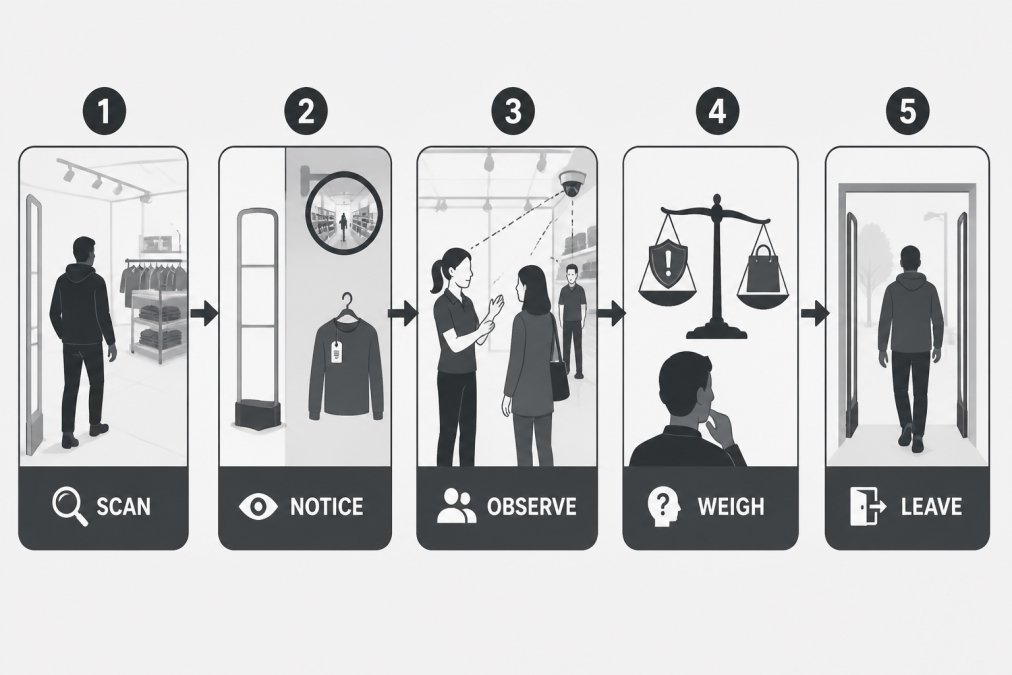
Security signage acts as a constant reminder of the consequences of theft. Signs stating the premises are protected by CCTV and merchandise is electronically tagged inform honest customers the store takes security seriously and remind potential thieves the risk of being caught is high.
Deterrence works best when the thief cannot identify exactly what is being monitored. When a store combines EAS tags, mirrors, CCTV, and attentive staff, the thief cannot know which measure will catch them; this uncertainty is more powerful than a single visible guard.
Budget-Friendly Retail Theft Prevention for Small Businesses
Effective loss prevention does not require a six-figure budget. The most cost-effective strategy is to implement a 'Zero-Dollar Deterrent' protocol first, then layer in low-cost physical measures, prioritising process and psychology over expensive electronics.
The Zero-Dollar Deterrent Protocol
Before spending a dollar, implement these four process changes that cost nothing but time:
- The Two-Person Rule for High-Value Transactions: Implement a policy where any transaction over a certain threshold (e.g., $100) requires a second staff member to visually verify the items being scanned. This simple check disrupts the most common point-of-sale (POS) fraud, sweethearting (where a cashier deliberately fails to scan an item for a friend or accomplice).
- The 'Clean Desk' Policy for the Service Counter: Ensure the area behind the counter is free of clutter. A clear counter allows customers to see that staff are not distracted and that all transactions are visible. It also removes potential hiding spots for unscanned items.
- The 'Open Box' Delivery Check: For any delivery, require the staff member receiving the goods to open the boxes and count the items against the invoice before signing for the delivery. This shifts the liability for missing stock from your business to the supplier and prevents 'short-shipping' fraud.
- The 'Walk the Floor' Routine: Assign a specific staff member to do a 'lap' of the store every 15-20 minutes. This is not a security patrol, but a task-based walk, checking stock levels on the floor, tidying displays, or looking for spillages. This movement makes staff presence unpredictable and covers blind spots that a static greeter cannot.
Low-Cost Physical Measures (Under $200)
Once zero-dollar protocols are in place, add physical deterrents with the highest impact per dollar:
- Convex Mirrors ($30 - $80 each): The single most cost-effective tool. A 60cm convex mirror placed in a corner can eliminate a blind spot that would otherwise require a staff member to physically walk down the aisle. The key is placement; position them so they reflect the aisle entrance, not just the shelf, allowing staff at the counter to see anyone entering or exiting the aisle.
- Security Signage ($20 - $50 for a pack): Invest in professional-looking signs that state specific measures: 'This store uses 24-hour CCTV recording', 'All items are electronically tagged', and 'Staff are trained in loss prevention'. The specificity is crucial. A generic 'Shoplifters will be prosecuted' sign is less effective than one that lists the specific technologies in use.
- Lockable Display Cables ($40 - $100 per kit): For high-value items like electronics, power tools, or premium cosmetics, simple coil cables that tether the item to the display are an inexpensive alternative to locked cabinets. They allow customers to handle the item (which is crucial for sales) but make it impossible to walk away with it without a loud, visible struggle.
- A 'Dummy' or 'Decoy' Camera ($25 - $60): A realistic-looking dummy CCTV dome camera, placed in a high-traffic area, can be a powerful psychological deterrent for a fraction of the cost of a real system. However, use this with caution. If a theft occurs and a customer is injured, the fact that the camera was fake could be a liability issue. A more ethical and effective approach is to purchase a single, real, high-resolution IP camera (from $150) and point it at the most critical area, the exit or the high-value display.
The 'Sweep' Routine for Stock Management
Budget-friendly inventory management requires a disciplined 'sweep' routine, not expensive software. At the end of each day, a designated staff member should perform a quick visual count of the top 5-10 most-stolen items (typically small, high-value goods like razor blades or branded cosmetics). This daily 10-minute check reveals discrepancies indicating a theft pattern, allowing you to adjust strategy before the loss becomes significant.
:::warning A Note on 'Dummy' Cameras
While a decoy camera can be a deterrent, it is not a security measure. If you rely on it and a serious incident occurs, you will have no footage to provide to police or for insurance claims. It is always better to save up for a single real camera than to install several fakes. A real camera provides evidence, which is the ultimate tool for recovery and prosecution.
Prioritising Your Spend: A Simple Framework
When budget is tight, use this framework to decide where to spend:
- Identify your highest-risk items (by value and theft frequency).
- Identify your biggest blind spot (where you cannot see the exit or the high-value items).
- Spend your first $100 on a mirror for the blind spot and signage for the high-value area.
- Spend your next $200 on a real IP camera pointed at the exit.
- Only then consider more expensive EAS tags or locked cases.
This ensures your limited budget is directed at the most critical vulnerability rather than spread thinly across generic products.
Legal and Privacy Considerations
Any theft prevention strategy must operate within the legal framework governing surveillance and detention. CCTV is generally permitted in retail, but cameras must not be positioned where customers have a reasonable expectation of privacy, such as changing rooms or toilets.
Staff training should emphasise that apprehension and detention are high-risk activities best left to trained security personnel. The threshold for lawful detention is narrow, and a mistake can expose the business to civil liability. For most retailers, the correct response to observed theft is to document and report it.
Documented shrinkage reporting serves both security and legal purposes. Accurate incident records help identify patterns – which products are targeted or which times see the most theft – informing future decisions and providing an audit trail if incidents escalate to police.
Build a Layered Theft Prevention Strategy
The most resilient approach to retail theft prevention combines multiple measures so no single point of failure exists. A store relying only on CCTV has a weakness when the camera angle shifts; one relying only on staff vigilance struggles when the floor is busy. A layered strategy ensures that when one measure fails, another catches the gap.
| Layer | Primary Function | Key Tools | Best For |
|---|---|---|---|
| Store Layout | Eliminate blind spots | Sightline mapping, convex mirrors | All store sizes |
| Electronic Tags | Deter and alarm at exits | EAS tags, ink tags, security cables | Clothing and high-value goods |
| Staff Protocols | Disrupt anonymity | Greeting routines, behaviour training | Boutiques and service-led retail |
| Environmental Cues | Shape perception | Signage, visible CCTV | Small to medium stores |
| Stockroom Controls | Prevent internal theft | Access control, delivery checks | Stores with back-of-house areas |
Begin by conducting a simple retail risk assessment: walk the floor and note every blind spot, review stockroom procedures, and observe how staff interact with customers. The gaps you identify will tell you which layer to strengthen first.
For retailers who want a professional assessment, an independent security design review can identify weaknesses not obvious from the shop floor. Request a quote to have our multi-class licensed operators assess your store and build a protection plan around how your site actually operates.
Frequently Asked Questions
What is the best way to prevent theft in a retail store without security guards?
The most effective approach combines several methods. Start by optimising your store layout to eliminate blind spots and place high-value items near staff. Then, add electronic article surveillance (EAS) systems like tags and labels to protect merchandise. Finally, train your staff in active customer service techniques, which are a proven deterrent. This layered strategy makes theft more difficult and risky than it is worth, without the negative atmosphere that visible guards can create.
Are electronic article surveillance (EAS) systems effective as a deterrent?
Yes. EAS systems are a powerful deterrent because they create a real risk of detection at the point of exit. The visible tags and alarm pedestals signal that merchandise is protected. Even if a thief attempts to remove a tag, they risk setting off an alarm or damaging the item. When combined with a clear policy for responding to alarms, EAS systems significantly reduce shrinkage, which is the term for inventory lost to theft.
How can retail store layout design reduce shoplifting?
Good layout design removes the opportunities a thief looks for. Keep sight lines clear by using low-profile shelving so staff can see down aisles. Position the checkout near the exit to create a natural choke point. Place high-value, frequently stolen items like electronics or designer goods in locked cabinets or in full view of the counter. Also, minimise cluttered displays and corner racks that create blind spots where theft can occur unnoticed.
What role does staff training play in retail loss prevention?
Staff are your most flexible asset. Training should focus on proactive customer service: greeting every person, offering help, and being visibly present on the floor. This simple interaction is often enough to deter a potential thief. Staff should also learn to recognise the early signs of suspicious behavior and understand the correct, non-confrontational procedure for reporting it. Your team then becomes an effective, human layer in your overall retail theft prevention strategy.