 how-to
Reducing Retail Shrinkage With CCTV: A 7-Step Guide
Table of Contents
- What Is Retail Shrinkage and Why CCTV Matters
- Causes of Inventory Loss in Retail Environments
- Step 1: Assess Your Site and Identify High-Risk Areas
- Step 2: Plan Strategic Camera Placement for Maximum Coverage
- Step 3: Integrate CCTV and POS Systems for Real-Time Monitoring
- Step 4: Implement Retail Loss Prevention Strategies Beyond the Camera
- Step 5: Understand Privacy Laws for Retail Surveillance
- Step 6: Train Staff and Establish Incident Investigation Procedures
Last Updated: August 17, 2026
What Is Retail Shrinkage and Why CCTV Matters
Retail shrinkage is the loss of inventory between purchase and point of sale, whether through theft, damage, administrative error, or employee misconduct. A retail business losing even 2-3% of stock annually can see tens of thousands of dollars disappear from the bottom line.
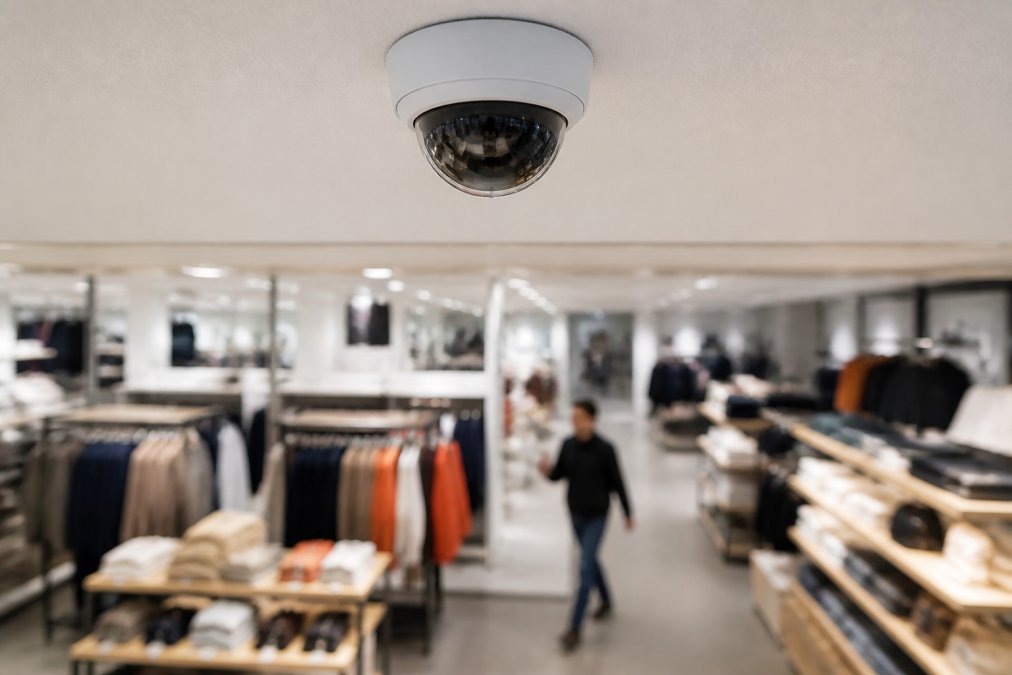
CCTV systems address shrinkage by creating accountability through visibility. When staff and customers know they're being monitored, behaviour changes. Documented video evidence transforms incident investigation from guesswork into fact-based analysis. Modern systems integrate with point-of-sale terminals, allowing you to cross-reference video footage with transaction records instantly. A till discrepancy at 3 PM can be matched to video from that exact moment, turning security from reactive into proactive.
At Tupper Security, we've worked with retail operations across South-East Queensland where shrinkage was bleeding profit. The businesses that saw the most dramatic improvement integrated their CCTV strategy with their POS systems and trained staff on what the footage revealed. That combination created accountability and results.
Causes of Inventory Loss in Retail Environments
Inventory loss rarely stems from a single cause. Understanding where shrinkage occurs is the first step toward fixing it.
External theft accounts for significant shrinkage. Organised retail crime groups study store layouts, timing, and staff patterns systematically. A single organised group can cost a retailer tens of thousands in weeks.
Internal fraud and employee misconduct often surprise business owners. This ranges from staff underringing sales to taking merchandise without payment. Internal shrinkage is harder to detect because perpetrators have legitimate access to inventory systems and know where cameras are positioned.
Damage and waste account for losses that don't involve theft: merchandise damaged during handling, stock that expires before sale, or items lost due to poor organisation.
Administrative errors create phantom shrinkage through incorrect inventory counts, items logged to wrong locations, or data entry mistakes that make stock appear lost when simply mislabelled.
The common thread is visibility. When you can't see what's happening, who's handling stock, or what transactions are being processed, shrinkage thrives. CCTV creates the visibility that makes each issue detectable and addressable.
Step 1: Assess Your Site and Identify High-Risk Areas
Before installing a single camera, walk your retail space like a security analyst. You're looking for vulnerability patterns, not just obvious blind spots.
Start with a floor plan marking every entrance, exit, staff doors, loading areas, and emergency exits. Note where high-value merchandise is stored. These areas are targets where external theft and internal loss concentrate.
Identify areas with minimal oversight: stockrooms with one entrance, blind corners between aisles, checkout areas where multiple tills operate side-by-side. These zones need monitoring.
Walk your store during peak and quiet periods. Peak times create chaos and distraction; quiet periods leave areas unmonitored. Both create opportunity for loss.
Document incident history. If you've had shrinkage spikes, when did they occur? Which departments? Which shifts? This data reveals patterns. Talk to your staff, they see what you don't and know which areas feel vulnerable.
Create a heat map marking high-risk areas in red, medium-risk in yellow, lower-risk in green. This becomes your camera placement guide.
Step 2: Plan Strategic Camera Placement for Maximum Coverage
Strategic placement means cameras positioned to capture behaviour, not just create the appearance of coverage.
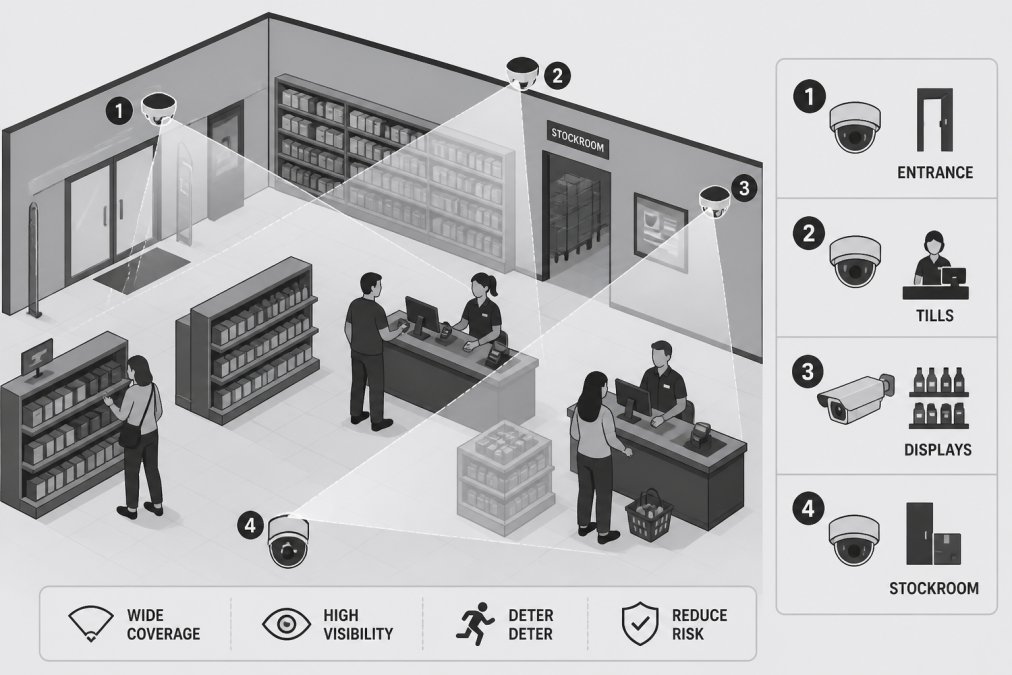
For checkout areas, position cameras to capture the till operator's hands, the customer's face, and the transaction screen. This triple-angle view lets you see if an item was scanned and if the price was correct.
Stockroom and storage areas need cameras covering all access points and high-value merchandise. Position cameras high enough that they can't be easily obscured, but low enough for facial recognition if needed.
Perimeter security requires cameras covering all entrances and exits. A camera at the main entrance should show faces clearly; back exits and loading areas are equally important for organised retail crime prevention.
High-value merchandise displays need dedicated coverage. Position cameras to capture the shelf and anyone approaching it rather than wide-angle views of entire displays.
Blind spots between aisles are common theft points. Position cameras at aisle ends to eliminate dead zones.
Coverage overlap eliminates transition zones where someone could move between monitored areas undetected. Overlap also provides backup footage if one camera is damaged.
Resolution and lighting are critical. A high-definition camera in a dimly lit stockroom produces usable footage; a standard-resolution camera produces blur. Ensure lighting supports your camera resolution.
Step 3: Integrate CCTV and POS Systems for Real-Time Monitoring
Reducing retail shrinkage with CCTV reaches its full potential only when video integrates with point-of-sale data. This integration transforms security from visual documentation into actionable intelligence.
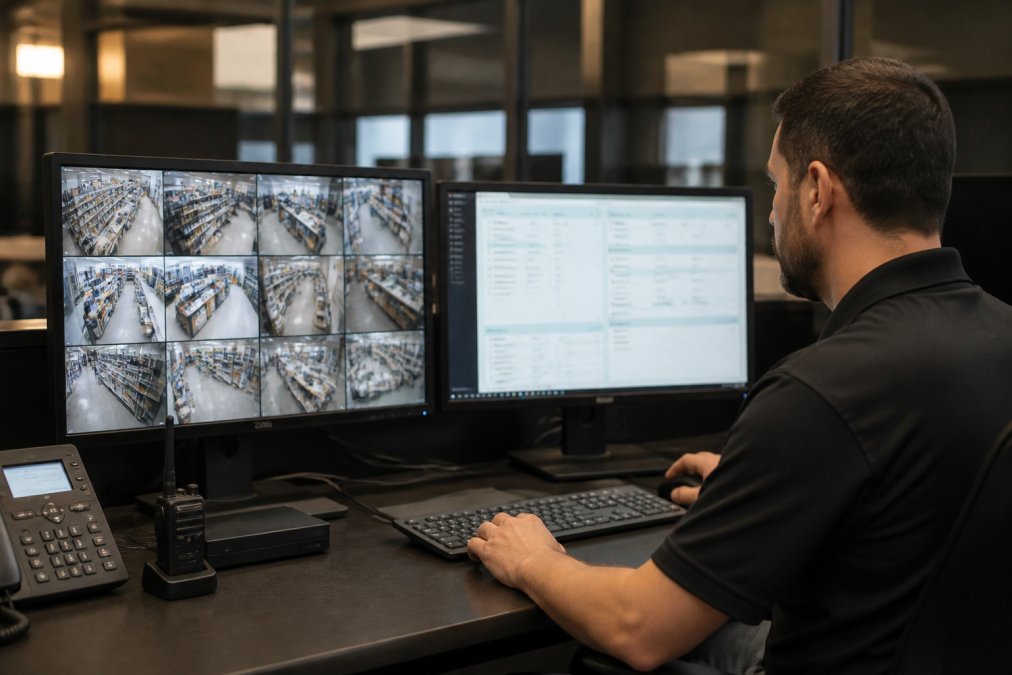
When CCTV and POS systems communicate, discrepancies become immediately visible. A till showing a £50 sale when video shows a £200 item being scanned triggers an alert. A transaction logged at 2:47 PM can be matched to video from that exact moment.
Modern retail security platforms allow operators to view live CCTV feeds alongside transaction logs. When a till discrepancy is flagged, the operator can pull up video from that till at that exact time. Instead of reviewing hours of footage, you're looking at a 30-second clip showing exactly what occurred.
Integration steps typically include:
- Connecting your POS system to your CCTV management software via secure network protocols
- Synchronising timestamps across systems (critical for accurate matching)
- Setting alert thresholds for till discrepancies, voided transactions, or unusual activity patterns
- Configuring automated flags when specific conditions occur
Cloud-managed surveillance solutions simplify this integration by centralising both feeds, enabling remote access to live monitoring, automatic backup, and easier scaling.
Step 4: Implement Retail Loss Prevention Strategies Beyond the Camera
CCTV is critical, but it's not a complete solution. The most effective retail loss prevention strategies combine video surveillance with operational discipline and staff engagement.
Electronic article surveillance (EAS) systems work alongside CCTV. A tag deactivated at checkout should match video showing the transaction. A tag leaving the store undeactivated triggers an alarm, and video provides context.
Till procedures and controls matter as much as camera coverage. Requiring till operators to log in individually, limiting override access, and requiring manager approval for voids and refunds create accountability. CCTV documents whether these procedures are followed.
Staff training directly impacts shrinkage. Employees who understand why loss prevention matters and feel empowered to report suspicious behaviour become your first line of defence. A trained staff member spotting a customer removing a security tag is more valuable than a camera capturing the act after the fact.
Merchandise placement influences shrinkage. High-value items positioned where staff can see them reduce theft opportunity. Items requiring security tags should be easily visible from checkout.
Customer service intensity affects external theft. A store where staff actively engages with customers sees less theft than one where staff is invisible. Thieves prefer anonymity.
Inventory management discipline catches internal shrinkage. Regular stocktakes, cycle counting in high-shrinkage areas, and careful documentation of damaged or expired stock reveal patterns.
Step 5: Understand Privacy Laws for Retail Surveillance
Retail surveillance operates within a legal framework. Understanding your obligations protects your business and ensures your CCTV system is legally defensible.
In Australia, surveillance is governed by the Privacy Act 1988 (Cth) and state-specific regulations. The Workplace Health and Safety Act 2011 (QLD) also applies when monitoring staff.
Notification and transparency are mandatory. Customers and staff must know they're being recorded through visible signage at store entrances stating that CCTV is in operation, its purpose, and contact information.
Footage retention and access are regulated. Most Australian retailers operate on a 30-90 day retention cycle, deleting footage after that period unless a specific incident requires preservation. Individuals have the right to request access to footage of themselves.
Limited use of footage is required. You can use CCTV for loss prevention and security, but not for other purposes without consent. Monitoring solely for productivity may exceed legal bounds.
Staff monitoring has specific constraints. You can monitor staff for security and loss prevention purposes, but monitoring in areas where privacy is expected (toilets, change rooms, break rooms) is prohibited.
Data security is your responsibility. Footage is personal information and must be stored securely with logged access. If your CCTV system is cloud-based, ensure the provider has appropriate security certifications.
Consult with a privacy specialist or legal advisor familiar with Australian retail operations if in doubt.
Step 6: Train Staff and Establish Incident Investigation Procedures
CCTV footage is only useful if someone knows how to use it. Staff training and clear investigation procedures transform video from recorded evidence into actionable intelligence.
Staff training should cover recognising suspicious behaviour, understanding the CCTV system, and knowing incident reporting procedures.
Recognising suspicious behaviour means training staff to spot patterns associated with theft: customers repeatedly visiting the stockroom without purchasing, customers handling merchandise without proceeding to checkout, customers removing security tags, staff members voiding transactions without clear reason. These patterns, when documented and reviewed against CCTV footage, often reveal shrinkage sources.
Understanding the CCTV system means staff know how to report incidents in a way that makes footage retrieval possible. Instead of "someone stole something yesterday," a useful report is "on Tuesday at approximately 2:30 PM, a customer in a red jacket removed a security tag from a handbag in aisle three."
Knowing incident reporting procedures means staff understand the chain of command and what documentation is required.
Incident investigation procedures should be standardised:
-
Retrieve relevant footage from the time and location in question.
-
Review transaction records cross-referencing video with POS data.
-
Document findings including time stamps, individuals involved, and specific actions.
-
Determine action following your disciplinary procedures for staff issues, involving police for customer theft, or correcting administrative errors.
-
Review for patterns to identify systemic issues rather than one-off events.
Retail shrinkage doesn't disappear on its own. It requires visibility, systems, and disciplined response. CCTV provides visibility; integration with POS systems creates intelligence; training and procedures convert that intelligence into action. When these elements work together, shrinkage rates fall measurably and profit margins improve.
Reducing retail shrinkage with CCTV is most effective when tailored to your specific operation, layout, merchandise, staff, and risk profile. At Tupper Security, we conduct site-specific risk assessments to identify exactly where your shrinkage is occurring and where monitoring will have the most impact. Our team designs CCTV systems that integrate with your existing POS infrastructure and provides staff training and incident investigation support. If you're ready to move beyond guessing where shrinkage is happening, request a quote and we'll show you how precision-installed CCTV and integrated monitoring can protect your bottom line.
Frequently Asked Questions
How much can reducing retail shrinkage with CCTV actually save a typical store?
The savings depend on your current shrinkage rate and the causes driving it. Retail shrinkage typically ranges from 1-3% of revenue, with theft and fraud accounting for a significant portion. By deploying CCTV strategically, especially at checkout and stockroom areas, most retailers see measurable reductions within 3-6 months. The actual figure depends on your store size, product mix, and existing loss prevention practices. A professional site risk assessment will identify your specific loss drivers and help quantify realistic ROI.
What privacy laws apply to CCTV surveillance in retail stores?
In Australia, retail surveillance is governed by the Privacy Act 1988 (Cth) and relevant state-based privacy laws. You must notify customers that CCTV is in use (usually via signage), collect only necessary footage, store it securely, and limit access to authorised personnel. Audio recording is generally prohibited unless there's a specific lawful purpose. Facial recognition and AI-powered analytics have additional compliance requirements under privacy regulations. It's essential to document your surveillance policy and ensure it's proportionate to your security needs. Consult your privacy officer or legal advisor before implementing advanced analytics.
Can CCTV and POS integration really help identify where shrinkage is happening?
Yes. When CCTV and POS systems are integrated, you can cross-reference transaction records with video footage in real time. If a till shows a discount applied but no corresponding barcode scan, or if stock counts don't match sales records, you can pull the exact video clip from that moment. This integration reveals patterns, whether shrinkage is driven by checkout errors, internal fraud, or external theft, and lets you focus your loss prevention strategies accordingly. Most modern POS systems can flag suspicious transactions and trigger video review automatically.
How do I know if a CCTV system is actually reducing shrinkage at my store?
Track your shrinkage rate before and after deployment. Calculate it monthly: (Opening Stock + Purchases − Closing Stock) ÷ Sales × 100. Document any changes in incident reports, audit findings, and staff behaviour. Use CCTV analytics to count detected incidents (unauthorised access, suspicious transactions, unscanned items). Compare your shrinkage rate against industry benchmarks. A professional security provider can generate audit trails and shrinkage reports that show the impact of your system over time. Most retailers see measurable improvement within the first quarter if the system is properly positioned and monitored.
This article was written using GrandRanker