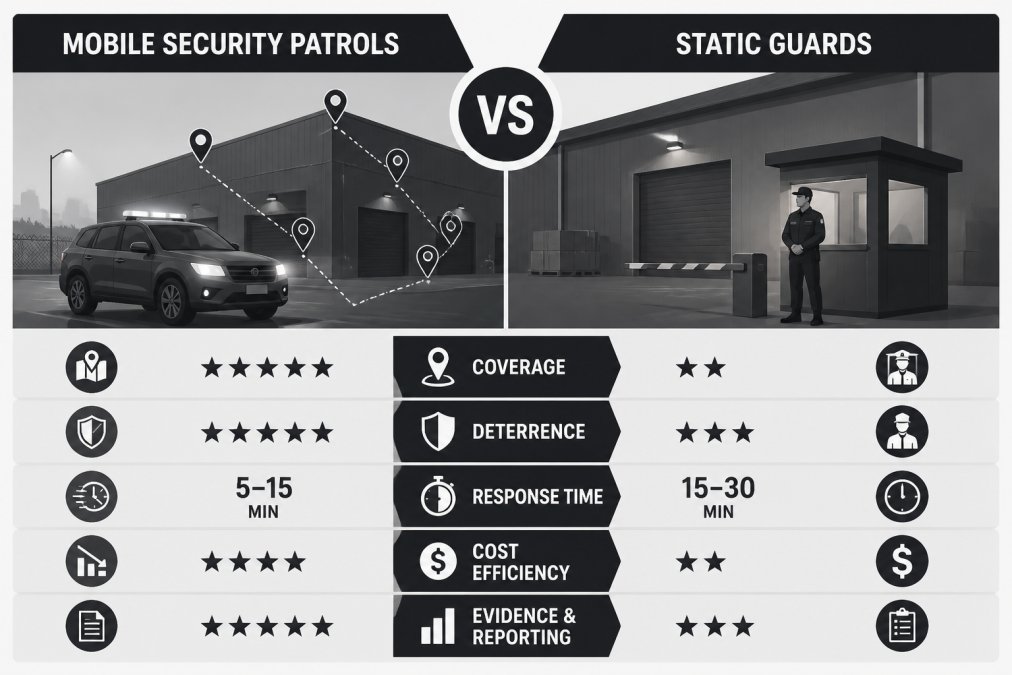
 comparison
Mobile Security Patrols vs Static Guards for Warehouses
Table of Contents
- Mobile Patrols vs Static Guards: Which Warehouse Security Model Fits?
- Feature Comparison: Static Guards vs Mobile Patrols
- Static Guards: Maximum Deterrence for High-Value Sites
- Mobile Patrols: Broad Coverage and Cost Control
- The Real Cost of Static Security Guards vs Patrol Frequency
- Start With a Warehouse Security Risk Assessment
- Integrating Guards With a CCTV System Audit for Warehouses
- Making the Call: A Decision Framework for Warehouse Managers
- Frequently Asked Questions
Last Updated: September 8, 2026
Choosing between mobile security patrols vs static guards for warehouses depends almost entirely on your site's specific risk profile. A static guard provides a fixed, visible deterrent at a single point, while a mobile patrol extends coverage across a larger perimeter at a lower operational cost. The most common mistake is selecting a model based on budget alone rather than on site vulnerability. This guide breaks down the trade-offs so you can match the security model to your actual threat exposure.
Mobile Patrols vs Static Guards: Which Warehouse Security Model Fits?
The core distinction between mobile security patrols vs static guards for warehouses comes down to coverage versus constant presence. A static guard provides continuous access control and immediate intervention at a fixed location (fbi.gov). A mobile patrol operates on a randomized vehicle-based route, preventing criminals from predicting when the premises will be unguarded.
Neither model is inherently superior. Static guards excel at high-value sites requiring strict entry point management, while mobile patrols suit larger areas prioritizing broad coverage and cost control. Many facilities discover a hybrid approach delivers the strongest posture.
How We Compared the Two Approaches
We evaluated both models against deterrence effectiveness, incident response capability, site coverage, operational cost, and integration with existing security infrastructure, including performance under Australian regulatory expectations and support for auditable reporting.
Feature Comparison: Static Guards vs Mobile Patrols
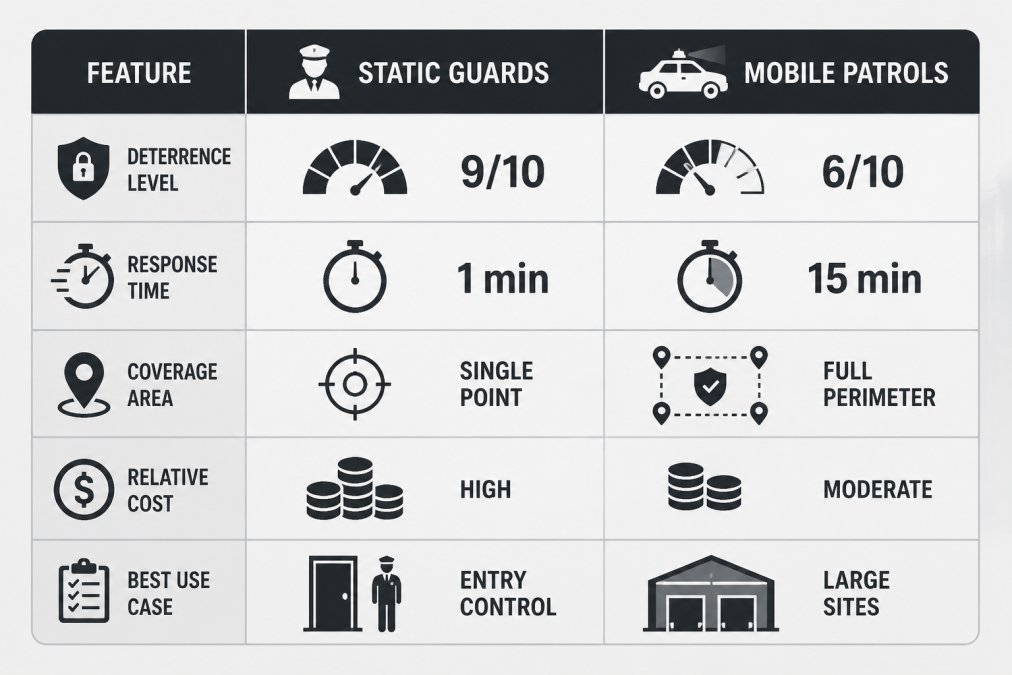
| Feature | Static Guards | Mobile Patrols |
|---|---|---|
| Deterrence Level | High, constant visible presence | Moderate, intermittent presence |
| Response Time | Immediate on-site intervention | Dependent on patrol location |
| Site Coverage | Fixed location only | Broad, vehicle-based coverage |
| Relative Cost | Higher hourly rates | Lower, per-visit or contract basis |
| Best Use Case | High-value entry points | Large perimeters, multi-site operations |
Static Guards: Maximum Deterrence for High-Value Sites
Static guarding is the strongest security presence available because the guard's physical presence at a fixed location deters opportunistic crime before it occurs. This model suits facilities storing high-value inventory, operating sensitive loading docks, or managing strict access control, providing immediate intervention that eliminates the response delay inherent in any patrol model.
The trade-off is operational cost. Maintaining a guard 24/7 requires shift coverage, multiplying the hourly rate across three daily rotations. Static guards also tend to focus on their assigned post, leaving perimeter areas unmonitored unless integrated with surveillance systems. For a site with multiple access routes and a large footprint, this leaves gaps.
Mobile Patrols: Broad Coverage and Cost Control
Mobile patrols deliver randomized, vehicle-based checks that cover a warehouse perimeter far more efficiently than a fixed post. Unpredictable routes prevent the pattern recognition criminals use to time their entry. This model suits distribution centers with large perimeters, multiple buildings, or sites only active during business hours.
The primary advantage is cost. Mobile patrols require fewer personnel hours than round-the-clock static guarding and scale naturally across multi-site operations, allowing one team to service several warehouses in a single shift. The limitation is the absence of a constant on-site deterrent; between visits, the site relies on physical measures and alarm systems, with response time depending on the patrol vehicle's proximity.
The Real Cost of Static Security Guards vs Patrol Frequency
Cost comparison is rarely a simple hourly rate calculation. Static guarding commits personnel to a fixed schedule regardless of site activity, meaning you pay for presence even during low-risk periods. Mobile patrols charge per visit or contract, allowing you to scale frequency up during high-risk seasons and reduce it when threat levels drop.
When evaluating the cost of static security guards, factor in shift coverage, leave entitlements, and supervisory overhead. Mobile patrol contracts typically bundle vehicle costs, fuel, and officer time into a per-visit rate, simplifying budgeting. The most cost-effective approach for many warehouses is a layered model: static guarding for the highest-risk entry points during operational hours, supplemented by mobile patrols for perimeter checks overnight and on weekends.
Start With a Warehouse Security Risk Assessment
Before comparing models, conduct a structured warehouse security risk assessment to identify what you are protecting and where vulnerabilities sit. Map every entry point, document current access control measures, evaluate perimeter fencing and lighting, and identify high-value inventory zones. The output is a threat profile that tells you whether your site needs constant guard presence, intermittent patrols, or both.
A thorough assessment also examines operational patterns, such as delivery schedules, shift changeovers, and after-hours activity, because these routines create predictable windows of vulnerability. Many managers discover their highest-risk period is during peak receiving hours when loading docks are open and staff are distracted.
Integrating Guards With a CCTV System Audit for Warehouses
Most warehouse security guides treat guards and cameras as separate line items. In practice, the most effective deployments treat them as one system, where the guard is the response mechanism and technology is the detection layer, connecting alarm events, video verification, and patrol activity in a single operational workflow.
The Missing Link: Alarm Verification and Patrol Dispatch
A common failure pattern is the 'blind alarm response'. The patrol officer receives an alert, drives to the site, and must search the perimeter to find the cause, wasting critical minutes. The fix is a model where the monitoring centre or officer can pull up live camera feeds for the specific zone that triggered the alarm before dispatch, confirming whether the activation was a genuine intrusion, a stray animal, or a faulty sensor.
For static guards, a gatehouse guard can use a camera network to track a vehicle from the entry point to the loading dock, ensuring it follows the authorised route. If a door contact sensor activates in a storage zone while the guard is managing a delivery, the system should automatically push that camera view to the guard's monitor or mobile device, allowing them to assess the situation without leaving their post.
Moving Beyond CCTV: IoT Sensors and Smart Fencing
The term 'CCTV audit' undersells what a modern warehouse security infrastructure can do. Beyond cameras, consider how Internet of Things (IoT) sensors feed data into the same platform your guards use.
- Perimeter vibration sensors on fencing can detect an attempted climb or cut before a camera would capture a clear image.
- Door and gate contact sensors provide instant notification of an unscheduled opening, which is a critical trigger for a mobile patrol response.
- Video analytics on existing cameras can detect loitering in a loading dock or a vehicle stopping in a non-designated area, generating an alert that a human operator might miss.
These sensors do not replace the guard; they make the guard's time more effective. A mobile patrol officer who receives a verified sensor alert with a linked camera view is responding to a specific event, not just driving a random route hoping to spot a problem.
The Audit Checklist: What to Verify Before You Sign
When reviewing your CCTV and sensor infrastructure, focus on the integration points, not just camera resolution. A practical audit should confirm:
- Camera coverage overlaps with sensor zones. Every door, gate, and fence section with a sensor should have a camera view that can verify an alarm from that location.
- Remote access works for the guard. Whether the patrol officer uses a vehicle-mounted terminal or a mobile app, they must be able to view live footage and receive alarm notifications while on the road.
- Recording retention meets evidence standards. For insurance and potential prosecution, footage must be stored at a resolution and duration that is admissible and useful. Most practitioners recommend a minimum of 30 days for standard definition and longer for critical incident zones.
- The monitoring centre has a clear escalation protocol. If an alarm is not acknowledged by the patrol within a set time, the protocol should automatically escalate to a supervisor or, if the threat is verified, to the relevant emergency services.
This integration layer is what separates a basic security service from a modern, risk-managed operation. It also provides the data trail that insurers and auditors increasingly expect to see when assessing a warehouse's security posture.
Making the Call: A Decision Framework for Warehouse Managers
The decision between static guards and mobile patrols is not solely a security question; it is a risk financing question. The choice directly affects your liability exposure and insurance premiums, yet most security providers never mention this.
How Your Security Model Affects Insurance Premiums
Insurers underwriting warehouse policies assess the likelihood and potential severity of losses from theft, vandalism, and fire (iii.org). A static guard at the gatehouse demonstrates a higher level of access control, which can be a positive factor in negotiations. However, a static guard not integrated with the alarm system may not reduce the risk of internal theft or after-hours perimeter breaches.
Insurers generally view mobile patrols as cost-effective for large perimeters, but they will scrutinise patrol frequency and response time commitments. A patrol that visits a site once every eight hours is not a substitute for a monitored alarm system with rapid response (asisonline.org). Underwriters often look for a layered approach: physical measures, electronic detection, and a documented response mechanism.
The Liability Question: Duty of Care and Incident Response
The choice of security model also has implications for your duty of care to employees, visitors, and contractors. A warehouse that relies solely on a mobile patrol with a 30-minute response time may struggle to demonstrate that it took reasonable steps to protect people on site if an incident occurs during the response gap.
A documented patrol log with timestamps and checkpoint scans provides a clear record of when the site was last checked. A static guard's incident report provides a contemporaneous account of events. Both are critical for defending against liability claims or supporting an insurance claim after a loss.
A Framework That Includes Risk Transfer
To make a fully informed decision, add a risk transfer column to your analysis. Consider the following:
| Scenario | Recommended Model | Security Rationale | Insurance & Liability Consideration |
|---|---|---|---|
| High-value inventory, single entry point | Static guards | Constant presence, immediate response | Strong access control record; ensure guard is trained on emergency evacuation procedures. |
| Large perimeter, low after-hours activity | Mobile patrols with monitored alarms | Broad coverage, cost control | Confirm patrol response time is within insurer guidelines; verify alarm monitoring is 24/7. |
| Multi-site operations | Mobile patrols | One team services multiple locations | Ensure each site has a documented patrol schedule for audit; check if insurer requires a minimum visit frequency. |
| Peak-hour loading dock activity | Static + mobile hybrid | Coverage during highest-risk windows | Document the handover between static and mobile teams to avoid gaps in coverage. |
| Budget-constrained, moderate risk | Mobile patrols with CCTV | Layered detection, lower personnel cost | Be prepared to demonstrate that CCTV is monitored and that patrols are scheduled at random intervals. |
The right framework aligns your physical security posture with your risk financing strategy. A warehouse manager who can articulate how their security model reduces both the likelihood and financial impact of a loss is in a far stronger position than one who simply chose the lower-priced option.
Frequently Asked Questions
What are the primary differences between mobile patrols and static guards for warehouse sites?
A static guard remains at a fixed location, such as a gate or loading dock, providing a constant visual deterrent and immediate intervention. Mobile patrols use a vehicle to cover a larger perimeter or multiple sites on a randomised schedule. The core difference is continuous presence versus broad, intermittent coverage. Static guarding suits high-value sites with strict access control needs, while mobile patrols offer a more cost-effective model for securing large areas or checking multiple facilities.
How do I determine if my warehouse requires 24/7 static security?
A warehouse security risk assessment is the best starting point. Consider your inventory value, incident history, and the number of entry points. If your site handles high-value goods, operates around the clock, or has been a repeat target for theft, a static guard is often justified. For sites with lower risk profiles or where the main concern is after-hours breaches, mobile patrols with 24/7 alarm response usually provide sufficient coverage at a lower cost.
Are mobile patrols a cost-effective alternative to static guards for smaller warehouses?
Yes, for many smaller warehouses, mobile patrols deliver meaningful security presence at a fraction of the cost of static guards. You pay for scheduled visits and alarm response rather than a full-time wage. This model suits sites that need perimeter checks, door verifications, and a rapid response to alarms, without the expense of a dedicated on-site officer. The trade-off is the lack of a constant, visible guard to deter casual theft.
How does a CCTV system audit complement mobile patrol services?
A CCTV system audit identifies camera blind spots, poor resolution, and recording gaps. When paired with mobile patrols, the audit ensures that patrol routes and camera views work together. The patrol officer can check areas the cameras miss, while the CCTV provides continuous recorded coverage between visits. This integration creates a layered security model where each system covers the other's weaknesses, improving overall threat detection and evidential quality.