 ultimate-guide
Mobile Patrol Services Ipswich QLD: A 2026 Buyer's Guide
Table of Contents
- Why Mobile Patrol Services Beat Static Guards for Most Sites
- What a Professional Mobile Patrol Actually Covers
- The Mobile Patrol Site Risk Assessment Process
- Commercial Security Patrol Costs: What Drives the Price
- How Patrols Integrate With CCTV and Access Control
- Legal Boundaries: What Licensed Officers Can and Can't Do
- Conclusion: Build a Patrol Plan Around Your Site's Rhythms
- Frequently Asked Questions
Last Updated: September 4, 2026
Most security advice treats every site like a fortress under siege. The reality for most property managers, construction supervisors, and retail owners in the Ipswich corridor is different: you need a visible deterrent, a rapid response to alarms, and someone checking the perimeter when the site is empty. That is what mobile patrol services Ipswich QLD deliver. In this guide from Tupper Security, we break down how they work, what they cost, and how to build a patrol plan that fits your site's actual rhythms.
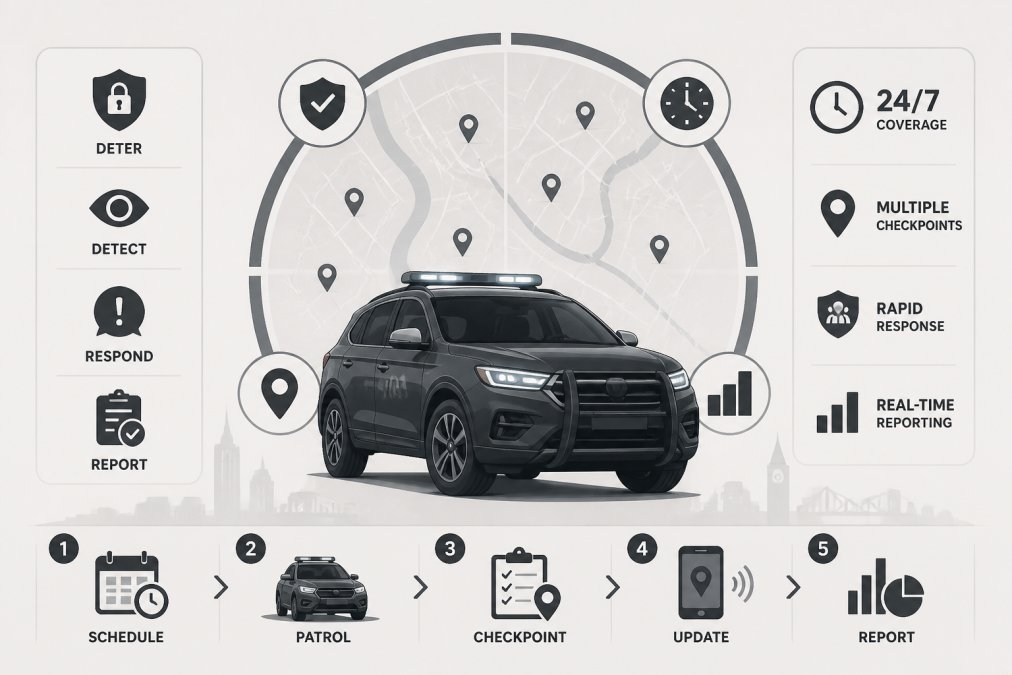
A mobile patrol is a licensed security officer who moves between sites in a marked vehicle, conducting checks, responding to alarms, and reporting hazards. Unlike a static guard, patrols cover multiple locations or large perimeters efficiently. You pay for coverage when you need it, not for someone standing in a carpark all night.
Why Mobile Patrol Services Beat Static Guards for Most Sites
The biggest mistake property owners make is defaulting to a static guard because it feels more secure. For a single high-risk entry point or an active event, static guarding makes sense. But for a warehouse, a construction site after hours, or a retail strip, a mobile patrol delivers more value for the same or lower cost.
Static guards are expensive because they occupy one officer for an entire shift. Patrols concentrate that labour into targeted windows: a check at lock-up, a mid-evening sweep, and a response if an alarm triggers. A marked patrol vehicle moving through a site at irregular intervals is harder to predict than a guard visible in the same spot all night.
Patrols are not the right choice for a site needing continuous access control or crowd management. They excel at asset protection, perimeter checks, and late-night staff safety.
What a Professional Mobile Patrol Actually Covers
A professional mobile patrol is not a drive-by. Each visit follows a documented route tied to your site risk assessment, and every check is logged for your records.
Typical patrol activities include perimeter checks of fencing and gates, checking that doors and windows are secured, verifying that lighting is functional, and looking for signs of forced entry. Officers also conduct safety hazard inspections, flagging trip risks, spills, or unsafe equipment. For sites with staff working late, patrols provide a welfare check. When a patrol identifies a breach or hazard, the officer files an incident report and, where needed, coordinates an emergency response.
Alarm Response Services That Cut False Alarm Downtime
Alarm response is where patrols earn their keep. When your monitoring system triggers, a patrol vehicle is dispatched to verify the alarm rather than relying on a remote call centre guessing from a camera feed.
The key metric is response time. A provider with a local depot, like Tupper Security's Silkstone base, can reach Ipswich properties far faster than a company dispatching from Brisbane's outer suburbs. Before signing, ask for the provider's average response window for your postcode and how they prioritise calls overnight.
The Mobile Patrol Site Risk Assessment Process
Every patrol plan should start with a mobile patrol site risk assessment. This is not a paperwork exercise; it determines your patrol frequency, route, and focus points. A proper assessment walks the site, identifies vulnerabilities, and maps them against how the property actually operates.
The process covers several layers: the physical environment (fencing, lighting, sightlines, entry points); the operational rhythm (when staff arrive, when the site empties, when deliveries create exposure); the threat profile (incidents on neighbouring sites, valuable assets); and existing technology (CCTV coverage and blind spots).
A common mistake is treating the assessment as a one-off. Your patrol plan should be reviewed whenever the site changes, whether a new building phase, a retail fit-out, or a change in staffing hours.
Commercial Security Patrol Costs: What Drives the Price
Commercial security patrol costs are not published as a flat rate because every site demands a different level of service. Pricing depends on patrol frequency, site size, after-hours coverage, and technology integration. You are paying for the officer's time, the vehicle, and the response capability held in reserve.
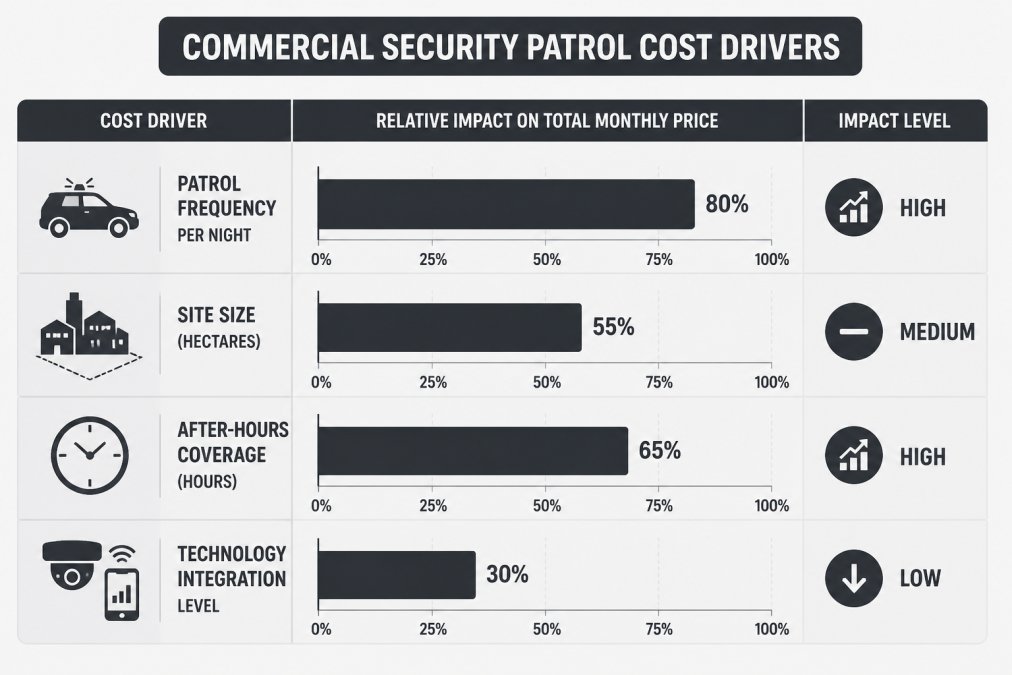
The main levers are straightforward. A site needing two checks per night costs less than one needing four. A large industrial perimeter takes longer to cover than a single retail lock-up. A site requiring 24/7 monitoring and rapid deployment carries a higher premium than one where patrols run only during business shutdown.
Small businesses often assume patrols are out of reach. The opposite is usually true. A patrol shared across a business park can give a small retail store professional coverage at a fraction of the cost of a dedicated guard. When comparing quotes, ask what is included: are hazard reports generated after every visit, is the vehicle marked, and is the officer licensed under Queensland security licensing requirements? Checking the provider holds a current QLD firm licence is non-negotiable.
The Cost-Benefit Case for Small Retail and Local Offices
Most security marketing targets enterprise clients, leaving small retail shops, local medical clinics, and standalone offices to guess whether patrols are worth the line item. Here is a practical framework to test the investment.
Start with your single biggest risk: the after-hours break-in. For a small retail tenancy or local office with stock or equipment, one forced entry typically runs into the thousands of dollars. You are covering physical damage, stolen goods, the insurance excess, and lost trading days. Add administrative time on police reports and claims, and a single incident can wipe out a month of profit.
Now price the alternative. A mobile patrol checking your site twice per night is a predictable monthly cost. For many small operations, that figure lands well below the cost of a single after-hours incident. The patrol also catches small issues that become big liabilities, like an unlocked fire door or a faulty security light.
For a local office, the calculation shifts slightly. Your exposure is less about stock and more about data, client files, and equipment. A patrol that verifies the building is secure after the last staff member leaves reduces the risk of a quiet theft that goes unnoticed for days. It also provides a documented record of checks that supports your insurance and duty of care.
A common pattern is comparing patrol cost against a static guard and concluding security is unaffordable. That comparison misses the point. A static guard for a single shift can cost more per night than a full week of scheduled patrol visits. The patrol model spreads cost across multiple clients, which is why it can work for a single shopfront where a guard never could.
When you request quotes, ask providers to break down the price against your specific risks. A reputable firm will walk your site, identify the scenarios that keep you awake at night, and show you how patrol frequency addresses each one. If a provider cannot explain the cost in terms of risk reduction, the quote is not tailored to your business. standardize physical security.
How Patrols Integrate With CCTV and Access Control
The best mobile patrol services do not replace your security technology; they complete it. CCTV gives you eyes on a site, but a camera cannot kick a trespasser off the property. A patrol gives you boots on the ground, but an officer cannot watch every corner at once. The two work together.
Integration starts with the patrol route designed around your camera coverage. The officer checks the blind spots the cameras miss, while the monitoring team uses the cameras to guide the officer to a developing incident. Access control systems feed into this as well. When a door is opened outside authorised hours, the system logs it and can trigger a patrol response to verify who is on site.
For retail loss prevention, this integration produces documented shrinkage reporting that traces incidents back to specific times and entry points. For multi-tenant sites, auditable and revocable access control means you can change who enters a building instantly, without rekeying locks. The patrol officer becomes the enforcement arm of your security infrastructure.
Making Your Existing Technology Work Harder
Most Ipswich businesses already have some security technology in place. The opportunity is not to rip it out and start again; it is to make the patrol the human layer that closes the gaps your current setup leaves open.
Smart alarms that verify before dispatching. Traditional alarm systems send a signal to a monitoring centre, which then calls you at 2 am. Smart systems integrate with video verification: the alarm triggers, the camera captures a short clip, and the operator can see whether the event is a genuine intrusion or a possum on the roof. When real, the patrol is dispatched with context, not just a generic alarm code.
Remote video monitoring as a force multiplier. A patrol vehicle cannot be on every site at once. Remote video monitoring fills the gaps. An operator watches live feeds from multiple sites and can direct a patrol officer to the exact location of a developing incident. This turns a single patrol vehicle into a response unit that covers a wide area with intelligence.
Access control events that trigger patrol tasks. Modern access control systems log every door open, card swipe, and failed attempt. When these events happen outside authorised hours, the system can automatically create a patrol task. The officer checks the specific door, verifies who is on site, and reports back. This turns your access control system from a passive log into an active trigger for human verification.
The practical limits of integration. Technology integration only works when the provider actually connects the systems. Ask whether their dispatch software receives alerts directly from your alarm or access control system, or whether they rely on a separate monitoring centre to phone them. Direct integration cuts response time and reduces miscommunication. Also ask how the officer confirms a resolved incident: a photo log, a written note, or a timestamped entry.
A realistic integration checklist for your site. Before you sign a contract, confirm the provider can: receive alarm signals from your existing panel, view your camera feeds during an incident, log patrol visits against your access control events, and deliver a consolidated report showing both technology alerts and officer actions on a single timeline. If they cannot, you are paying for a patrol that operates separately from your technology.
Legal Boundaries: What Licensed Officers Can and Can't Do
Understanding the legal boundaries of security work protects you from liability and sets realistic expectations. In Queensland, security officers must hold a licence issued under the Security Providers Act, and the firm employing them must hold a QLD firm licence (qld.gov.au).
A licensed security officer does not have police powers. They can ask a trespasser to leave the property, and if the person refuses, the officer can use reasonable force to remove them under the same laws that allow any citizen to defend their property. Officers can detain someone in limited circumstances while police are called, but they cannot arrest, search, or use force beyond what is reasonable and proportionate. The Queensland Government security licensing requirements set out the exact training and conduct standards firms must meet.
This is why hiring a licensed provider matters. An unlicensed operator who oversteps these boundaries exposes you to legal action and invalidates your insurance. A professional patrol knows when to intervene, when to observe and report, and when to call police. The Australian Criminal Intelligence Commission guidance on private security reinforces that the industry's role is complementary to police, not a replacement for them.
Conclusion: Build a Patrol Plan Around Your Site's Rhythms
The common advice to buy the most patrols you can afford is wrong. Effective security matches coverage to when your site is actually vulnerable, not to a fixed schedule. A site that empties at 5 pm and a site running a night shift need completely different patrol plans.
This is where Tupper Security differs from providers selling one-size-fits-all agreements. Since 2014, our multi-class licensed operators have built tailored protection plans based on how each site operates, backed by independent site risk assessments and a local Silkstone depot for rapid response across Ipswich and the immediate corridor.
Get started with Tupper Security and build a patrol plan that matches your site's real rhythms, not a generic template. Request a quote today.
Frequently Asked Questions
How do mobile patrol services deter criminal activity on commercial sites?
Mobile patrols deter crime through visible, unpredictable presence. A marked patrol vehicle moving through your site at random intervals disrupts would-be offenders' planning. Officers check doors, windows, fences, and lighting, logging each check. This proactive security approach removes the certainty criminals rely on. When combined with clear signage and 24/7 monitoring, the perceived risk of apprehension rises sharply, making your site a less attractive target than neighbouring properties.
Are mobile patrol services cost-effective for small businesses?
For many small businesses, mobile patrols cost less than static guarding because one officer covers multiple sites per shift. You pay for scheduled patrols and alarm response, not for an officer stationed on-site for eight hours. This makes professional security accessible to retail stores, small warehouses, and offices. The key is matching patrol frequency to your actual risk level, which a proper mobile patrol site risk assessment determines before you commit to a contract.
What is the difference between static guarding and mobile patrols?
Static guarding means an officer remains on your premises for a fixed shift, providing immediate physical presence and access control. Mobile patrols involve an officer travelling between multiple sites, performing checks, and responding to incidents. Choose static guards for high-risk sites needing constant control, such as construction sites with valuable plant equipment. Choose mobile patrols for lower-risk properties that need periodic checks, alarm response, and a visible deterrent at a more accessible price point.
What should be included in a professional security patrol report?
A professional patrol report documents the date, time, and officer name, plus every checkpoint inspected. It should record findings such as unlocked doors, damaged fences, faulty lights, or signs of forced entry. If an alarm activates, the report logs response time, actions taken, and police notification if required. Good reporting also notes hazards like trip risks or chemical spills. These patrol logs become your audit trail for insurance claims and compliance requirements.
This article was written using GrandRanker