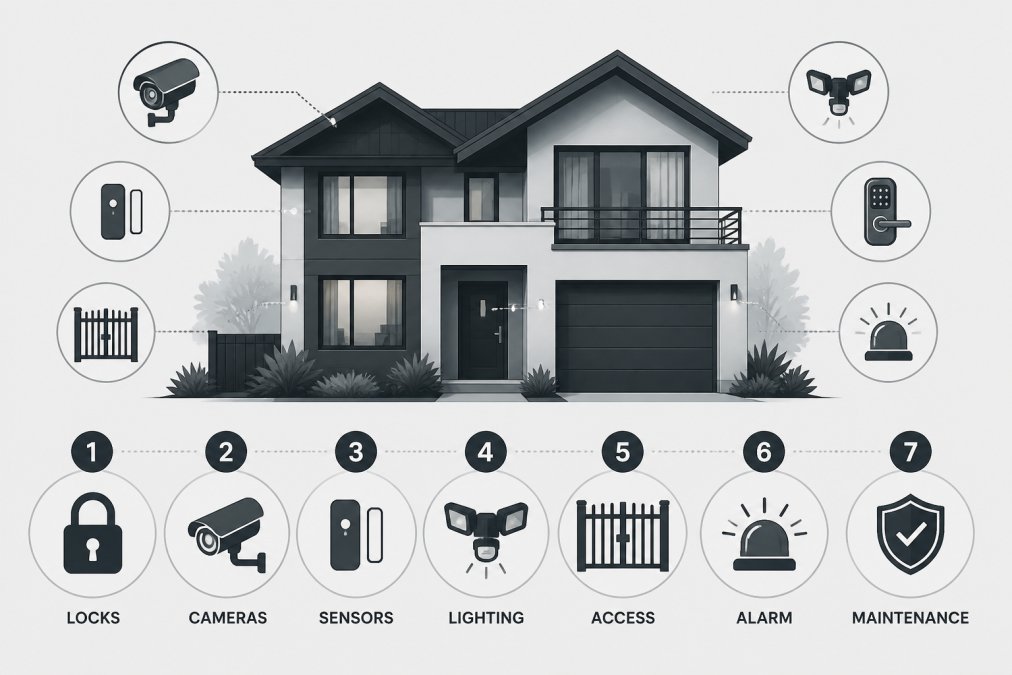
 how-to
How to Secure Your Home for Renters: 7 Proven Steps
Table of Contents
- Step 1: Conduct a Rental Property Security Audit
- Step 2: Get Landlord Permission for Security Upgrades
- Step 3: Choose Non-Permanent Security Solutions for Renters
- Step 4: Upgrade Locks and Deadbolts Without Breaking Your Lease
- Step 5: Install Renter-Friendly Smart Home Security
- Step 6: Improve Perimeter Security with Lighting and Motion Sensors
- Step 7: Know Your Insurance and Emergency Contacts
- Frequently Asked Questions
Last Updated: September 13, 2026
Step 1: Conduct a Rental Property Security Audit
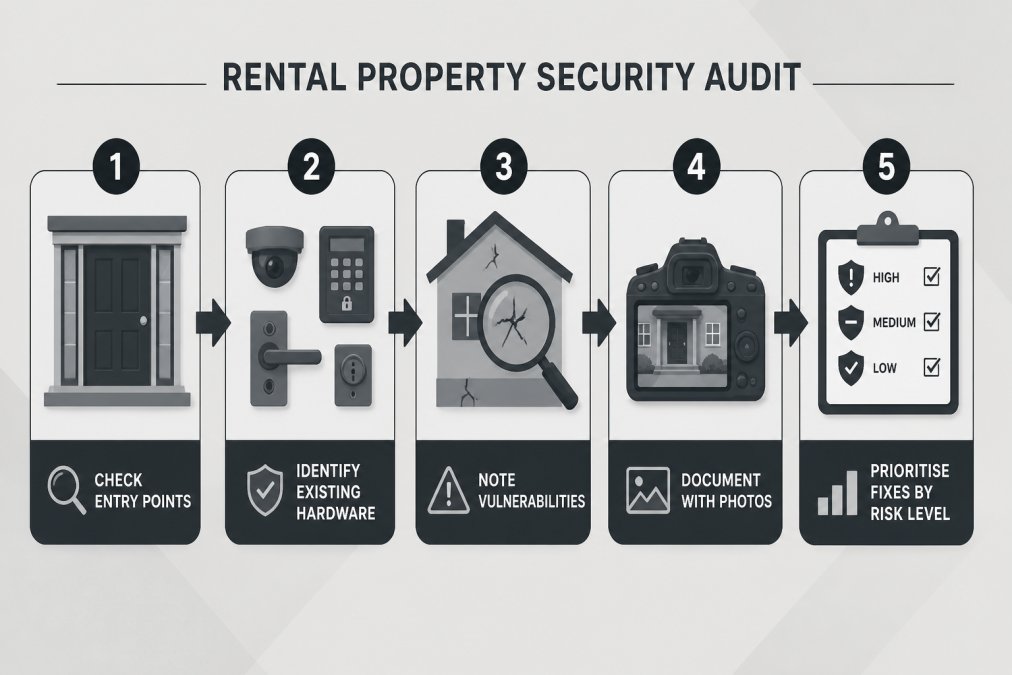
A rental property security audit is a systematic inspection of your home's entry points, existing hardware, and weak spots, documented so you can secure your home, prioritise fixes, and support any request to your landlord. We run the same assessment process on homes and commercial sites: walk the perimeter, test every lock, and log what fails.
Renters in older Queenslanders and units face the same problem: the hardware is often original, and nobody has checked it in years.
Check All Entry Points
Walk the property and test every access point, not just the front door. A common mistake is assuming the back door and garage are as secure as the front. They rarely are.
- Front and back doors: check the strike plate, frame, and deadbolt throw
- Windows, especially ground-floor and those near a fence or bin
- Sliding doors: test the lock and lift the panel to check for play
- Garage, side gates, and any shared entry
Identify Existing Security Hardware
Note what is already installed and whether it works. Existing deadbolts, window restrictors, and sensor lights tell you what you can keep rather than replace.
Step 2: Get Landlord Permission for Security Upgrades
Landlord permission is required before any permanent modification, and a written request is the fastest route to a yes. Most disputes start with verbal agreements nobody can prove. The gap most guides leave open is the legal distinction between a removable fitting and a permanent alteration, get that wrong and a security upgrade becomes a lease breach.
What Your Lease Agreement Says About Security Modifications
Your lease agreement sets the boundaries, but the general residential tenancy rules sit underneath it. In most Australian jurisdictions, a renter must not alter the premises without the lessor's consent, and some locks or fixtures count as alterations even when they improve security. The practical test is reversibility: can the item be removed at the end of the tenancy without leaving holes, marks, or damage that requires repair?
- Removable (usually low risk): adhesive mounts, clamp-on window restrictors, portable door locks, freestanding battery lights, plug-in cameras.
- Permanent (usually needs consent): deadbolts, re-keyed cylinders, drilled camera mounts, hardwired sensors, security screens.
- Grey zone: anything that reuses an existing bore hole or replaces an existing fixture. Treat it as permanent and get consent in writing.
Read the special conditions before you buy anything. Some leases prohibit even adhesive mounts on painted surfaces, and some strata or body corporate by-laws add a second layer of rules for units and townhouses.
How to Write a Request That Gets Approved
Keep it short, specific, and framed as protecting the owner's asset. A request that reads like a demand gets refused; a request that reads like a maintenance proposal gets approved.
- State the security gap you found in your audit, with the photo attached.
- Name the exact product or fix you propose, including the model where relevant.
- Note whether it is reversible, who pays, and who removes it at the end of the tenancy.
- Offer to use a licensed installer and share the invoice.
- Offer the landlord a key or access code for emergency entry, and put that arrangement in writing.
If the landlord refuses a reasonable security request, ask for the refusal in writing and check your state or territory tenancy authority's guidance on repairs, safety, and urgent maintenance. Some jurisdictions allow a renter to apply to a tribunal where a security issue makes the property unsafe, but that is a last resort, the written request is almost always faster.
Step 3: Choose Non-Permanent Security Solutions for Renters
Non-permanent security solutions for renters are fittings that secure your home's entry points without drilling, cutting, or altering the property. They are the fastest way to harden a rental without a landlord conversation.
Door Wedges, Security Bars, and Portable Door Locks
A door wedge or portable door lock jams the door from the inside, so it cannot be opened from outside even with a key. A security bar braces against the handle. These work well when you are home; they do nothing when you are out. Comprehensive measures for securing home while traveling remain essential for maintaining peace of mind during extended absences.
| Solution | Protects When | Reversible | Best For |
|---|---|---|---|
| Door wedge | Home | Yes | Bedroom, front door at night |
| Portable door lock | Home | Yes | Travel and shared housing |
| Security bar | Home | Yes | Sliding and hinged doors |
| Window restrictor | Away | Yes | Ground-floor windows |
| Sliding door lock | Away | Yes | Patio and balcony doors |
Window Restrictors and Sliding Door Locks Without Drilling
Window restrictors and sliding door locks that clamp or wedge into the frame secure the opening without screws. Check the track depth first; a loose fit is worse than no lock because it gives false confidence.
Step 4: Upgrade Locks and Deadbolts Without Breaking Your Lease
Lock upgrades are the single most effective change a renter can make, but they are also the most likely to breach a lease. The workaround is a re-keyable cylinder or a deadbolt that reuses the existing bore hole, installed by a licensed locksmith with the landlord's written consent.
Two practical points. First, key management matters: if you change the cylinder, you control who holds a key, which is exactly what you want after a break-up or a housemate moves out. Second, ask the landlord to keep a copy for emergency access, and put that arrangement in writing.
Step 5: Install Renter-Friendly Smart Home Security
Renter-friendly smart home security covers devices that mount without drilling or wiring: smart doorbells, wireless cameras, and sensors that stick, clamp, or sit on a shelf. They deliver most of the benefit of a hardwired system with none of the permanent damage. The angle most guides miss is the hub-less, Wi-Fi-only stack, devices that need no proprietary bridge, no electrician, and no landlord conversation.
Smart Doorbells and Wireless Cameras with Non-Invasive Installation
A smart doorbell replaces your existing button or mounts beside it with adhesive or a clamp. A wireless camera runs on battery or USB and streams over Wi-Fi, so there is no cabling and no electrician. Look for models with local storage or a subscription you can cancel.
What to check before you buy:
- Power: battery or USB-C, not hardwired. Battery life varies widely with motion alerts, so a busy hallway drains faster than a quiet yard.
- Connectivity: 2.4 GHz Wi-Fi is the most compatible band; 5 GHz-only devices can drop out through brick or render.
- Storage: on-device microSD or a local base station avoids a monthly fee and keeps footage off a third-party cloud.
- Mounting: adhesive, magnetic, or clamp. Check the surface, adhesive fails on textured render and painted weatherboard in heat.
- Hub requirement: avoid devices that need a proprietary bridge unless you are happy to leave it plugged in and return it at the end of the tenancy.
A common pattern is a battery doorbell at the front, one wireless camera covering the rear entry, and a couple of contact sensors on ground-floor windows. That covers the three entry points most break-ins use without a single screw.
Privacy vs. Security: What to Check Before You Install
Privacy vs. security is the trade-off every renter has to weigh, and in shared complexes it is a legal issue, not just a neighbourly one. A camera pointed at a shared hallway, a common driveway, or a neighbour's window can breach privacy expectations and, in some cases, surveillance and listening-device laws. Point cameras only at your own entry, your own yard, or common areas where you have a legitimate reason to film.
Practical rules that keep you out of trouble:
- Frame the camera so it captures your door and threshold, not the footpath or the neighbour's door.
- Turn off audio recording unless you need it. Listening devices attract stricter rules than cameras in most Australian jurisdictions.
- Tell your housemates what you have installed, where it points, and how footage is stored. Co-tenants have a reasonable expectation of privacy inside the home.
- Check your strata or body corporate by-laws before mounting anything on a common wall. Some schemes ban cameras on common property outright.
- If a neighbour objects, adjust the angle rather than argue. A camera that captures a shared corridor is the most common source of complaints.
Office of the Australian Information Commissioner on surveillance and privacy sets out how personal information captured by cameras is regulated, and is worth reading before you install anything that overlooks shared space.
Step 6: Improve Perimeter Security with Lighting and Motion Sensors
Motion-activated lighting is the cheapest deterrent available to a renter, and it needs no permission when it is battery-powered and freestanding. Light removes the cover a burglar relies on.
- Battery motion lights at the front and back doors
- A plug-in timer or smart plug to make the home look occupied
- Solar path lights along side access
- Motion sensors paired with a wireless camera for alerts
Aim lights at the approach, not into a neighbour's window. If you are away often, a smart plug on a lamp is more convincing than a light left on all day.
Step 7: Know Your Insurance and Emergency Contacts
Renter's insurance and a clear emergency contact list are the two things most renters skip, and both matter more than any single lock. Insurance covers your contents if someone gets in; the contact list gets help moving fast.
Renter's Insurance and Security Implications
Renter's insurance covers your belongings, not the building. Check whether your policy requires working locks or a minimum security standard, because a claim can be refused if you left the property unsecured. Many policies also cover temporary accommodation after a break-in.
Building a Neighborhood Watch and Emergency Contact List
A neighborhood watch works because someone notices when something is wrong. Introduce yourself to neighbours, join a local community group, and agree to watch each other's places.
Keep a written list: your property manager, the emergency line, a locksmith, and a security provider for monitored alarm response. If you want 24/7 monitoring and dispatch rather than a DIY camera you check yourself, an Australian Cyber Security Centre home network guidance style of layered approach applies to physical security too: check the basics, then add monitoring.
Queensland Residential Tenancies Authority on rental modifications sets out what renters can and cannot change without consent, so read it before you buy hardware. For personal safety and crime-prevention guidance, Queensland Police Service home security advice is a practical starting point.
Frequently Asked Questions
Can I install security cameras in a rental property?
In most cases, yes, but you need landlord permission first. Non-permanent options like wireless cameras or smart doorbells that don't require drilling are usually approved. Always check your lease agreement and get written consent before installing. Avoid cameras that point into neighbours' windows or common areas, as this can breach privacy laws. If you're unsure, ask your property manager what's allowed under your specific lease terms.
Do I need landlord permission to upgrade door locks?
Yes, you need landlord permission for security upgrades that involve changing locks or hardware. Even if you're improving security, altering a deadbolt or strike plate without consent can breach your lease agreement. The best approach is to submit a written request explaining the upgrade, who will do the work, and whether you'll restore the original hardware when you leave. Many landlords approve reasonable requests, especially if you cover the cost.
What are the best non-permanent security solutions for renters?
Portable door locks, door wedges, window restrictors, and adhesive-mounted wireless cameras are all effective non-permanent options. Security bars that brace against the floor require no installation. Smart doorbells with renter-friendly mounts work well for entry points. For sliding doors, use a cut-to-size security bar or a patio door lock that fits without screws. These solutions provide real protection while keeping your bond safe and your lease intact.
Are smart home security systems worth it for renters?
They can be, especially if you choose systems that don't require permanent installation. Smart doorbells, wireless cameras, and motion sensors can be mounted with adhesive or removable brackets. They offer remote monitoring, real-time alerts, and integration with your phone. The main limitation is that you'll need to take them with you when you move. If you're planning to stay long-term or want portable protection, they're a solid investment for renter-friendly smart home security.
Securing a rental comes down to doing the audit, getting consent in writing, and layering reversible fixes. If you want the monitoring, alarm response, and site assessment handled by licensed operators, Tupper Security provides multi-class licensed teams, a local depot for fast alarm response, and independent site risk assessments. Get started with Tupper Security and protect what matters most.