 how-to
Secure Vacant Commercial Property: 7 Steps to Stop Squatters
Table of Contents
- Why Vacant Commercial Properties Are Targets for Squatters
- Understand Commercial Property Trespass Laws and Your Legal Rights
- Step 1: Conduct a Risk Assessment and Security Audit
- Step 2: Harden Physical Entry Points and Perimeter Security
- Step 3: Install Alarm Systems and Remote CCTV Monitoring for Vacant Sites
- Step 4: Deploy Professional Mobile Security Patrols and Regular Inspections
- Step 5: Create a Vacant Building Security Checklist and Documentation Protocol
- Step 6: Maintain Insurance Compliance and Legal Possession Records
- Frequently Asked Questions
Last Updated: September 19, 2026
Why Vacant Commercial Properties Are Targets for Squatters
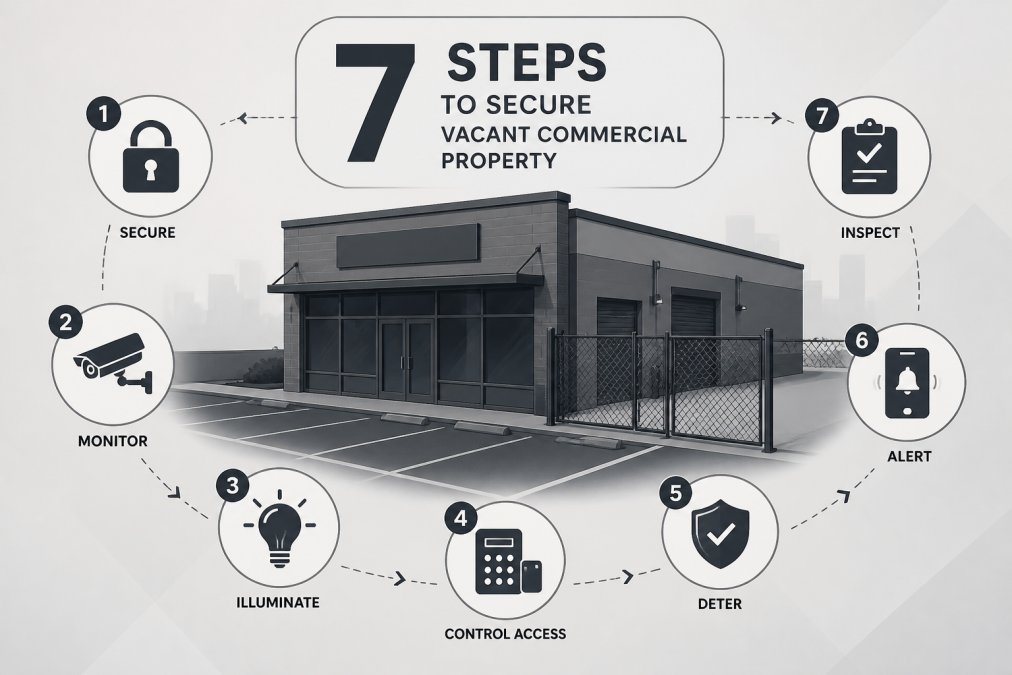
Vacant commercial properties attract illegal occupation because they're empty, poorly monitored, and offer free shelter, making it essential to secure vacant commercial property against trespassers. Without proper security, they become open invitations to trespassers.
Illegal occupation costs thousands in property damage, liability, legal fees, and remediation, far beyond lost rent.
Prevention through layered security, physical deterrents, legal documentation, monitoring, and professional oversight, stops illegal occupation before it starts.
Understand Commercial Property Trespass Laws and Your Legal Rights
Commercial property trespass is unauthorised entry or occupation of land you own or control. Your legal rights depend on state legislation and documented proof of ownership and possession.
You have the right to exclude trespassers and recover possession, but you must prove legal possession through documented evidence: title deeds, lease agreements, council rates notices, or insurance policies in your name.
Step 1: Conduct a Risk Assessment and Security Audit
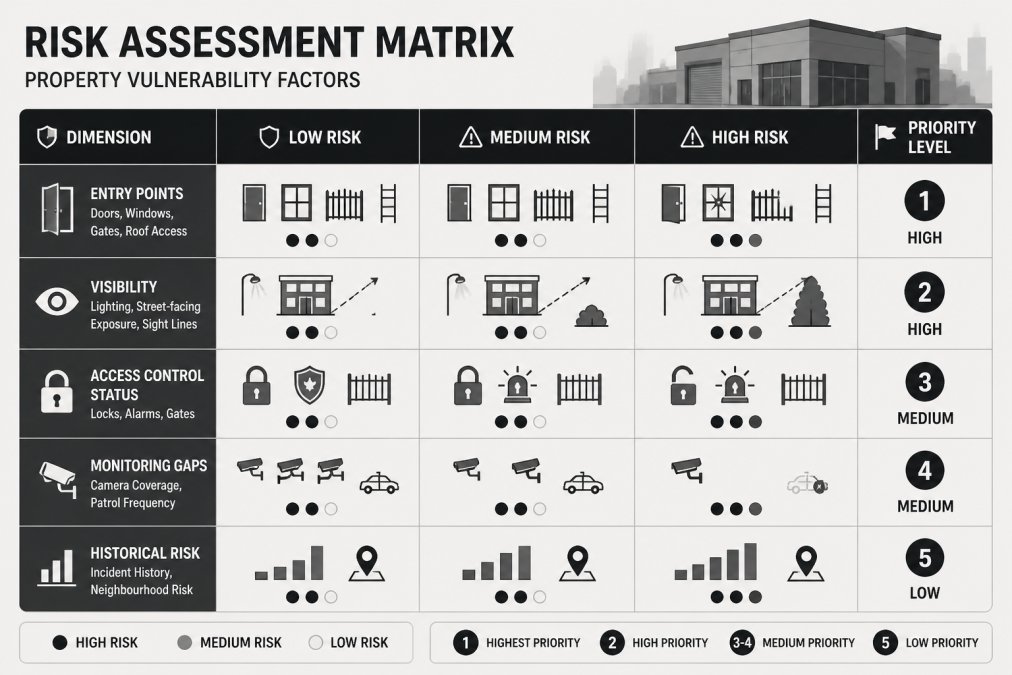
Identify weak points trespassers exploit: unsecured entry points, poor visibility, lack of monitoring, and signs of abandonment.
Step 2: Harden Physical Entry Points and Perimeter Security
Physical barriers deter most trespassers by making entry difficult.
Install heavy-duty deadbolts, padlock protectors, and metal door frame reinforcement. Board windows with steel screens or roller shutters. Secure service doors, loading bays, and roof access. Repair fencing to 1.8 metres minimum, add anti-climb toppers, remove climbing aids, and install locking gates. Install "No Trespassing" and "Private Property" signs, use security signage, ensure perimeter lighting, and remove overgrown vegetation.
Step 3: Install Alarm Systems and Remote CCTV Monitoring for Vacant Sites
- Wireless door and window sensors trigger instant alerts and log breach history. Motion-activated lighting deters trespassers and creates the impression of occupancy. Environmental sensors detect signs of habitation. Smart locks allow remote verification and control with audit trails. Integration with property management platforms enables multi-property monitoring and alert prioritisation.
The combination of visible cameras, active alarms, and smart sensors creates a powerful deterrent. Trespassers know they'll be detected, recorded, and reported immediately, and that the property is actively monitored even without visible human presence.
Step 4: Deploy Professional Mobile Security Patrols and Regular Inspections
To secure vacant commercial property effectively, physical security and alarms work best when paired with human presence. Professional mobile security patrols create unpredictability, trespassers never know when someone will check the property.
Step 5: Create a Vacant Building Security Checklist and Documentation Protocol
Consistency matters. A security checklist ensures every patrol, inspection, and response follows the same standard. This protects your property and creates the evidence you need if legal action becomes necessary.
Step 6: Maintain Insurance Compliance and Legal Possession Records
Insurers require proof of active management and security during vacancy. Most standard commercial policies exclude vacant buildings entirely, leaving owners unaware until a claim is denied.
The vacant property insurance gap:
- Deny claims for theft, vandalism, or squatter damage
- Require written notification and approval before coverage continues
- Impose higher excess (deductible) amounts
- Demand proof of active security measures
- Require monthly (or more frequent) inspections documented in writing
- Exclude certain perils (e.g., malicious damage) unless you meet specific security standards
Insurance compliance checklist, what insurers actually require:
- Written notification: Inform your insurer in writing at least 14 days before the property becomes vacant. Provide the expected vacancy period and reason (renovation, sale, lease-up).
- Security measures: Maintain alarm systems, CCTV, or manned patrols. Your insurer will specify minimum standards (e.g., "monitored alarm system" or "weekly patrols").
- Inspection frequency: Most insurers require monthly inspections, documented in writing with photos and dated records. Some high-risk properties require fortnightly or weekly inspections.
- Maintenance: Keep utilities active (electricity, water, heating) to prevent deterioration and show active ownership. Some insurers require you to maintain heating to a minimum temperature to prevent pipe damage.
- Access control: All entry points must be secured (locked doors, boarded windows, secured gates). Your insurer may require specific lock types or boarding standards.
- Incident reporting: Report all break-in attempts, alarms, trespass, or damage to your insurer within a specified timeframe (usually 7-14 days). Failure to report can be grounds for claim denial.
- Policy renewal: Some insurers will not renew vacant property coverage beyond 12 months. Plan ahead if your vacancy is expected to be longer.
Maintaining legal possession:
- Title deeds and ownership documents: Keep originals secure and accessible. Provide copies to your insurer and legal advisors.
- Council rates: Pay property rates on time. Rates notices in your name prove active ownership and are admissible as evidence in court.
- Insurance policies: Maintain active insurance in your name. Policy documents prove you consider yourself the owner and are protecting your asset.
- Utility accounts: Keep at least one utility (electricity, water, or gas) in your name and active, even if minimal. This creates a paper trail of active ownership.
- Security and inspection records: Document every patrol, alarm trigger, and inspection with date, time, inspector name, findings, and photos. These records prove you maintained active control and did not abandon the property.
- Correspondence: Keep all council letters, insurer communications, and legal notices. These establish your engagement with the property's status.
- Lease or management agreements: If you've engaged a property manager or security firm, keep signed agreements on file. These prove you appointed agents to act on your behalf.
Common insurance claim denials and how to avoid them:
-
"You didn't notify us of vacancy." Solution: Send written notice to your insurer before vacancy begins. Keep a copy and proof of delivery (email read receipt, registered mail).
-
"Your security measures didn't meet our requirements." Solution: Request the insurer's specific security requirements in writing before vacancy. Document that you've met or exceeded them. If they require monitored alarms, get written confirmation from your monitoring provider.
-
"Your inspection records are incomplete." Solution: Use a standardised inspection checklist (see Step 5). Every inspection must include date, time, inspector name, findings, and photos. Store records in a cloud-accessible format so you can retrieve them quickly if a claim arises.
-
"You didn't report the incident within the required timeframe." Solution: Establish a protocol: if trespass or damage is discovered, photograph it immediately, report it to police (get incident number), notify your insurer within 24 hours, and document the report in writing.
-
"The property was abandoned, so we don't cover it." Solution: Maintain active utilities, pay rates, and document regular inspections. These prove continuous ownership and control, not abandonment.
Post-vacancy transition:
Frequently Asked Questions
What security measures are most effective at deterring squatters?
Physical deterrents work best in combination: steel screens and roller shutters on windows, anti-climb fencing with clear 'No Trespassing' signage, secured entry points with heavy-duty padlocks, and visible CCTV cameras. However, the most effective approach pairs these with active monitoring, regular inspections, alarm systems with rapid response, and professional mobile patrols. Squatters actively avoid properties that show signs of active ownership and surveillance. A property left completely dark and unvisited is far more attractive than one with visible security measures and evidence of regular checks.
Can you kick squatters out in Australia?
Yes, but the process requires proper legal steps. Property owners can pursue eviction through the courts under the Property Law Act 1974 (QLD) by establishing that the occupants are trespassers without legal right to occupy. You must serve a notice to vacate and, if they refuse to leave, apply to the District or Supreme Court for an eviction order. This process typically takes weeks to months. The faster approach is prevention: secure the property before squatters establish occupation. Once they've occupied for a period, establishing 'adverse possession' claims becomes more complex, making early intervention far more cost-effective than legal removal.
How often should vacant commercial property be inspected?
Weekly inspections are the industry standard for vacant commercial properties at high risk. For lower-risk properties in secure areas, fortnightly inspections may be sufficient. However, properties in high-turnover areas or with a history of trespass should be checked twice weekly or use continuous remote monitoring with CCTV and alarm systems. Regular inspections serve two critical purposes: they detect unauthorized access early (when removal is fastest and least costly) and they establish documented proof of your active ownership, which is essential for legal proceedings and insurance compliance. Professional mobile security patrols can handle these inspections on a scheduled basis, providing auditable records of each visit.
What is the difference between a trespasser and a tenant in commercial law?
A trespasser enters or occupies property without legal permission or right, while a tenant has a formal lease agreement granting them lawful occupation rights. In commercial property law, the distinction determines your legal remedies. For trespassers, you can pursue immediate removal under trespass law without formal eviction procedures. For tenants, you must follow lease termination and formal eviction processes, which take considerably longer. Squatters occupy as trespassers initially, but if left unchallenged for extended periods, they may claim adverse possession rights. This is why swift identification and removal of unauthorized occupants is critical, the longer they occupy, the more complex and costly removal becomes.