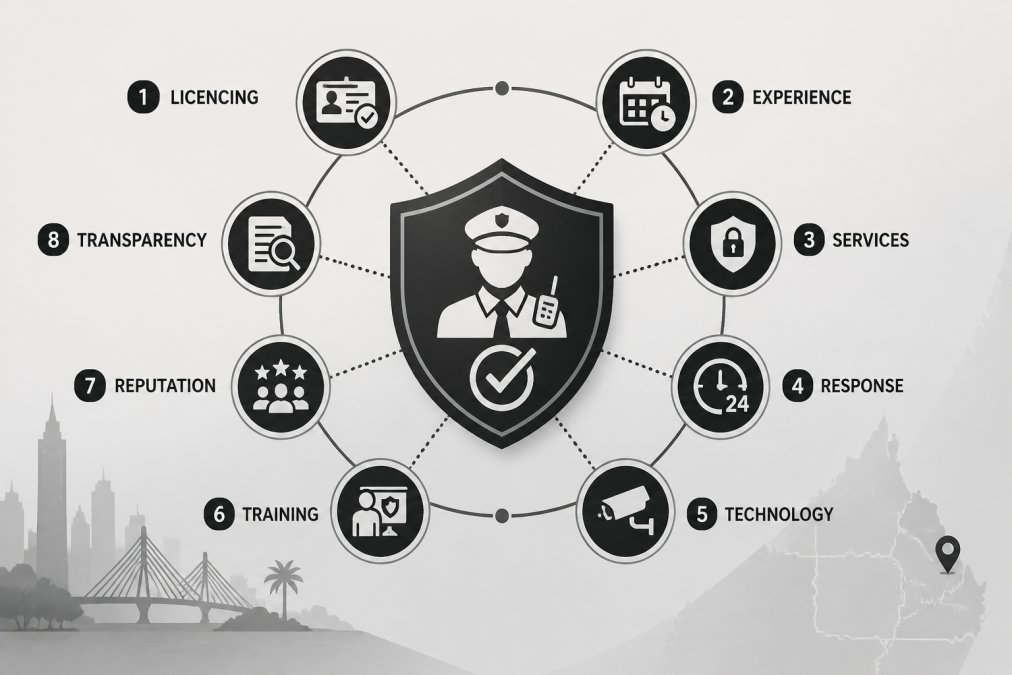
 how-to
How to Choose a Reliable Security Company in Queensland
Table of Contents
- What Makes a Security Company Reliable?
- Security Firm Licence Verification: Check Before You Sign
- Security Risk Assessment for Businesses: What to Expect
- Security Guard Service Agreement Checklist
- Technology, Equipment, and Integration with Smart Systems
- Insurance, Vetting, and Operational Transparency
- Red Flags and Common Mistakes When Hiring a Security Company
- Frequently Asked Questions
Last Updated: September 12, 2026
What Makes a Security Company Reliable?
Choosing a reliable security company starts with one hard truth: a licence proves someone is allowed to operate, not that they will protect your site well. Reliability is operational, and it shows up in response times, documented procedures, and how a firm handles a mistake. At Tupper Security, we have run mobile patrols and alarm response across South-East Queensland since 2014, and the pattern is consistent. The firms that keep clients are the ones that can prove what they did, when they did it, and who attended.
Reliability rests on four pillars:
- Licensing that is current and correctly classed for the work
- Documented processes for patrols, incident reporting, and escalation
- Insurance and vetting that protect you, not just the contractor
- Local presence that makes fast response physically possible
Miss any one of these and you are buying a promise, not a service.
Security Firm Licence Verification: Check Before You Sign
Every security firm operating in Queensland must hold a master licence under the Security Providers Act 1993, administered by the Queensland Government security licensing authority. Individual guards must hold a current security provider licence with the correct class for their duties. Ask for the master licence number in writing before you sign anything.
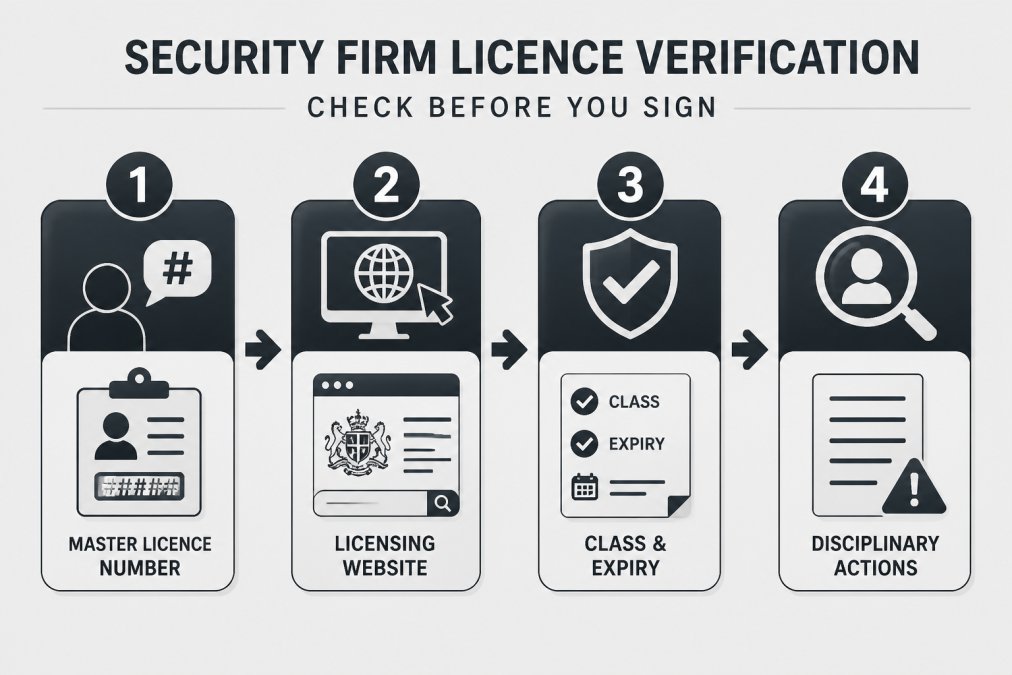
A common mistake is accepting a photocopy of a licence with no expiry check. Licences lapse, and a firm running unlicensed staff exposes you to liability. Verify the number yourself on the official register. Confirm the classes cover what you need: crowd control, unarmed guard, monitoring, or cash-in-transit are separate endorsements, and a firm licensed for one is not automatically licensed for another.
Security Risk Assessment for Businesses: What to Expect
A security risk assessment for businesses is a documented review of your site's vulnerabilities, entry points, existing controls, and response gaps, ending in prioritised recommendations. It is not a walkthrough with a clipboard. A proper assessment maps access points, reviews lighting and sightlines, tests alarm and CCTV coverage, and identifies where a threat could realistically get in or out.
What to expect from a credible assessment:
- A site audit conducted on foot, not from a desk
- A written report with findings ranked by risk
- Clear separation between must-fix items and optional upgrades
- Recommendations tied to how your site actually operates
The thing nobody tells you about assessments is who conducts them. Ask directly whether a senior assessor or a junior with a template is attending. Independent site risk assessments and security design reviews are carried out by experienced operators, because the value sits in judgement, not paperwork. If a firm cannot explain its methodology, treat the report as marketing.
Security Guard Service Agreement Checklist
A security guard service agreement should lock down scope, response expectations, insurance, and exit terms in writing. Verbal promises about response times are worthless when an alarm activates at 2am. Use this checklist before signing:
- Master licence number and the specific licence classes stated
- Scope of services defined per site, not generically
- Response time commitments written as a service level agreement
- Patrol frequency and check-in method specified
- Incident reporting format and delivery timeframe agreed
- Public liability insurance and professional indemnity certificates attached
- Vetting and background checks confirmed for all personnel
- Exit clauses, notice periods, and handover obligations stated
- Escalation contacts and after-hours numbers listed
| Agreement Clause | What to Check | Why It Matters |
|---|---|---|
| Service level agreement | Written response time commitment | Turns a promise into an obligation |
| Insurance | Current certificates attached | Protects you if something goes wrong |
| Exit clause | Notice period and handover terms | Prevents being locked into a poor provider |
| Incident reporting | Format and delivery timeframe | Gives you an audit trail |
Licence Classes to Name in the Agreement
Under the Security Providers Act 1993, a Queensland master licence is issued with specific classes, and a firm licensed for one class is not automatically licensed for another (qld.gov.au). The classes most commonly relevant to commercial clients are:
- Unarmed guard, static guarding, concierge, and access control
- Crowd controller, licensed venues, events, and crowd management
- Monitoring, alarm monitoring centre operations
- Cash-in-transit, movement of cash and valuables
- Bodyguard, close personal protection
- Security adviser, risk assessment, security design, and consultancy
- Security equipment installer, installation of alarms, CCTV, and access control
If your agreement covers more than one activity, the contract should name every class the firm will rely on. A firm that holds an unarmed guard class but deploys crowd controllers at your event is operating outside its licence, and that exposure flows to you as the client.
Exit Clauses and Contract Flexibility
Most guides stop at hiring. The harder question is how to leave. A well-drafted exit clause should specify:
- Notice period, commonly 30 to 90 days, and shorter is better for you
- Handover obligations, return of keys, access cards, codes, and site documentation
- Data and footage ownership, who holds CCTV footage and for how long after termination
- Outstanding fees, how final invoices and any early-termination charges are calculated
- Transition support, whether the outgoing firm will brief the incoming provider
A common pattern is a 12-month term with automatic rollover and a 90-day notice period. That combination can leave you paying for three months of a service you no longer want. Push for a shorter initial term, a defined trial period, and a notice period you can live with.
Technology, Equipment, and Integration with Smart Systems
Modern security is as much about data as it is about guards. High-resolution IP surveillance with remote access lets you review footage from anywhere. Access control systems should be auditable and revocable, so you can see who entered and cut off a lost credential in minutes. Alarm monitoring and mobile patrols work best when they talk to each other.
Integration is where many firms fall short. Smart systems, IoT sensors, and existing CCTV should feed into one monitoring picture rather than sitting in silos. If you already have CCTV and access control, ask what can be integrated rather than replaced. The ROI question is fair, and the honest answer is that integration usually costs far less than a full rip-out and delivers faster response because operators see the full site, not fragments.
Vetting a Firm's Digital Integration Capability
Most guides tell you to ask about cameras. Few tell you how to test whether a firm can actually integrate them. Use these questions before you commit:
- What protocols does your platform support? Look for ONVIF-compliant cameras and open standards rather than a single-vendor lock-in.
- Can you demonstrate a live integration? Ask for a screen-share or site visit showing your existing cameras feeding into their monitoring dashboard.
- How is footage stored and for how long? Confirm whether storage is on-site, cloud, or hybrid, and what the retention period is.
- Who owns the data? The answer should be you, with a documented export process if you leave.
- What happens during an internet outage? A credible firm will describe local buffering and failover, not just "the cloud handles it".
- How are firmware and software updates managed? Unpatched devices are a known entry point for attackers.
Smart Systems and IoT: What to Ask Before You Connect
If you are integrating smart locks, sensors, or building management systems, the security company becomes part of your digital attack surface. A firm that cannot explain how it segments a security network from your corporate network is a risk, not a solution. Ask whether the security VLAN is isolated, whether remote access uses multi-factor authentication, and who at the firm can access your footage and access logs.
A common pattern is a firm that installs excellent hardware but leaves default credentials in place and never updates firmware. The hardware is fine; the operational discipline is not. Reliability in a modern security provider means the same thing online as it does on site: documented, auditable, and revocable.
Insurance, Vetting, and Operational Transparency
Insurance and vetting separate professional operators from opportunists. Ask for current certificates for public liability insurance and professional indemnity, and confirm the cover limits match the risk at your site. A certificate with the wrong entity name or an expired date is a red flag.
Vetting matters just as much. Every guard should pass background checks before deployment, and the firm should be able to describe its vetting process. Operational transparency means documented incident reporting, named supervisors, and clear escalation paths. If a firm cannot tell you who is attending your site and what they will do, you have no way to hold them accountable.
Red Flags and Common Mistakes When Hiring a Security Company
The biggest mistake is choosing on price alone. The second is accepting verbal assurances about response times. Watch for these red flags:
- No master licence number provided on request
- Insurance certificates that are expired or name a different entity
- Response times quoted verbally but absent from the contract
- No documented incident reporting process
- High staff turnover with no continuity plan
- No exit clause or an unreasonable notice period
A firm that loses staff without a coverage plan will leave your site exposed. Ask how coverage gaps are handled and demand a written continuity commitment. Regulatory compliance is not optional, and a provider that treats it casually will treat your site the same way.
Frequently Asked Questions
What licence must a security firm hold to operate legally in Queensland?
A security firm must hold a master licence issued under the Security Providers Act 1993 (Qld). This licence covers the business entity and specifies the classes of security activities it can provide, such as crowd control, monitoring, or patrols. Individual guards must hold a current security provider licence for their class of work. Always verify both the firm's master licence and the individual guards' licences before engaging services.
How do I verify if a security company is licensed in Queensland?
Ask for the firm's master licence number, then check it on the Queensland Government's online licensing register. Confirm the licence is current, covers the services you need, and has no conditions or suspensions. For individual guards, request their security provider licence and verify it the same way. A reliable security company will provide these details without hesitation.
What is the difference between a security firm and a sole trader?
A security firm holds a master licence and employs multiple licensed guards, offering backup, supervision, and 24/7 coverage. A sole trader operates alone, which can mean limited availability and no redundancy if they are sick or on leave. For sites needing consistent patrols or emergency response, a firm with a master licence is usually more reliable.
What should be included in a security guard service agreement checklist?
Your checklist should cover: scope of services, response time guarantees, escalation procedures, insurance details (public liability and professional indemnity), incident reporting frequency, vetting process for guards, exit clauses, and service level agreements (SLAs). Also confirm how the provider handles staff turnover and coverage gaps. A thorough agreement protects both parties and sets clear expectations.
Choosing a reliable security company comes down to evidence, not sales pitch. Tupper Security provides multi-class licensed operators, tailored protection plans built around how your site actually operates, and a local Silkstone depot for rapid alarm response. With independent site risk assessments, auditable access control, and documented shrinkage reporting, we give you the proof most providers only promise. Request a quote and get a security plan you can actually audit.