 ultimate-guide
Benefits of 24/7 Alarm Response: A 2026 Guide
Table of Contents
- What Is 24/7 Alarm Response and How Does It Work?
- Immediate Emergency Response and Rapid Dispatch
- Commercial Alarm Monitoring Services for Business Protection
- Security Patrol Response Times: What to Expect
- Reducing False Alarm Incidents with Smart Verification
- Cost-Benefit Analysis: Insurance Premium Reductions and ROI
- DIY vs. Professional Monitoring: Which Is Right for You?
- Frequently Asked Questions
Last Updated: September 10, 2026
What Is 24/7 Alarm Response and How Does It Work?
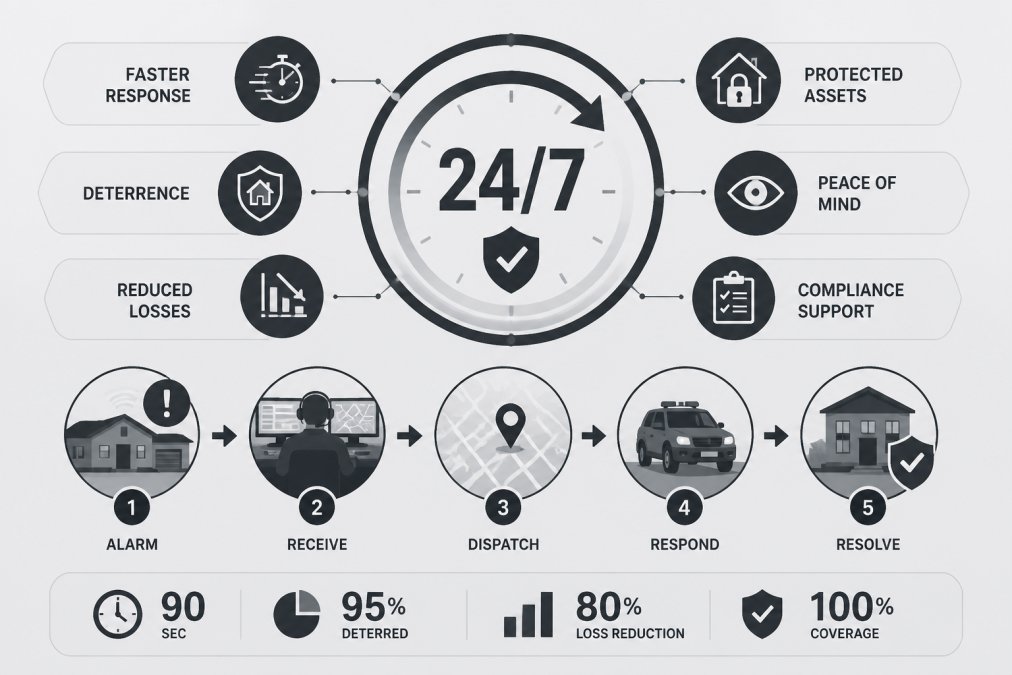
24/7 alarm response is a monitoring service that watches your alarm system around the clock and sends a physical response when a genuine activation occurs. It combines a monitored alarm panel, a control room that receives signals, and a mobile patrol or emergency dispatch that attends your property. This guide covers how the alert sequence works, what response times look like, and how to choose between professional and DIY monitoring.
The difference between a monitored system and an unmonitored one is stark. An unmonitored alarm makes noise and hopes someone reacts; a monitored system routes every activation to a control room staffed by operators who verify the signal and act on it. That gap matters most at 2am, when a siren alone changes nothing.
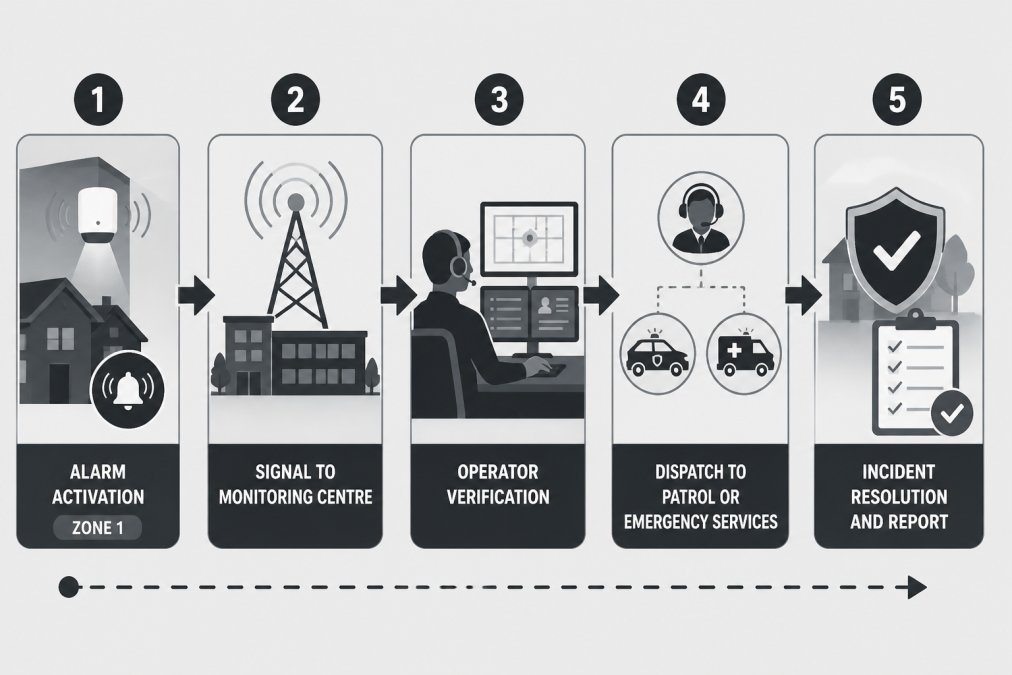
The Alert Sequence: From Activation to Dispatch
The alert sequence follows a fixed path, and understanding it helps you spot weak points in your setup.
- System activation. A sensor trips, a door contact opens, or a motion detector triggers. The panel logs the event.
- Signal transmission. The panel sends the signal to the monitoring centre, ideally over an IP connection with cellular backup in case the primary line fails.
- Operator verification. A control room operator receives the signal, checks the zone, and attempts to contact nominated keyholders.
- Dispatch. If the operator confirms an intrusion, they dispatch a patrol vehicle, or escalate to emergency services where the situation warrants it.
- Incident resolution. The attending officer checks the site, secures the property, and files a report.
Immediate Emergency Response and Rapid Dispatch
The core benefit of 24/7 monitoring is that someone acts the moment a real event occurs, not the next morning. Rapid dispatch shortens the window between intrusion and intervention, when most loss happens, and creates a documented record of every activation for insurance claims and repeat problem zones.
Response speed depends less on the monitoring centre and more on where the responding patrol is based. A control room can dispatch in seconds, but if the nearest vehicle is 40 minutes away, that dispatch time is irrelevant. Depot location is a real selection criterion, not a sales line.
What Actually Determines Response Speed
Four variables decide how fast a patrol reaches your site, and only one sits inside the control room:
- Verification time. The operator must confirm a genuine event before dispatching. Video verification compresses this to seconds; audio-only or keyholder-callback verification adds minutes.
- Escalation tier. Not every activation triggers a patrol. Many providers triage: keyholder notification first, patrol dispatch second, emergency services third. You get the tier your contract specifies.
- Depot proximity. The distance from the nearest patrol base to your site sets the floor on attendance time. A 10 km radius is a different service from 60 km.
- Patrol availability. A vehicle already committed to another job cannot attend yours. Coverage density, vehicles per shift in your area, matters more than the headline response promise.
The Technical Failure Protocols Competitors Don't Explain
A monitoring system is only as reliable as its transmission path. If the link between your panel and the control room fails, the alarm is silent, the failure mode most sales content avoids.
- Primary path. Most modern panels use an IP connection over broadband. It is fast and cheap, but dies with your internet.
- Cellular backup. A SIM-based path (4G/5G) takes over when the IP link drops, the single most important redundancy feature to confirm in writing.
- Dual-path signalling. Better systems run IP and cellular simultaneously, so a cut line or broadband outage does not take the panel offline.
- Power failure. A rechargeable backup battery keeps the panel running for a defined period after mains power drops (ul.com). Ask what that period is, it varies by panel and battery condition.
- Line-cut detection. Some panels signal the control room when the primary path is severed, so the operator knows the site has gone dark.
Escalation: Who Gets Called, and in What Order
A documented escalation path separates a monitored system from a noisy box. A typical sequence: the control room verifies the signal, attempts the first nominated keyholder, then the second, then dispatches a patrol if the event is confirmed or keyholders cannot be reached. Emergency services are escalated to directly where warranted, a confirmed break-in in progress, a duress activation, or a medical event. Ask your provider to put the escalation order in writing; the default is not always the one you would choose.
What 'Rapid' Should Mean in Your Contract
Response benchmarks are only meaningful if defined and measured. A credible contract specifies the benchmark (for example, attendance within a stated window for a verified alarm), the measurement method, and the reporting cadence. If a provider will not commit a benchmark to paper, treat the verbal promise as marketing.
Commercial Alarm Monitoring Services for Business Protection
For businesses, alarm monitoring protects more than stock: it protects the people on site, the assets in the yard, and the operational continuity that keeps revenue flowing. But the commercial case is a cost-benefit question most provider content skips.
What Commercial Monitoring Actually Includes
A commercial-grade monitoring service typically bundles:
- Intrusion detection across multiple zones, with zone-level identification so the operator knows which door or area triggered.
- After-hours monitoring, since most commercial loss occurs when the site is unoccupied.
- Keyholder escalation and patrol dispatch, with a documented escalation order.
- Integration with CCTV, access control, and where relevant, duress and hold-up alarms.
- Incident reporting: every activation, patrol visit, and door event logged and reviewable.
For a warehouse or multi-tenant site, the value sits in that audit trail, which turns monitoring from a deterrent into a management tool.
The Insurance and ROI Case (The Gap Most Competitors Miss)
Most sites mention 'peace of mind' and stop there. The harder question is whether monitoring pays for itself, and the answer has two parts.
Insurance premium reductions. Insurers commonly recognise monitored systems, but the discount depends on the policy, the insurer, and how the system is specified. Some require verified response; others require a specific standard or certification. The only reliable way to know your potential saving is to ask your insurer what they recognise, in writing, before you buy. A system that does not meet their specification may attract no discount at all.
Avoided loss. The ROI case rests on what does not happen. A single prevented break-in, stopped shrinkage pattern, or deterred intruder often outweighs years of monitoring fees. For retail and warehouse sites, documented shrinkage reporting also targets loss prevention where it actually pays.
Treat insurance recognition and avoided-loss data as two separate lines in your business case. The first is a known, quantifiable discount you can ask your insurer for today. The second is a risk-adjusted estimate. Both belong in the decision, but they should not be blended into a single 'ROI' figure that hides the assumptions.
Privacy and Data Considerations
Remote camera access and cloud-recorded footage raise legitimate privacy questions sales-heavy content tends to ignore. If your monitoring includes video verification or remote viewing, ask:
- Where is footage stored, and for how long?
- Who inside the provider can access live and recorded video, and under what authorisation?
- How is access logged and audited?
- What happens to footage at the end of the contract?
For sites with employees or tenants, these questions also touch on workplace surveillance and privacy obligations. A provider that cannot answer them clearly has not thought about the data it holds.
Matching Monitoring to the Site
Protection should be built around how a site actually operates rather than a generic schedule. For a retail store, that might mean documented shrinkage reporting and loss prevention checks. For a construction site, static guards and a site risk assessment before installation. For a multi-tenant property, auditable, revocable access control so you always know who entered and when.
| Business Type | Primary Risk | Monitoring Focus |
|---|---|---|
| Retail store | Shrinkage, after-hours break-in | Loss prevention, shrinkage reporting |
| Warehouse | Asset theft, unauthorised access | Access control, CCTV integration |
| Construction site | Plant and material theft | Static guards, site risk assessment |
| Multi-tenant property | Uncontrolled access | Auditable, revocable access control |
Australian Securities and Investments Commission guidance on insurance
Security Patrol Response Times: What to Expect
Security patrol response times vary by provider, contract, and the distance between the nearest patrol and your site. No provider can guarantee a fixed number for every activation, because traffic, weather, and patrol availability all affect the clock. What you can assess is the depot location, coverage model, and whether benchmarks are committed in writing.
When you compare providers, ask three questions:
- Where is the nearest patrol based, and how far is that from my site?
- What is the committed response benchmark, and is it contractual?
- How is response time measured and reported back to me?
If a provider talks about response times but won't put a benchmark in the contract, treat the promise as marketing. Ask for the depot address and the coverage model instead.
Reducing False Alarm Incidents with Smart Verification
False alarms are the single biggest drain on any monitoring setup. They waste patrol resources, erode trust in the system, and can trigger penalties from authorities. Reducing false alarm incidents starts with verification: confirming a real event before dispatching.
Smart verification uses video, audio, and sequential zone logic to separate a genuine intrusion from a cat walking past a sensor.
Real-Time Video Verification and Two-Way Audio
Real-time video verification lets the control room operator see what triggered the alarm before dispatching anyone. Two-way audio lets the operator challenge an intruder directly and gather information for the attending patrol. Together, these tools cut wasted dispatches and give responding officers a clearer picture.
The gains: fewer wasted callouts, faster confirmation of genuine threats, and better evidence for police or insurers.
Set your panel to require two zones to trip before signalling an alarm where your site layout allows it. This single configuration change eliminates most single-sensor false alarms without slowing genuine detection.
Cost-Benefit Analysis: Insurance Premium Reductions and ROI
Monitored alarm systems can support insurance premium reductions, but the amount depends on your insurer, your policy, and how the system is specified. Some insurers offer discounts for monitored systems with verified response; others require specific standards or certifications. The only reliable way to know your potential saving is to ask your insurer what they recognise.
Beyond insurance, the ROI case rests on avoided loss. A single prevented break-in, stopped shrinkage pattern, or deterred intruder often outweighs years of monitoring fees. For retail and warehouse sites, documented shrinkage reporting also targets loss prevention where it actually pays.
Australian Securities and Investments Commission guidance on insurance
DIY vs. Professional Monitoring: Which Is Right for You?
DIY monitoring routes alerts to your phone through an app. Professional monitoring routes them to a staffed control room that dispatches a physical response. The choice comes down to what happens when you're asleep, on a plane, or not looking at your phone.
| Factor | DIY Monitoring | Professional Monitoring |
|---|---|---|
| Alert destination | Your phone | Staffed control room |
| Physical response | None | Patrol dispatch |
| Cellular backup | Often optional | Standard configuration |
| Best for | Low-risk, occupied premises | Unoccupied, high-value sites |
| Audit trail | App logs only | Documented incident reports |
DIY suits a small premises where someone is almost always present and the main risk is daytime. Professional monitoring suits unoccupied sites, high-value stock, and any property where a delayed response means real loss. For most commercial sites, the deciding factor is simple: if nobody is there to respond, you need someone who is.
Tupper Security has operated from its Silkstone depot since 2014, with multi-class licensed operators and a coverage model built for the Ipswich corridor and South-East Queensland. If you want to know what a realistic response benchmark looks like for your site, request a quote.
The difference between a good outcome and a bad one is measured in minutes, and those minutes depend on who is watching and how close they are. Tupper Security provides 24/7 monitoring and dispatch, multi-class licensed operators, and a local depot positioned for rapid response across the Ipswich corridor. We also deliver independent site risk assessments and documented shrinkage reporting so your protection is built around how your site actually runs. Request a quote.
Frequently Asked Questions
What are the benefits of alarm monitoring?
Alarm monitoring provides 24/7 oversight, immediate emergency dispatch, and real-time video verification. It reduces false alarms, lowers insurance premiums, and offers peace of mind. Professional monitoring ensures a rapid response even when you are away, protecting assets and people. It also provides documented event logs for audits and incident management.
How does 24/7 alarm response improve insurance premiums?
Insurers often offer discounts for professionally monitored alarm systems because they reduce risk. A verified response can lead to fewer false alarms and faster police attendance, which may lower claim costs. Check with your insurer for specific discounts; many Australian insurers provide premium reductions for monitored systems.
What is the difference between alarm monitoring and alarm response?
Alarm monitoring involves a control room receiving signals and verifying them. Alarm response is the physical action taken, such as sending a security patrol or emergency services. Monitoring is the eyes and ears; response is the boots on the ground. Both are essential for comprehensive security.
How quickly can a security patrol reach a site during an alarm event?
Response times vary by location and provider. A local depot can often reach sites within 15-30 minutes in urban areas. Tupper Security, with a Silkstone depot, aims for rapid response in Ipswich and Brisbane. Factors include traffic and site access. Always ask for documented response times.