 ultimate-guide
Hybrid Security Models for Australian SMBs: 2026 Guide
Table of Contents
- What Are Hybrid Security Models for Australian SMBs?
- Managed vs In-House Security for SMEs: Which Fits Your Operation?
- Security Risk Assessment for Small Businesses: The Starting Point
- Building a Layered Hybrid Model: Guards, Patrols, Alarms and Access Control
- Cybersecurity Protection Guide for Australian Businesses: The Digital Half of Hybrid
- Benefits and Drawbacks of Hybrid Security Models
- Implementation Steps for Australian SMBs
- Frequently Asked Questions
Last Updated: September 16, 2026
What Are Hybrid Security Models for Australian SMBs?
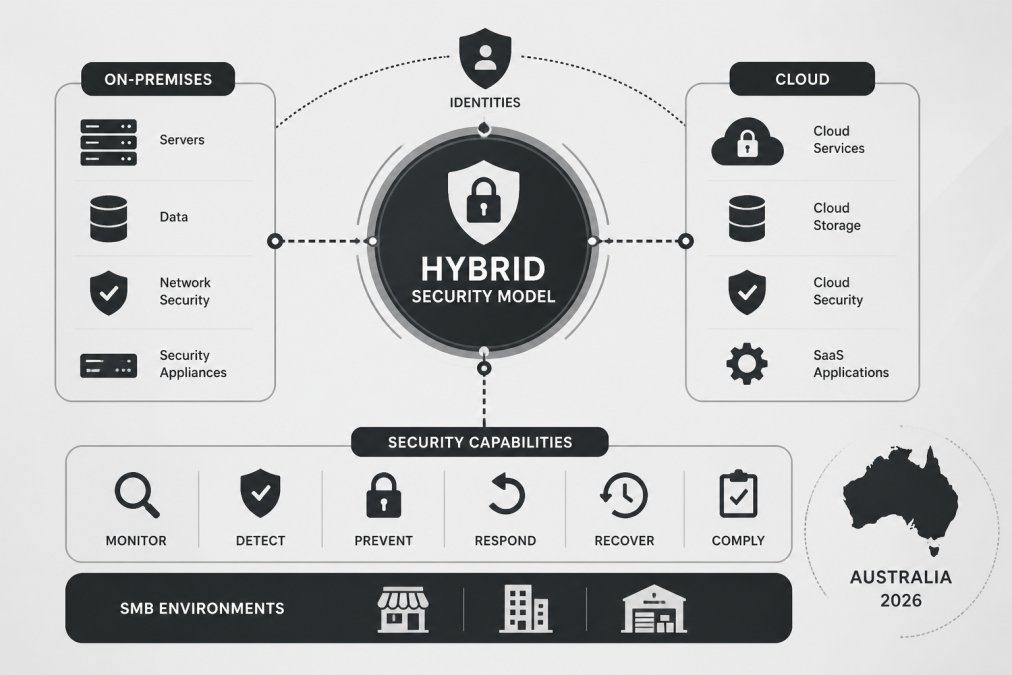
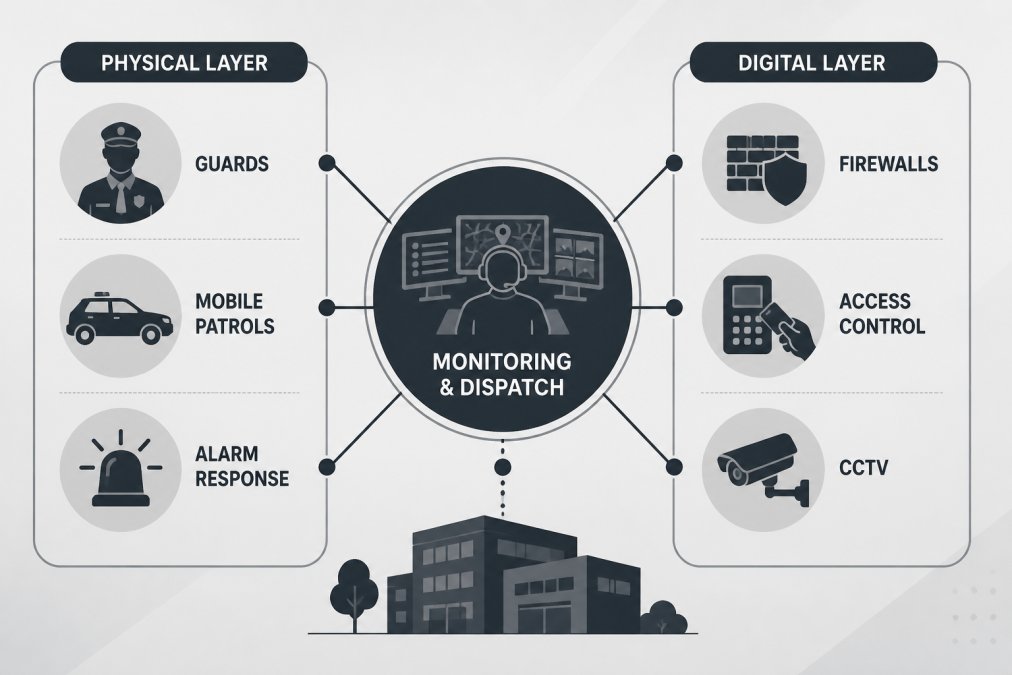
Hybrid security models combine physical guarding and electronic systems with digital cybersecurity controls, managed under one coordinated plan rather than as separate contracts. For most small and medium businesses, that means guards, patrols, alarms and access control working alongside network protection and monitoring. This guide breaks down how the model works, what it costs in staff time, and how to implement it without ripping out systems you already own.
Physical and Cyber Security Working Together
Most breaches start at a point where the two halves meet. A tailgated door, an unattended delivery entrance, a shared login. Physical controls stop the person; digital controls stop the credential.
The Australian Cyber Security Centre's Small Business Cyber Security Guide treats physical access and network access as one problem, not two. That framing matters for SMBs because it removes the false choice between "a security guard" and "an IT guy".
Why One-Size-Fits-All Security Fails SMBs
A fixed guard roster on a site with unpredictable trading hours wastes money on quiet shifts and leaves gaps when it matters. Generic packages also tend to ignore how a site actually operates: where stock moves, when cash is handled, which doors stay open during deliveries.
Tailored plans start from a site risk assessment, not a price list.
Managed vs In-House Security for SMEs: Which Fits Your Operation?
Managed security suits most SMEs because it delivers 24/7 coverage without the cost of employing round-the-clock staff. In-house works when you have a genuine need for a permanent on-site presence, such as a single controlled entry point during business hours.
The decision usually comes down to two things: how fast you need a response, and what you can sustain on payroll.
Response Times and Coverage Gaps
An in-house guard covers the hours you roster. Everything outside that window is unmonitored unless someone is on call. Managed monitoring and mobile patrols close that gap by covering nights, weekends and public holidays as standard.
Ask any provider for their documented response process, not a verbal promise. A local depot makes a measurable difference to how quickly a patrol reaches your site.
Cost Comparison: Staff vs Contracted Monitoring
| Model | Coverage | Ongoing Commitment | Best For |
|---|---|---|---|
| In-house guard | Rostered hours only | Wages, super, leave, training | Sites needing a permanent presence |
| Contracted static guard | Agreed shifts | Fixed contract | Construction, events, high-value sites |
| Mobile patrol + alarm response | 24/7 response | Monthly service fee | Retail, warehouses, multi-tenant sites |
| Hybrid (patrols + monitoring + digital) | 24/7 across sites | Monthly fee, scalable | SMBs with several locations |
Full-time staffing carries costs beyond the hourly rate, including superannuation, leave entitlements, workers compensation and ongoing licensing. Contracted monitoring converts that into a predictable monthly figure.
Security Risk Assessment for Small Businesses: The Starting Point
A security risk assessment for small businesses is a documented review of your site's vulnerabilities, existing controls and realistic threats, ranked by likelihood and impact. It should be completed before any equipment is specified or any roster is written.
What most guides miss is who conducts it. A genuine assessment is done by someone who walks the site, checks sightlines, tests door hardware, reviews camera coverage and interviews staff about how the business actually runs. Ask who is attending and what their licensing and experience are before you book.
The output should be a written report you can act on: prioritised findings, recommended controls, and a clear distinction between what needs fixing now and what can wait.
Building a Layered Hybrid Model: Guards, Patrols, Alarms and Access Control
A layered model assigns each control a job. Patrols deter and detect. Alarms notify and trigger response. Access control limits who goes where. CCTV documents what happened. No single layer carries the whole load.
That redundancy is the point. When one layer fails, the others still hold.
Mobile Patrols and 24/7 Alarm Response
Mobile patrols conduct scheduled and random checks on your site, while alarm response dispatches an operator when a sensor trips. The combination covers both the routine and the unexpected.
For SMBs spread across multiple locations, one provider managing all sites keeps standards consistent. You deal with one dispatch process and one reporting format rather than three different teams with three different interpretations of "checked".
Auditable Access Control and CCTV Surveillance
Access control should be auditable and revocable. Every entry event logged, every credential removable the day someone leaves. That matters for warehouses and multi-tenant sites where contractors, cleaners and delivery drivers all need different levels of access.
High-resolution IP surveillance adds remote viewing, so you can check a site from anywhere without sending someone out. Pair it with access logs and you can match a person to a door to a timestamp.
Cybersecurity Protection Guide for Australian Businesses: The Digital Half of Hybrid
The digital half covers the systems that run your physical security: alarm panels, cameras, access controllers and the network they sit on. If that network is compromised, your cameras can be disabled and your access logs altered.
Practical starting points for most SMBs:
- Enable multi-factor authentication on every administrative account
- Segment security devices onto a separate network from point-of-sale and office systems
- Change default credentials on cameras and recorders before they go live
- Apply firmware updates on a schedule, not when something breaks
- Restrict remote access to named users with logged sessions
The Australian Cyber Security Centre's Essential Eight guidance is the sensible baseline for prioritising these controls. The Office of the Australian Information Commissioner publishes current guidance on notification obligations if personal information is involved in a breach, and the thresholds are worth checking against your own systems.
Benefits and Drawbacks of Hybrid Security Models
The main benefit is coverage without overstaffing. You get 24/7 response, documented activity and multiple layers that back each other up, at a cost that scales with the site rather than the headcount.
The drawbacks are real too. Hybrid models require coordination between physical and digital controls, which means someone has to own the whole picture. Integration with legacy equipment can be awkward, and if you inherit a mix of old cameras and new controllers, expect some compatibility work.
There's also a management overhead. More layers mean more things to review, and a model that isn't reviewed drifts out of alignment with how the site actually operates.
Implementation Steps for Australian SMBs
- Commission a site risk assessment. Get a written report with prioritised findings before specifying any equipment.
- Map your existing controls. List what you already have: cameras, access readers, alarm panels, locks. Reuse what works.
- Define your coverage requirement. Identify the hours and areas that genuinely need monitoring, and the response time you need.
- Choose your delivery model. Decide what stays in-house and what goes to a managed provider, using the comparison table above.
- Specify the digital layer. MFA, network segmentation, credential management and update schedule for every connected device.
- Document the response process. Who is notified, in what order, and within what timeframe.
- Review quarterly. Check logs, response records and access lists against how the site is actually being used.
Frequently Asked Questions
What is a hybrid security model for small businesses?
A hybrid security model combines physical measures like guards, mobile patrols, and alarms with digital controls such as access management and cybersecurity. For small businesses, this means you don't rely on a single layer. Instead, you get overlapping protection that covers both on-site risks and online threats. It's often more cost-effective than a full in-house team because you scale services to your actual risk profile.
How does a hybrid security approach differ from traditional managed services?
Traditional managed services usually focus on one area, like monitoring or guarding. A hybrid approach integrates multiple disciplines, including physical patrols, alarm response, access control, and cyber hygiene. This integration means incidents are handled holistically. For example, a break-in triggers an alarm response while access logs are reviewed remotely. It also allows you to mix in-house staff with contracted specialists where it makes sense.
Is a hybrid security model cost-effective for small businesses?
Yes, for many SMBs hybrid models can be more cost-effective than hiring full-time in-house security. You pay for the services you need, such as after-hours patrols or alarm monitoring, rather than a permanent guard. The key is matching the model to your risk assessment. A security provider can design a plan that avoids over-spending on unnecessary layers while still meeting insurance and compliance requirements.
How do Australian privacy laws impact SMB security requirements?
Australian privacy laws, including the Privacy Act 1988 and the Notifiable Data Breaches scheme, require businesses to protect personal information. If you collect customer data, you need reasonable security measures. This affects both physical and digital security: locked filing cabinets, access-controlled server rooms, and encrypted systems. A hybrid model helps you meet these obligations by addressing both physical and cyber risks in one coherent plan.
Security models fail quietly. A roster drifts, a camera goes offline, a departed contractor keeps their access card, and nobody notices until something goes wrong. Tupper Security builds hybrid models around how your site actually operates, with multi-class licensed operators, a local Silkstone depot for rapid response, auditable and revocable access control, and high-resolution IP surveillance you can view remotely. Request a quote and we'll start with an independent site risk assessment.