 how-to
How to Reduce Security Costs with Mobile Patrols
Table of Contents
- What Mobile Patrols Actually Do and Why They Cost Less Than You Think
- The Difference Between a Patrol and a Permanent Guard
- Mobile Patrol vs Static Guard Cost: Which Delivers Better Value?
- What Drives Mobile Patrol Security Cost in Australia
- Optimising Security Patrol Routes to Cut Wasted Hours
- How to Calculate Your Security ROI Before You Sign
- Building a Hybrid Model: Mobile Patrols Plus Smart Tech
- Negotiating Your Security Contract: What to Ask For
- Frequently Asked Questions
Last Updated: September 14, 2026
What Mobile Patrols Actually Do and Why They Cost Less Than You Think
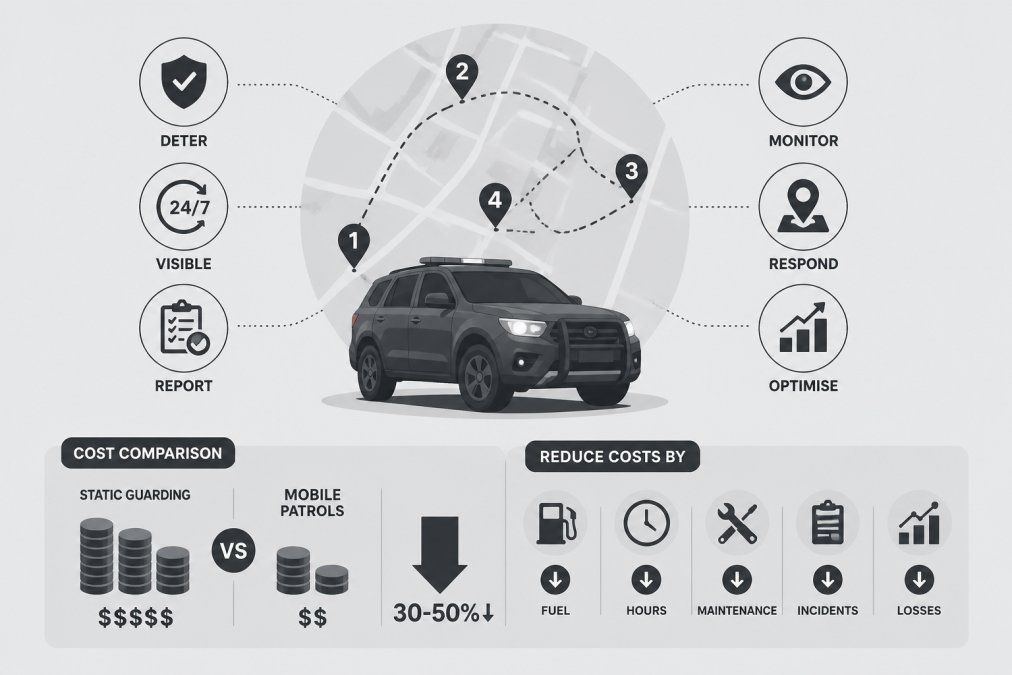
Mobile patrols are scheduled, randomised security visits to a property by a licensed vehicle crew who check the site, respond to alarms, and log conditions, rather than staying on-site for a full shift. This guide from Tupper Security explains how to reduce security costs with mobile patrols by replacing constant presence with unpredictable coverage.
The core logic is simple: an intruder cannot time a patrol they cannot predict.
A static guard bills for every hour of presence, including quiet ones. A patrol vehicle covers several sites in a loop, so your site pays only for the visits it receives. That single structural difference is where the savings begin.
The Difference Between a Patrol and a Permanent Guard
A permanent guard provides continuous presence at one address. A patrol provides intermittent presence across many addresses. The guard is visible for eight or twelve hours straight; the patrol is visible at irregular intervals that nobody outside the operation can map.
That distinction changes what each service is good at. Continuous presence suits sites where an incident escalates within minutes. Intermittent presence suits sites where the risk is opportunistic: a fence line, a rear loading dock, a construction compound overnight.
Most sites need deterrence more than they need a body on a chair.
Mobile Patrol vs Static Guard Cost: Which Delivers Better Value?
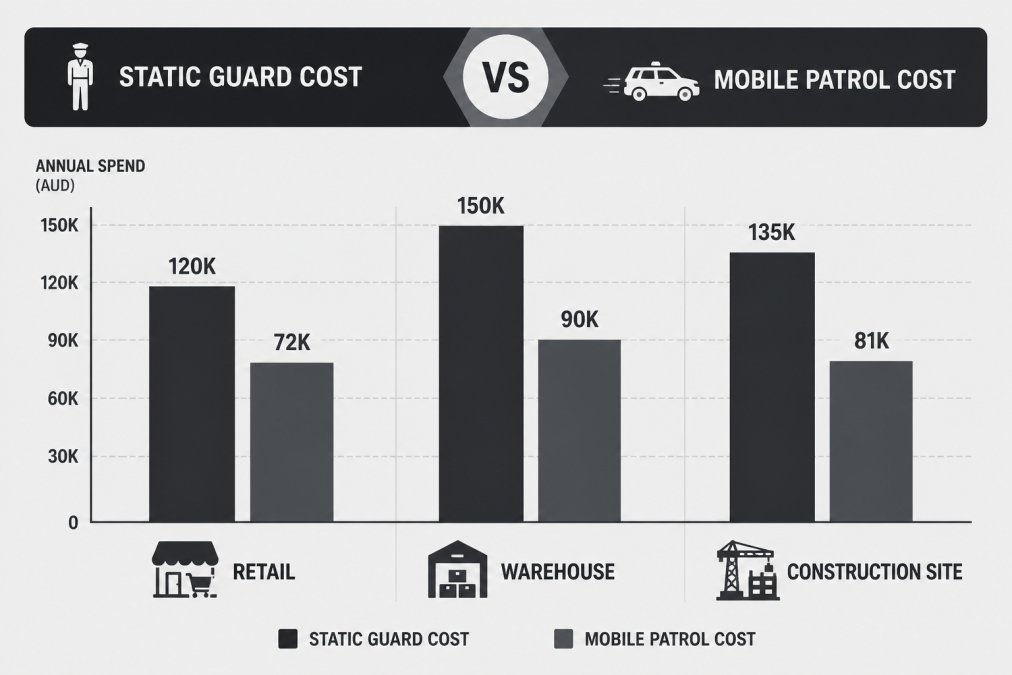
Mobile patrols typically cost less per site than a dedicated static guard because one vehicle and crew cover multiple properties per shift. The saving is structural, not a discount: you share the crew's time with other sites instead of buying all of it.
The mechanic is worth spelling out. A static guard is billed on a one-to-one ratio, one guard, one site, every rostered hour. A patrol is billed on a one-to-many ratio, one crew, a route of sites, with your site paying a share of the vehicle, the labour, and the travel. The more sites a provider can cluster efficiently around yours, the lower your per-site share tends to be. That is why two quotes for the same visit frequency can differ: one provider has density in your area, the other is driving past empty suburbs to reach you.
Cost varies with visit frequency, site size, alarm response obligations, and whether the patrol includes internal checks. Because pricing depends on those variables, the honest comparison is value per dollar, not headline rate. Tupper Security publishes current rates on its pricing page.
| Site Type | Static Guard Strength | Patrol Strength | Better Value Usually |
|---|---|---|---|
| Retail store | Continuous customer-facing presence | After-hours checks and alarm response | Patrol after hours |
| Warehouse | Loading dock control | Perimeter and yard checks | Depends on dock hours |
| Construction site | Full-time gate control | Overnight compound checks | Patrol overnight |
The cost drivers that actually move your quote
When you compare two patrol quotes, the difference almost always sits in one of five places. Ask about each explicitly:
- Visit frequency and window. Four visits between 22:00 and 04:00 costs more than four visits spread across the whole night, because the crew has to be in your area at a specific time rather than fitting you into a natural route.
- Call-out minimums. Many providers bill a minimum attendance (commonly one hour) per alarm activation, plus travel (Cost Recovery Implementation Statement). A site with frequent false alarms pays for every one.
- Travel loading. Sites outside a provider's existing route density carry a travel surcharge. If your site is isolated, expect to pay for the kilometres.
- Access complexity. Keys, codes, escort requirements, and internal checks all add minutes per visit. Minutes are the unit you are buying.
- Reporting standard. Audit-grade reporting with GPS-verified timestamps and photographic evidence takes longer to produce than a simple log, and that time appears in the rate.
When a Static Guard Still Makes Sense
A static guard earns its cost when the site needs a person, not a presence. Crowd control at a licensed event, access control at a busy loading dock, or a retail floor where staff safety is the concern all justify continuous staffing.
The mistake is buying static coverage for a site whose real exposure is a handful of high-risk hours. A common pattern is a business paying for twelve hours of static presence to cover a two-hour window of genuine risk, the remaining ten hours are insurance against a feeling, not against a threat. If your incident history clusters into a narrow window, a patrol covering that window plus alarm response is usually the cheaper structure.
What Drives Mobile Patrol Security Cost in Australia
Mobile patrol security cost in Australia is driven by visit frequency, site complexity, travel distance between sites, and response obligations. A site needing four nightly checks across a large yard costs more to service than one needing two external checks.
Other cost drivers include the number of alarm activations the patrol must attend, whether access requires keys, codes, or escort, and whether reporting must meet an audit standard. Each adds time, and time is what you are buying.
Optimising Security Patrol Routes to Cut Wasted Hours
Optimising security patrol routes means sequencing visits so travel time between sites drops and check time rises. A route that zigzags across a region burns fuel and labour without adding protection.
Practical route improvements include grouping sites by proximity, varying arrival times within a window, and prioritising high-risk sites during their highest-risk hours. A guard tour system with GPS tracking confirms each checkpoint was actually visited, which turns route design into something you can audit rather than assume.
Coverage that never repeats a pattern is harder to defeat than coverage that is merely frequent.
How to Calculate Your Security ROI Before You Sign
Calculate security ROI by comparing the annual cost of the service against the losses it prevents and the premiums it protects. You do not need a complex model; you need four numbers and one subtraction.
- Current annual loss figure. Add documented shrinkage, theft, vandalism repair, and after-hours incident costs for the last twelve months.
- Current annual security spend. Include guards, monitoring, alarm maintenance, and the management time spent chasing incidents.
- Quoted patrol cost. The annual figure for the proposed visit frequency and response terms.
- Insurance position. Ask your broker whether documented patrol coverage changes your premium or your claim conditions.
The framework, written out
The calculation is:
Net annual benefit = (Losses prevented + Premium effect + Internal time recovered) − Patrol cost
Losses prevented is the hard number. You cannot assume a patrol eliminates all loss, so apply a reduction factor you can defend. If your incident history shows opportunistic after-hours activity, a common planning assumption is that unpredictable patrol coverage removes a meaningful share of it, but the honest approach is to start conservative, run the service for a quarter, and compare actual incidents against the prior year's baseline.
Premium effect is the softest number and the one most often overstated. Insurers do not universally discount for patrol coverage. What they do respond to is documented risk mitigation: timestamped visit logs, GPS-verified checkpoints, and a written response protocol. Ask your broker to confirm in writing whether those artefacts change your premium or your excess before you count them as a saving.
Internal time recovered is the number businesses forget. If a manager currently spends several hours a week reviewing footage, chasing alarm call-outs, or coordinating repairs after incidents, that time has a cost. A patrol with proper reporting absorbs much of it.
A worked example
A warehouse with a documented annual loss of $18,000 (shrinkage, fence repairs, one after-hours break-in), an existing monitoring contract, and a manager spending roughly three hours a week on incident follow-up. A patrol quote comes in at $14,000 a year for nightly visits plus alarm response.
If the patrol reduces documented loss by half, $9,000, and recovers two of the three management hours per week, the arithmetic starts to close. If it also satisfies an insurer condition that removes a $2,000 excess on future claims, the case is stronger still. If it does none of those things, the quote is a cost, not an investment, and the right move is to reduce frequency or narrow the coverage window rather than sign.
Before you calculate: does the site need a patrol at all?
ROI maths is wasted if the underlying risk does not call for a patrol. Run a short risk assessment first:
- Is the risk opportunistic or targeted? Opportunistic risk, a fence line, an unlocked compound, a dark rear access, responds well to unpredictable visits. Targeted risk, a site with a known adversary, a dispute, or valuable portable stock, usually needs more than a patrol.
- Does the incident history cluster in time? If incidents happen between 01:00 and 04:00, you need coverage in that window, not around the clock.
- Would lighting or remote monitoring solve it cheaper? A well-lit perimeter with monitored cameras sometimes removes the opportunity a patrol is there to deter. If it does, spend there first.
- Is there a physical response requirement? Cameras detect; they do not attend. If your insurer or your risk profile requires a physical response to alarms, a patrol is the cheaper way to buy it than a static guard.
If the answers point to a narrow window of opportunistic risk with a response requirement, a patrol is likely the right structure. If they point to a targeted threat or a need for continuous presence, a patrol is the wrong tool and no ROI calculation will fix that.
Australian Securities and Investments Commission guidance on business risk and insurance
Building a Hybrid Model: Mobile Patrols Plus Smart Tech
A hybrid security model pairs patrols with technology so each covers the other's weakness. Cameras watch continuously but cannot intervene. Patrols intervene but cannot watch continuously. Together they close the gap.
CCTV blind spots are the usual starting point. A patrol route designed around what the cameras miss, combined with alarm-triggered dispatch, gives you continuous awareness and physical response without paying for a permanent guard.
The operational benefit is scalability. Adding a site to a patrol route costs far less than staffing it, and access control can be auditable and revocable per user, which matters when contractors and tenants change frequently.
Negotiating Your Security Contract: What to Ask For
Negotiate on measurable terms, not on the headline rate. The clauses that affect your real cost are the ones governing response, reporting, and flexibility.
- Response time commitment. Get the expected alarm response window in writing, with the consequences if it is missed.
- Visit reporting. Require timestamped, GPS-verified reports per visit so you can audit what you paid for.
- Frequency flexibility. Ask to adjust visits up or down with reasonable notice as your site risk changes.
- Multi-site consistency. If you operate several locations, confirm one account team and one reporting standard applies across all of them.
- Coverage continuity. Ask how the provider handles staff leave and rostering gaps so your coverage does not lapse.
Fair Work Ombudsman guidance on contracting and service arrangements
A provider that resists documented response times is telling you something about how it operates.
That is where Tupper Security differs from a generic quote. Our multi-class licensed operators work from a local depot, our patrol plans are built around how your site actually operates rather than a template schedule, and our independent site risk assessments and security design reviews are conducted by people who know what they are looking at. We have operated since 2014, hold QLD Firm Licence #4572076, and are rated 4.4 on Google.
Frequently Asked Questions
How do mobile patrols compare to static security guards in terms of cost?
Mobile patrols typically cost less than static guards because one vehicle covers multiple sites per shift. A static guard requires a dedicated wage for every hour on site, while a patrol divides its time across several properties. For low-to-medium risk sites, this can cut security spending significantly. High-risk or high-traffic locations may still need an on-site guard during peak hours, so a hybrid approach often delivers the best balance of coverage and cost.
What factors influence the cost of mobile patrol security in Australia?
Key factors include patrol frequency, the number of sites on a route, site risk profile, travel distance between locations, and whether alarm response is included. Sites requiring more frequent visits or complex access procedures cost more. Integration with existing CCTV and access control can reduce the number of physical patrols needed.
Can mobile patrols effectively replace 24/7 on-site security?
For many commercial properties, yes. Randomised mobile patrols create unpredictability that deters theft and vandalism without the cost of a permanent guard. However, sites with high-value assets, large crowds, or strict compliance requirements may still need an on-site presence during certain hours. A hybrid model, where mobile patrols cover after-hours and a static guard covers peak periods, often provides sufficient coverage at a lower total cost.
How do mobile patrols integrate with alarm response services?
Mobile patrol units can be dispatched when an alarm triggers at your property. The patrol vehicle responds, checks the site, and reports back in real time. This integration means you do not need a guard stationed on site around the clock. Instead, you pay for patrol coverage and alarm response only when needed. Many providers, including Tupper Security, combine 24/7 monitoring with mobile dispatch to reduce response times and overall security spending.
Security costs only fall when coverage is designed around your actual risk rather than a generic schedule. Tupper Security builds tailored protection plans for homes, businesses, and events across South-East Queensland, combining mobile patrols, 24/7 alarm response, auditable access control, and remotely accessible IP surveillance into one accountable service. Request a quote and get a patrol plan matched to your site, your hours, and your budget.